
Six Blind Mice and an Elephant
Jude Daly
Otter-Barry Books
So often in my teaching career have I used Six Blind Men and an Elephant that despite having the book beside me, I instinctively mistyped the title of Jude Daly’s rendition of the Indian fable at the start of this review.
Daly sets her story somewhere in rural South Africa and begins with a somewhat sleepy elephant wandering from its forest habitat into a farmer’s barn and there falling fast asleep in the straw. On discovering it and excited by his find, the farmer rounds up his family and neighbours to view the creature and its wonders.
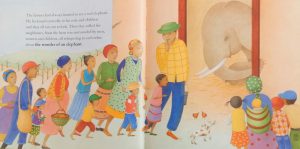
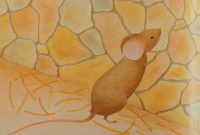
Meanwhile six blind mice nesting in a tree nearby are aroused from their slumbers by a strange aroma. Eager to discover the source of this new sensation, they follow their noses, encounter a cat and take refuge in a hole where they hear the humans chatting about the visitor asleep in the farmer’s barn. Search over they decide, and once the crowd has dispersed off they go to the barn.
Suddenly “Ouch!” that’s the oldest mouse coming up rather hard against the elephant’s side and declaring the beast to be “like a – wall”.
The second mouse disagrees likening the animal to a spear as she almost nose dives from the end of a tusk. And so it goes on with the other four mice giving their opinions based on partial evidence until as the youngest completes its simile, the somnolent pachyderm gives a flap of its enormous ears and expostulates so loudly that the rodents run for cover. The elephant then delivers a piece-by-piece description of himself (love those palm fan-like ears)

before finally, likening himself to … (readers aloud might want to pause at that point and give listeners an opportunity to complete the sentence) and crashing out once more exhausted by laughter.
Exit six fully satisfied mice …
Daly’s playful take on the fable still leaves plenty of food for thought and is perfect for a community of enquiry style discussion with early years or primary children.
Glowing African light radiates from every one of her illustrations; the golden straw-strewn barn floor is for me, reminiscent of some of the fractured swirls of Hockney’s pool painting.
I’ve signed the charter 


 Red Reading Hub - Jillrbennett's Reviews of Children's Books