Inside Cat

Inside Cat
Brendan Wenzel
Chronicle Books

Brilliantly playful is Brendan Wenzel’s Inside Cat wherein rather than the cat being an object viewed by other creatures as in They All Saw a Cat, this cat is the subject doing the looking.

Readers share with said cat its view of the outside world through all kinds and shapes of windows. No matter where the moggy wanders, or the condition of the window(s) there’s something of note be it small or large upon which to fix its gaze and wonder – downward, upward or side by side.

There is SO much to behold, to watch – fluffy rats, roaring flies …

Consequently inside, Cat is a veritable fount of knowledge with all this information amassed from various vantage points.

But … then comes a startling surprise. It’s certainly one for the protagonist but readers faced with that final spread will probably wonder what took our feline friend so long to widen its horizons …

The story is told through a seemingly simple, carefully considered rhythmic, rhyming text and a sequence of brilliantly constructed, equally carefully considered mixed media illustrations that demonstrate how our own experience and our emotions shape our view of the world and the personal narrative we construct.

Assuredly this is one of those books that readers will want to return to over and over, with the possibility of new discoveries emerging on each reading. Equally it’s a wonderful starting point for children’s own creativity or a community of enquiry discussion.

A Stone Sat Still

A Stone Sat Still
Brendan Wenzel
Chronicle Kids

As with They All Saw a Cat, Brendan Wenzel explores perspective, this time playfully using a stone as the focal point.

A stone sat still/ with the water, grass, and dirt,/ and it was as it was/ where it was in the world.

A series of spreads, shows the stone as it is experienced by all manner of wild creatures: a snail crawls over it, a chipmunk stops on it to nibble a nut; for an owl it’s a bright place upon which to perch, while a gull cracking a clam shell finds it ‘loud’,

in contrast to the snake for which it was a quiet spot upon which to bask in the sun.

The stone’s texture to a slug is ‘rough’ whereas to a racoon’s paws it’s smooth.

The meditation on the inanimate object continues through the seasons when it takes on a variety of hues – green, red, purple and blue as witnessed by four different animals.

Its size can seem as a mere pebble to a large moose but to a bug, it’s an enormous hill; while in the dark, its sensory qualities are picked up as a feel to investigative racoons, whereas it’s a smell to a sniffing coyote on the hunt.

Readers too experience the stone’s sensory qualities, thanks to Wenzel’s text and his superb mixed-media illustrations, large and small.

As they move through the book, readers will, so long as they are observant, see that around the stone, the water is on the rise

as little by little it is engulfed, becoming a tiny island and then a wave, a memory, ‘and the stone was always.’ Submerged beneath the waves ‘with water, grass, and dirt a stone sits still in the world.’

Assuredly this is a book that invites us to celebrate the changing and the unchanging, and encourages us to look closely and ever closer, not only at the illustrations, but also at the natural world around.

It’s one to have on hand if you are thinking about wildlife, about perception and perspective, even perhaps about existence itself; it’s deep and gently powerful, and has much to offer across a wide age range.

Look, Look and Look Again

Where’s the Baby?
Britta Teckentrup
Big Picture Press
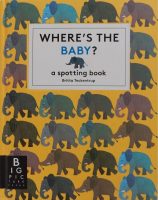
Baby animals are the objects of the search in Britta Teckentrup’s latest ‘spotting’ book, which, once again is intended to develop visual perception in the very young.
A rhyming text accompanies each digitally composed spread and the challenge is satisfyingly demanding for youngsters: I had to search for a while to locate the gosling on the pond.
With their matt colours and wallpaper style patterns, the artist’s visuals really demand that you look closely savouring the pleasing design of each one be it the vibrant parrots,

the farmyard hens, the kangaroos, the zebras or the seahorses to name just some of the fourteen creatures featured.
The final challenge in the book is different asking, ‘can you see the mother/ whose babies are TWINS?’
Alluring, absorbing and enjoyable.

Have You Seen My Lunch Box?
Steve Light
Walker Books
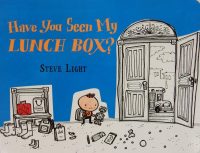
Morning chaos reigns as a small boy gets ready for school: the clock is ticking but he wants help locating all the things he needs: his socks, his pencil case, a crayon, his book,

a ball, marbles and particularly important, his lunch box. Mum and Dad are on hand to hunt but essentially it’s down to the reader to save the day and ensure he boards the bus on time.
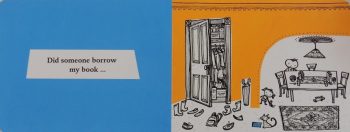
The text, delivered as a first person narrative, appears on each verso, set against the same colour as the missing item to be located on the recto among the plethora of items inked in detail against a predominantly white background. This pattern continues throughout until the last object is safely in the hands of its owner. The final page shows all eight things.
Essentially this is a game for adult and toddler to play together: there’s plenty to talk about in addition to those misplaced items, and that’s in the hands of the adult sharer; in fact every spread is a possible starting point for some adult/child storying.

Double Take!
Susan Hood and Jay Fleck,
Walker Books
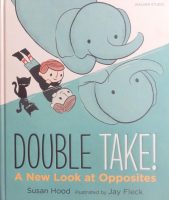
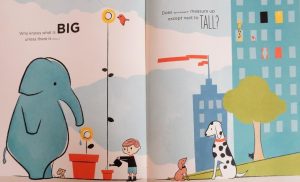
We’re in the company of a little boy, his cat and a friendly elephant being asked not to take things at first sight. Assuredly, we’re told, some opposites – in/out, asleep/ awake for instance, are pretty straightforward, albeit orchestrated herein; but others are totally dependent on one’s frame of reference.

Subtitled ‘A New Look at Opposites’ and published under the imprint Walker Studio, this rhyming invitation certainly demands that readers think about opposites with regard to perspective.

I’ve signed the charter