But the Bear Came Back

But the Bear Came Back
Tammi Sauer and Dan Taylor
Sterling

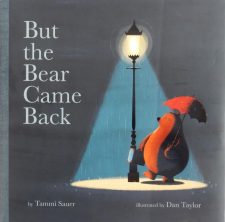
‘You don’t know what you’ve got until you lose it’ is what the little boy protagonist in this story discovers when a large furry ursine character comes a-knocking.

It all starts quite politely on the boy narrator’s part; he’s disturbed from his reading and understandably a tad irritated but isn’t on this occasion rude. ‘And I said, “Go home, bear.” And that was that. ‘

However, this bear is persistent, returning over and over;

but time and again the boy sends him packing until things get just too much. He yells at the creature at the top of his voice, after which there are no further visits.

Peace ensues but the boy isn’t as happy as he’d expected; in fact, he really misses that hulking great irritating animal.

Can he ever find his friend again? The boy certainly goes to great lengths to do so …

but will he ever hear that longed for knock on his door?

There is much to discuss about the way the characters behave in Tammi Sauer’s gently humorous story – not the least being the lengths each goes to find a friend.

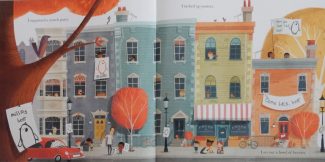
Day Taylor’s illustrations are captivating: the bear is adorable – decidedly huggable in fact; and there are lots of lovely details to spend time over.

She Persisted Around the World

She Persisted Around the World
Chelsea Clinton and Alexandra Boiger
Penguin Random House

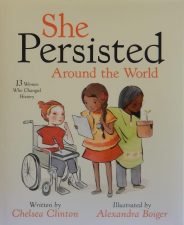
There’s been a plethora of books about amazing women and their achievements this year – unsurprising since we’re celebrating the 100th anniversary of the 1918 suffrage act; now here’s another, this time written by Chelsea Clinton.
The author has selected just thirteen women from various parts of the world who have changed history. ‘It’s not easy being a girl – anywhere in the world. It’s especially challenging in some places,’ she says but goes on to tell girls, ‘Don’t listen to those voices.’

Persistence is the key and that’s what all the women herein did; ‘She persisted’ being the catch phrase that comes up in each of the short biographical descriptions of each of her subjects.

Clinton has arranged her book in birth order of those included, the first woman being Sor Juana Inés de la Cruz, a largely self-taught Mexican author and philosopher who lived in the latter half of the 17th century and the youngest being Malala Yousafzai. She too persisted in the cause of education, and for girls everywhere to have the right to go to school.

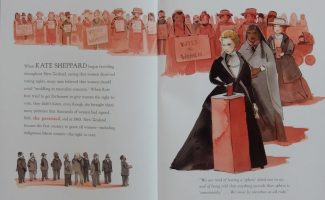
Education was not the only cause her subjects fought for however: there were significant contributions in the fields of astronomy (Caroline Herschel), women’s suffrage – new Zealander, Kate Sheppard;

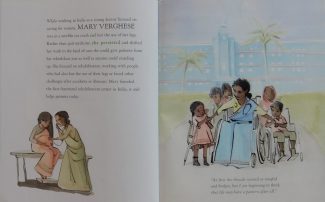
chemistry – double Nobel Prize winner, Marie Curie; Viola Desmond, who refused to leave the ‘only white Canadians’ part of the cinema she was visiting; medicine is represented by Mary Verghese, a young Indian doctor who when injured in a car accident that made her unable to walk, began to focus on rehabilitation.

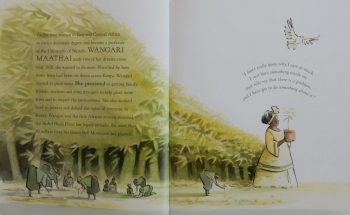
Unfamiliar to me are Aisha Rateb who worked in the field of law in Egypt and Wangari Maathai an environmentalist, political activist and university professor in Nairobi.

Familiar contemporary women in addition to Malala are author, J.K.Rowling, Brazilian soccer star, ‘Sissi’, Liberian peace activitist Leymah Gbowee and Chinese ballet dancer Yuan Yuan Tan.

There is a formula that Clinton uses for each of her subjects each one being allocated a double spread with a paragraph outlining the dream and the challenges faced, followed by the woman’s persistence and achievements.

Beautiful watercolour and ink portraits by Alexander Boiger, every one executed in a carefully chosen colour palette, grace each double spread, and there is also an inspirational quote from each woman.

The book ends with the author empowering her young audience thus: ‘So, speak up, rise up, dream big. These women did that and more. They persisted and so should you.’
Brief, yes, but also diverse, inspiring, and a good starting point to find out more about some of those included.

Meet Ada Twist Scientist, Mira & Em

DSCN8613

Ada Twist, Scientist
Andrea Beaty and David Roberts
Abrams Books for Young Readers
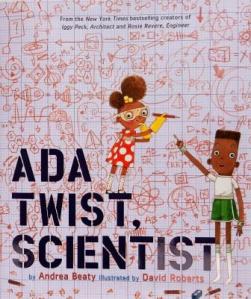
Readers may well be familiar with previous titles Rosie Revere and Iggy Peck from the creators of this inspiring rhyming read; Ada is the third in the series and like its predecessors, it’s a MUST to add to primary classroom bookshelves.
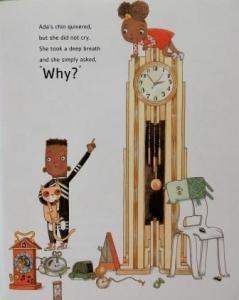
Ada remains silent, observing, investigating and thinking much until she turns three and then quite suddenly things change. ‘Why?’ she demands to know (of the grandfather clock: “Why does it tick and why does it tock?” “Why don’t we call it a granddaughter clock?

DSCN8614

And once she’s started, there’s no stopping this curious young lass. Her other favourite words are ‘Why?’, ‘What?’ ‘How?’ and ‘When’. (the very ones that should fill the hearts of all early years teachers worth their salt with delight). Yes, this child’s curioslty and imagination have no bounds and thank goodness she has such encouraging parents to support her.

DSCN8615

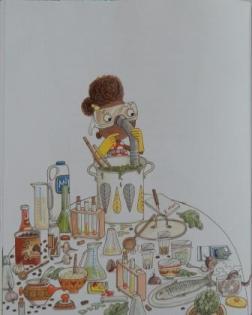
Then, one spring day – the first in fact – a revolting smell reaches Ada’s nostrils, setting questions flying and her curiosity into over-drive. Could that stench be emanating from Dad’s cabbage stew perhaps? That’s hypothesis number one.
DSCN8616

No – then where? The cat maybe? Wrong again and now Ada’s parents have had enough seemingly and Ada’s banished, silenced. Silent she may be, but her mind’s still very active and pretty soon, so is her thinking pencil until
thank goodness, Ada’s parents have had a rethink and before long, are back in support.
Will she ever find the answer to that ‘stink’ question? I suspect she might, for despite all her failures and blind alleys, Ada is an unstoppable problem-solver and what’s more, she’s ready to enlist the help of others. If not, then she’ll find other equally fascinating questions to pursue.
Delivered through a rhyming text and brilliantly characterised in David Roberts’ stylish illustrations, this story is sure to please young audiences and readers aloud, especially those who want to encourage the spirit of curiosity and champion the cause of girls in science. Ada is a force to be reckoned with – long may she continue. Seek this out and share it wherever you can.
Also take a look at the tale of another young girl who becomes a scientist :

%0A

Mira Forecasts the Future
Kell Andrews and Lissy Malin
Sterling Books
Mira’s mother is a fortune teller but try as she might, all that Mira sees when she gazes into the crystal ball is herself, “Telling the future is a gift,” her mother tells her. “You have it, or you don’t.” Mira most definitely didn’t; but one day she notices something – the wind whirring the blades of her pinwheel and fluttering the streamers of her windsock.

%0A

That’s the start of her meteorological findings and before long she’s putting her scientific talent to good use in predicting the future; she’s a weather forecaster no less.
Creativity and the imagination are at the heart of all scientific discoveries: they all begin with someone asking ‘what if’ or ‘suppose that’ and now here’s a book claiming to inspire creative play:
%0A

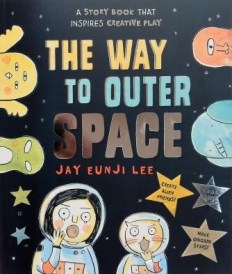
The Way to Outer Space
Jay Eunji Lee
Oxford University Press
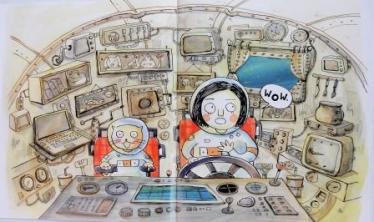
Herein we meet Em who on this particular day is feeling bored until that is, she receives a mysterious parcel containing a book and a card. She’s on the point of tossing them aside when she notices some rocket-making instructions and pretty soon here she is …
DSCN8608

blasting off and hurtling through the solar system to a strange place – a place she’s told belongs to her; and it’s in serious trouble. A challenge is issued and, accepted …

%0A

and off she goes creating …
Part story (told in comic strip style), part activities, this unusual book is likely to get young minds buzzing and fingers working on creating some of the ideas suggested herein – and one hopes moving on to projects of their own imagining.


WNDB_Buttonlocalbookshops_NameImage-2