Malala’s Magic Pencil

Malala’s Magic Pencil
Malala Yousafzai and Kerascoët
Puffin Books

Malala Yousafzai, the youngest ever recipient of the Nobel Peace Prize and campaigner for the rights of every child to attend school, has written an autobiographical account of her life designed for young audiences.
She tells of her childhood in Pakistan and uses a favourite television show she liked to watch about a boy with a magic pencil that he used to help other people and sometimes himself.
Gradually her desire for a magic pencil of her own translates as she grows into a discovery of the need to take real action. She learns that the troubles in her home village – children working to support their families and thus unable to go to school;
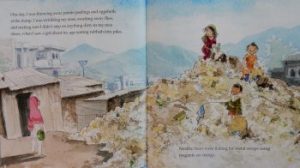
the gender inequalities and with the arrival of the (unnamed) Taliban, the ban on girls being educated, are things that need to be spoken about.
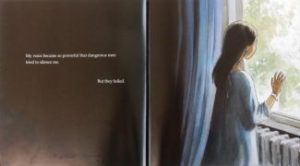
Malala starts writing and speaking out: “My voice became so powerful that dangerous men tried to silence me. / But they failed,” she states simply; the hospital band around her wrist being the only indication of all that she’s gone through.
Her quest for justice and for making the world a more peaceful place continues, a quest that has been joined by many others.
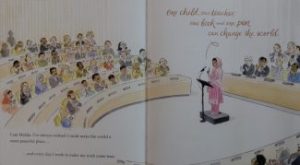
The final spread shows Malala giving her famous speech before the United Nations: “One child, one teacher, one book and one pen can change the world.

Here the force of her words and the message therein, that by finding your own voice, everyone can become a powerful force for positive change, resounds loud and clear.
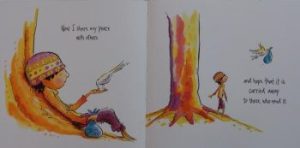
The watercolour and ink illustrations of Malala’s daily life by Kerascoët (the joint pen name of the French illustrators, comics and animation artists Marie Pommepuy and Sébastien Cosset) give a wonderful sense of place; and the overlay of gold highlights her optimism and hope for making the world a fairer, better place.

Truly inspirational.
As the biographical notes at the end remind us, Malala has now become the youngest-ever UN Messenger of Peace: long may she continue her crucial work promoting the importance of education for all.
A picture book to share, reflect upon and talk about, again and again.
I Am Peace / The Two Doves

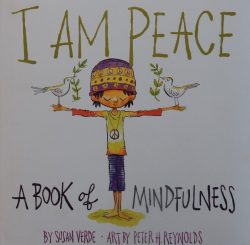
I Am Peace
Susan Verde and Peter H. Reynolds
Abrams Books for Young Readers

This is a companion book to yoga teacher, Verde, and illustrator, Reynolds’ I Am Yoga.
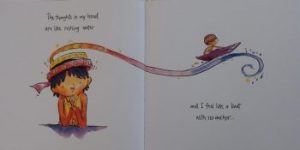
Here, a worried child narrator, feeling “like a boat with no anchor” …

shares with readers how focussing on the here and now helps to calm all those worries and troubling emotions, allowing them to dissipate and disappear. Inwardly watching the breath enables the child to feel centred and then, through acts of kindness, by connecting with nature and fully using the senses, feelings of at oneness with the world, inner peace pervades and can be shared with all those who need it.

With today’s increasingly fast-paced, pressurised and stressful world, this is a lovely gently joyful reminder to children, and also adults of the importance of cultivating the habit of mindfulness. That (along with yoga), can help them change their own world and perhaps that of others. Just 3 to 5 minutes a day with no distractions, no doing, merely being.
Peter Reynolds’ ink, watercolour and gouache illustrations reinforce the mindfulness message and add a delightful touch of whimsy as he portrays the child, peace symbols and all, balancing, cloud watching, feeding the birds and meditating.
(A guided meditation is included at the end of the book.)


The Two Doves
Géraldine Elschner and Zaū
Prestel

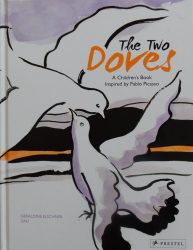
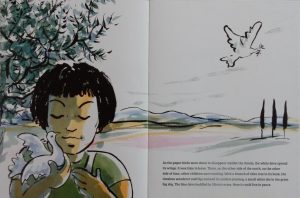
In search of a safe place to rest, a white dove lands on a deserted island; deserted save for another dove, a blue one that has been badly injured.

The white dove tends to the blue one until after a few days, it’s sufficiently recovered to take flight,
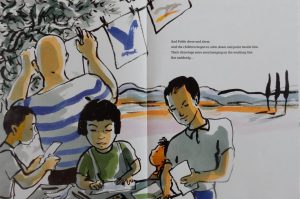
Together the two birds take wing eventually landing in – or rather in the case of the blue dove, falling – into a large garden where, under an olive tree, a man was painting, while around him some children played.
The man is the artist Picasso. The children see the wounded dove and want to care for it. Soon though both man and children are busy creating pictures of the bird,

pictures that Picasso tells them as their images are borne aloft by a gust of wind, will “go to countries all around the world.
Soon after, the white dove takes flight once more leaving the blue one safe in the children’s care.

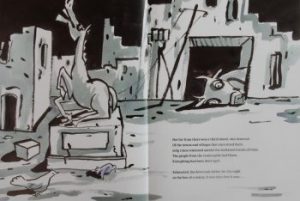
This lovely story of Géraldine Elschner’s, inspired by Picasso’s iconic work, The Dove of Peace, is beautifully illustrated by Zaü whose ink drawings filled mostly with greys, greens and blue give a strong sense of both the desolation of the war struck third island and the stark beauty of its countryside.
Adults using the book with primary age children may well need to fill in with a little information about the Spanish Civil War and on the visual references from Picasso paintings that the book’s illustrator mentions in a note at the end of the book.

Imagine

Imagine
John Lennon, illustrated by Jean Jullien
Frances Lincoln Children’s Books

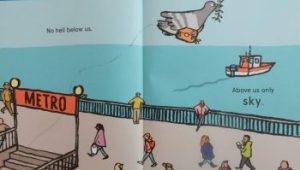
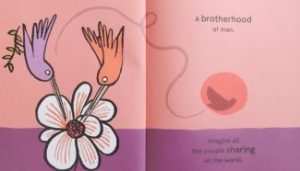
In this illustrated version of Lennon’s 1971 anthem to peace, published in partnership with Amnesty International, (royalties from the sale of the book go to the charity) illustrator Jean Jullien uses a pigeon instead of the usual peace dove to carry its message around the globe, asking readers to imagine a world without possessions, without greed or hunger a world where everyone is part of a universal brotherhood, sharing and caring for all; without countries or religion, with nothing to kill or die for.
We first see this feathered ambassador of peace emerging from the underground train, bag slung around its neck and then he takes off on his mission over land and sea …

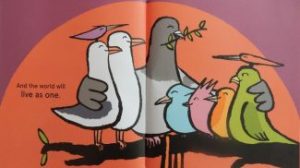
The pigeon’s focus as it wings its way around the earth distributing olive branches to its fellow feathered friends, is on fairness and sharing …

and culminates in an uplifting embrace for all the birds seen on his flight. (They too have become peace messengers.)

The artist’s boldly outlined images, digitally coloured and set against backgrounds of eggshell blue, white, purple or orange have a simple, heartfelt poignancy that make this beautiful book the perfect starting point for introducing Lennon’s message of tolerance, understanding, inclusiveness, unity and peace to today’s children. It’s certainly as relevant as when it was written over 45 years ago: indeed, we desperately need it now even more than ever.
Published on 21st September, International Day of Peace, let’s all pause and … Imagine.