100 First Words / Animal Sounds & Things That Go / My First Wildlife Sticker Activity Book

dscn0211

100 First Words
Dawn Sirett and Charlotte Milner
DK
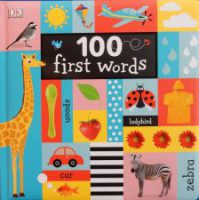
This large format book is definitely a lap style board book not a ‘clutch in the pram’ kind. It encompasses fourteen topics, one per page; and those on opposite pages are related, so we have for instance: My body and My clothes; My toys and Colours, Pets and Wild animals and …

dscn0212

Naming is an important element of a very young child’s language learning but essentially the language learning potential in this book is far greater than that: focussing on a single image could furnish so much language learning, and that is where it comes down to the skill of the person sharing the book with a baby or young infant, (or equally, a person just starting to learn English as an additional language).

dscn0213

The labelled photographic images are clear, uncluttered, and pattern is very much part of the whole look of the book.
Definitely a worthwhile investment if you have dealings with tinies

dscn0228

Animal Sounds
Things That Go
Jane Foster
Templar Publishing
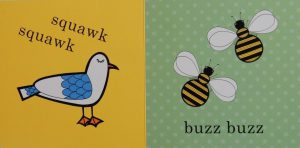
Rich in pattern and colour, and rich in language potential, are the two new board books from fabric designer, Jane Foster. Animal sounds include the ‘meow meow’ of a ginger cat and the ‘woof woof’ of an endearing spotty dog, the gentle ‘flitter flutter’ of a butterfly’s wonderful wings and the contrasting ‘ROAR’ of a lion; and these two delectable creatures …
%0a

The final spread comprises 22 named portraits of all the animals, taking a break from sound-making.
The layout of Things That Go is slightly different. We have eleven items represented: some that move through the air, some through water and others across land. I love the inclusion of this …

dscn0231

Each ‘mover’ has a double spread, its name is given against a subtly patterned page opposite which is the object and an associated sound, I can’t imagine any toddler not enjoying sharing these beauties with an enthusiastic parent or carer.

%0a

I foresee hours of fun and language learning where the three (or four) come together. Both books are a clever, winning mix of simplicity and sophistication.
fullsizerender-63

My First Wildlife Sticker Activity Book
illustrated by Gina Maldonado
Bloomsbury Activity Books
Published in conjunction with the rspb, this attractively illustrated book asks young children to look closely at what is on the printed page: to search for particular fauna and flora, to find matching pairs, to locate minibeasts, add stickers to scenes, find the odd one out and so on. There’s no substitute for seeing the real thing, but one hopes having done the activities herein, youngsters will be inspired to go out and look at the natural world for real.

Charter logo FINAL.indd

I Lost My Sock! / Fruits in Suits

dscn0104

I Lost My Sock!
P.J.Roberts and Elio
Abrams Appleseed
Subtitled ‘A Matching Mystery’ this begins with Fox’s declaration, “I lost my sock!” Ox, despite the fact his pal is sporting its pair, asks what it’s like. The dopey-seeming Ox then goes on to produce several unmatching sockish articles of a variety of patterns and sizes for the increasingly frustrated Fox.

dscn0096

A parcel and a rock are then proffered and rejected before a totally undaunted Ox comes up with a lorry load of socks, tips the entire contents out and proceeds to hunt for the match, without success.
Eventually Ox gives up and is about to depart when BINGO! Fox spots the sock …

dscn0099

There then ensues a dispute over the ownership of the blue-dotted article. Ox maintains it’s his brand new, perfectly fitting hat with a special handy place to keep his supply of oranges; oranges he cannot keep in his pocket because he doesn’t have one on account of not wearing any pants (trousers). PARDON!

%0a

Ox’s crazy response educes a crazily considerate response from Fox who generously hands over his one remaining sock/hat: but that is not quite the end of this wonderfully foolish tale.
Crazy as it may be, this tale of misunderstanding and mismatching offers much to learn about friendship, and also about pattern, shape, size and colour, comparison and contrast. Elio’s exuberant, cartoon-like illustrations, with their geometric shapes, are terrific fun and Roberts’ equally amusing text, all in dialogue, is hugely enjoyable to read aloud. (The exchanges reminded me somewhat of Mo Willems’ heroes, Elephant and Piggie). It’s also ideal for those in the early stages of reading to try for themselves; share it first though.

fullsizerender-46

Fruits in Suits
Jared Chapman
Abrams Appleseed
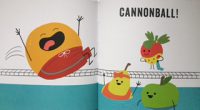
It’s time for a swim, fruit style. First changed into appropriate gear is Strawberry, the narrator, in snazzy polka dot trunks, who then endeavours to persuade the business suited Grapefruit that what he’s wearing – suit though it may be – is totally inappropriate for taking a dip in the pool. Other fruits duly dress suitably – pardon the pun – in one- or two-piece bathing attire (although the word swimsuit’ is never mentioned). After a ridiculous exchange culminating in “BUT I’M WEARING A SUIT!” the near-exasperated Strawberry eventually produces a pair of large trunks and finally …

fullsizerender-47

whereupon the infant Pomegranate throws caution to the wind and takes a leap in the buff …
This final action caused a giggle on behalf of my young reader who also enjoyed the whole nonsensical scenario.

Charter logo FINAL.indd

Wild Animals of the South

%0a

Wild Animals of the South
Dieter Braun
Flying Eye Books
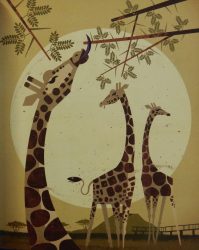
This companion volume to Braun’s Wild Animals of the North takes readers to Africa, South America, Asia, Australia and finally, Antarctica: it’s equally stunningly beautifully illustrated and almost every page would make a wonderful poster. How does a reviewer choose just a few pictures to show; a pretty impossible choice in this case as every one is magnificent in its own way. I’m starting in Africa with these beauties …

%0a

and I was surprised to discover that despite their necks being over two metres long, they have, like humans, only seven vertebrae. What a wonderful dusty, colour palette Braun has used here. Indeed each and every one of his poster-like images is strikingly composed of elegant, naturalistic detail and textural artistry.
Moving on to South America, this little Two-toed sloth is perfectly constructed …

%0a

to allow rain water to run off it more easily.’ I was surprised once again here, to learn its fur hosts algal growth, which has a double use – as a food source and as camouflage.
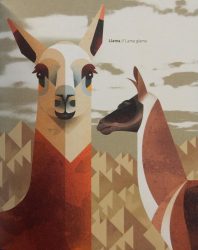
Cubism is, I think, the influence for this magnificent Llama portrait–

%0a

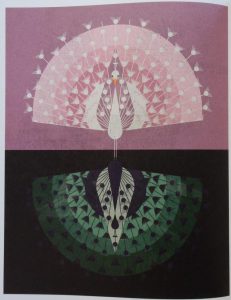
Indeed one can detect many artists styles herein. These incredible Indian peafowl (representing Asia)

%0a

have a definite Art Deco look about them
From Australia we have among others, the Common spotted cuscus and the Echidna: I love the way the curved shaped backs are juxtaposed on this page, as well as the use of geometric shapes. …

%0a

As with the ‘North’ volume, Braun allows his visuals of some of the animals to stand alone, such as this Kelp gull from Antarctica …

%0a

the region from which unsurprisingly, fewest animals are portrayed.
This is a book to keep, to give, to share and to inspire.

Charter logo FINAL.indd

A Letter for Bear

dscn9477

A Letter for Bear
David Lucas
Flying Eye Books
I make no apologies for reviewing this book again having first done so (as part of a seasonal roundup) when it was first published three years ago. That however didn’t really do justice to such a terrific book: I love it even more now, coming to it afresh.
Meet postman, Bear, meticulous in his delivery of other people’s mail but never himself the receiver of any letters. After each day’s work he’d retreat to his cave home, drink soup and ponder on the possibility of getting some mail of his own.

%0a

One windy day while out on his round, his mailbag is whisked skywards and its contents are scattered all over the snowy ground.

%0a

Bear collects every single letter but the addresses are smudged so he has to knock on all the doors to ensure correct delivery and thus gets to know the names of all the other animals. As expected every recipient appreciates his efforts but seeing all those families together only makes Bear feel more lonely than ever.

%0a

Back in his cave that night, Bear decides he must take the initiative and gets busy writing Christmas party invitations and next morning he delivers ‘a whole snowstorm of letters’ to his new acquaintances. The same evening he decorates his cave and waits … and waits …
The disconsolate creature is on the point of giving up when he hears voices outside asking to come in. Then, after all, it’s a case of ‘let’s party’; but even better, the following morning all the letters in his sack are for a certain ursine postman. Hurray!

%0a

An altogether uplifting seasonal story but for me, the book’s real strength lies in David Lucas’s intricately patterned illustrations. All but one of the double spreads has a geometric border of patterned triangles, rectangles, diamonds or scallops; and set into some of the scenes, we view Bear’s lonely world through circular peephole vignettes. His limited colour palette – – shades of blue, orange, purple, russet, pink and orange – and his use of geometric shapes for, or to pattern, trees, buildings, flowers and more, add to the impact. Add to all this angled viewpoints, interrupted borders, beautiful snowscapes and delectable endpapers, and what do you have? A small gem of a book, and a pattern-tastic treasure that is a masterpiece of design. The perfect present to tuck into the branches of a Christmas tree or to pop in the post.
If you work in a school and want to inspire some letter writing, sharing this story is a perfect starting point, and then you can set up a special “Bear Mail’ post box or perhaps let the writers peg their letters onto a Christmas tree.

Secrets of the Sea


Secrets of the Sea
Eleanor Taylor and Kate Baker
Big Picture Press

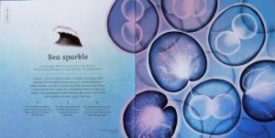
It is in the oceans that all life on Earth began, yet they are one of the least explored and least understood places on the planet.’ So writes Kate Baker in her introduction to this stunningly beautiful book that takes us from ‘In the Shallows’, through the ‘Forests of the Sea’and the ‘Coral Gardens’, into ‘The Wide, Wide Blue’ and down ‘Into the Deep’.
Venture beneath the waves and there’s an amazing variety of plant and animal life from single celled organisms such as ‘Sea sparkle’ …

to the Giant pacific octopus an enormous cephalopod that resides in the depth of the ocean and has an armspan of up to 4 metres. Not all octopus species are deep sea dwellers though: Coconut octopus is to be found in the shallows of tropical waters. This amazing creature is able, we’re told, to hide itself not only by changing its colour, texture and form to blend in with its surroundings, but also it can pick up an empty coconut shell, crawl inside and hide. Unsurprisingly it is considered the ‘master-mind’ of invertebrates.
Dive down to the kelp forests and discover minute algae and other fascinating creatures like this Hooded nudibranch:

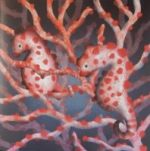
The coal reefs are home to almost 25% of marine life much of which is brightly coloured such as these Pygmy seahorses …

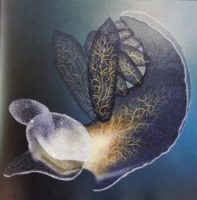
It’s in the open oceans where such as the Sea angel can be found. This graceful dancer is a predatory sea slug, another deadly hunter …

Dive deeper and at depths of about 2000 metres are thriving communities of squat lobsters, white crabs, mussels, snake-like fish, anemones and these giant tube worms …

This is a book that opens the eyes to the staggering beauty of marine life in all its forms. Every illustration is a celebration of the wonders of the oceans and focuses on the intricate shapes, structures, patterns and colours that are revealed when the marine flora and fauna are examined in extreme close-up. Kate Baker’s accompanying text provides a broader picture describing habits and habitat of each organism and some basic facts including Latin name, size and other fascinating snippets of information.

localbookshops_NameImage-2

One Is Not A Pair & Who’s Hungry?

%0A

One Is Not A Pair
Britta Teckentrup
Big Picture Press
This is the third of Britta Teckentrup’s ‘spotting’ series that encourage and develop visual perception in a playful way that children (and many adults) delight in. Here she takes fourteen objects and presents them in spreads where everyone has a pair except one – the odd one out. All interests are catered for: there’s food  – yummy-looking ice-cream cones, sweet shiny cherries –

DSCN8361

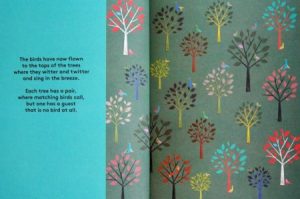
machines are represented by huffing puffing tractors and a ‘squadron of planes’, wild life has strutting magpies, spotted toadstools upon which spotty ladybirds crawl; there are birds in bird houses and in trees: ‘Each tree has a pair/ where matching birds call, / but one has a guest/ that is no bird at all.’ Can you find it?’

%0A

There are wonderfully coloured autumn leaves upon which insects crawl. We visit a toy shop with a host of cuddly bears …

%0A

and there are wooden blocks, built into towers and houses, a cacophony of yowling black cats, a richly hued pack of colouring pencils and last but definitely no least, washing lines of socks …

DSCN8366

And the final spread is a mix of all the things to pair up and find the odd one.
Characteristically stylish, bold bright graphics grace every page and Britta’s rhyming text trips off the tongue nicely.
Look, look and keep looking: it’s such fun.
There’s also a set of Where’s The Pair? spotting postcards from Britta:

DSCN8402

every one a diverting visual charmer and like the book, beautifully patterned in Britta’s inimitable style.

%0A

Who’s Hungry!
Dean Hacohen and Sherry Scharschmidt
Walker Books
The split page format is cleverly used to put young readers in control of feeding some hungry animals. By turning the half pages they can bring the food right to the animal’s mouth each time. The book starts with the straightforward, all-important ‘Time to eat. Who’s hungry?’ to which seven animals respond in the affirmative, starting with a rabbit who declares, “I am! I’m hungry.” A quick flip of the flap delivers a crunchy carrot almost straight into Bunny’s mouth. This is followed by ‘Glad you like it, Bunny. Who else is hungry?’ And thus the refrain is repeated and responded to, next by Seal who hastily slurps up a fish leaving only the bones behind.

%0A

Monkey unsurprisingly, snatches up a banana, dropping the peel; Horse chomps through a pile of hay, Squirrel consumes a large acorn, Panda some scrummy bamboo shoots, and lastly Mouse politely requests and nibbles on a chunk of cheese.
The off-screen narrator is always on hand to make certain each animal is duly satisfied: ‘There’s plenty more, Panda!’ he says …

%0A

And, the final spread offers a plate to the reader – I’d certainly relish the vegetables particularly that broccoli.
The eyes of each animal have that ‘come on’ appeal that seems to be directed straight at the reader (or listener) who will take great delight in responding by delivering the food to each member of this alluring-looking menagerie.
In addition to providing opportunities to discuss healthy eating, asking and receiving politely, caring for animals, and animal habitats with the very young, this is a great ‘have a go yourself’ book for those in the early stages of becoming a reader. All in all, it’s cleverly conceived, all-involving enjoyment for children and adults.

WNDB_Button localbookshops_NameImage-2

Playful Books for Little Ones

DSCN6339 (800x600)

Peek-a-Boo You!
Jane Cabrera
Templar Publishing
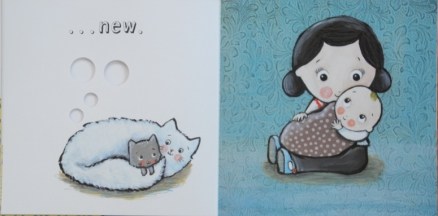
A frisky cat plays peek-a-boo with a small girl and her ted as it frolics through the peep holes in the pages of this delightful rhyming book. Kitty delights in activities such as jumping into a shoebox

DSCN6341 (800x600)

and overturning a beaker, although perhaps she isn’t quite so delighted by this …

DSCN6342 (800x600)

However, the playful puss has a surprise for the little girl …

DSCN6343 (800x600)

and there’s a surprise finale for readers too.
Great fun to share with the very young. Equally, with its predictable patterned text, this book is ideal for beginning readers and so much more fun that dull reading scheme fodder.

DSCN6344 (800x600)

One Lonely Fish
Andy Mansfield and Thomas Flintham
Templar Publishing
‘A counting book with bite!’ announces the cover of this playful book as we begin with one very tiny fish swimming through the sea watched only, or so it seems, by a couple of crabs from the ocean floor.
Flip the fin-like page and a second fish is revealed now swimming behind the first.

DSCN6345 (800x600)

Continue in similar fashion until nine fish of increasing size swim one behind the other, still watched by that pair of crabs that are now looking decidedly alarmed and turning over one more time will reveal the reason why.

DSCN6346 (800x600)

What follows is a satisfying finale? – Err, that all depends on your viewpoint.
Great fun and full of mathematical potential within and beyond the pages of the book.

DSCN6327 (800x600)

Brown Bear Colour Book
Jane Foster
Templar Publishing
This charming concept book is also an invitation to play hide and seek with Brown Bear – he peeps through the increasingly large die-cut circle on every colour spread. The three primary colours plus orange, green and purple each have a double spread which follows the same form: text on the left-hand side; seven small pictures, plus bear peeping through, on the right. The text too, keeps to a repeating pattern: here is Red …

DSCN6328 (800x600)

In fact pattern is key to the whole thing. The individual objects are beautifully patterned

DSCN6329 (800x600)

and often set against a patterned background in a shade of the featured colour.
As the pages are turned the previous colours are visible through the increasingly large hole on the left hand die-cut circle until the surprise grand finale …

DSCN6330 (800x600)

Those of us who have taught young children /and or/ are parents, will know that the very young do not generally acquire colour concepts from books, rather they develop them through experiences of the real world and interactions with adults. However, this book will certainly help to reinforce ideas relating to colour and is a delight in itself. There is so much to talk about on every spread; and the predictable, repeating pattern of the whole thing makes it a book that beginning readers can enjoy trying for themselves.

DSCN6366 (800x600)

Gobbly Goat
Axel Scheffler
Nosy Crow
It’s lunchtime and Gobbly Goat has a rumbly tum. He wanders around the farmyard in search of something tasty to munch. Ugh! That straw hat tastes pretty disgusting, the rosy apples are way too high and Horse isn’t keen on sharing his hay so what can Gobbly gobble? …

DSCN6367 (800x600)

Told with a rhyming text and with deliciously funny farmyard scenes, this is a tasty treat for toddlers who will delight in pressing that sound button and making Gobbly bleat.

In similarly delightful Scheffler style and also in boardbook format is

DSCN6364 (800x600)

Higgly Hen
Nosy Crow
Here, although Higgly is hungry as the story begins, food is not the main object of her search. No sooner has she begun her food finding walk than her eggs hatch – six in all –

DSCN6365 (800x600)

and it’s those she wanders around the farm in search of. Silly hen; it’s a good thing that the cat, horse, pigs and other farmyard animals are on hand to help with her hunt.

Use your local bookshop      localbookshops_NameImage-2

Rosie’s Chick & a Missing Monster

DSCN4322 (800x600)

Where, Oh Where, is Rosie’s Chick?
Pat Hutchins
Hodder Children’s Books
This is most assuredly a long-awaited, much anticipated sequel to the classic Rosie’s Walk – one of my all time favourite picture books – and its story is told in many more than its progenitor’s thirty-two words, (though with a patterned text it’s ideal, like Rosie’s Walk, for beginner readers).
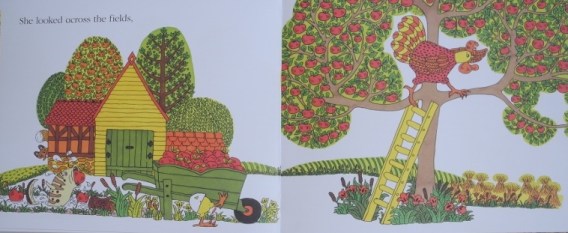
Forty-seven years later, Rosie’s egg has well and truly hatched but the baby chick seems to have gone missing. Off goes Rosie to search … under the hen house,


DSCN4317 (800x600)

in the basket, behind the wheelbarrow, across the fields (some pretty precarious balancing involved here),

DSCN4319 (800x600)

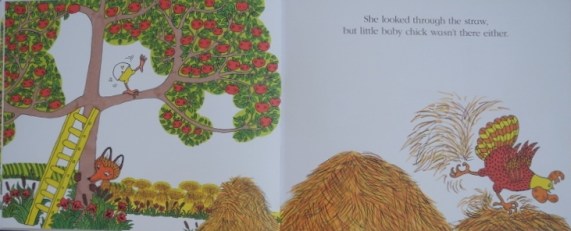
through the straw (likewise)

DSCN4320 (800x600)

but no sign of her little one – to Rosie that is. Of course, following close behind her all the while is her baby chick, but it takes her farmyard companions to make her see this.
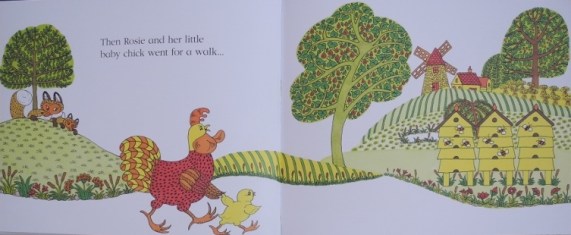
Then it’s off for a walk together, Rosie and chick side by side. Ahhh! (Great to see those beehives again.)

DSCN4321 (800x600)

Using the same colour palette as for Rosie’s Walk, Pat Hutchins has created another set of gorgeous scenes, more richly and densely patterned than before, full of that sparkling humour and with some old friends still lurking in the background. What more can one ask?
Wonderful, wonderful, wonderful: And certainly worth the incubation period.

DSCN4333 (800x600)

Have You Seen My Monster?
Steve Light
Walker Books
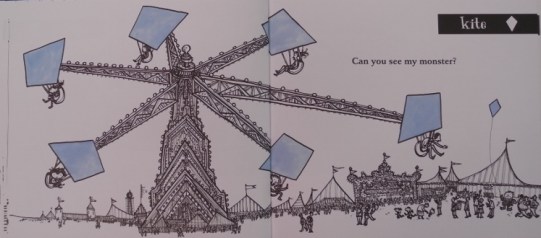
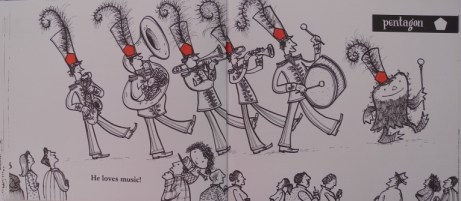
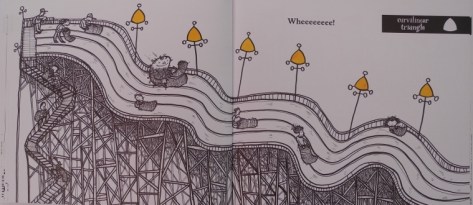
Geometric shapes abound in this follow up to Have You Seen My Dragon? This time we join a little girl as she searches the fairground, (a map is provided in the end papers), for her missing monster – a furry, friendly looking creature. It’s a search that encompasses amazing rides,

DSCN4335 (800x600)

all manner of stalls, exhibits, competitions, a hall of mirrors, animals, musicians

DSCN4337 (800x600)

and more – pretty much all the fun of the fair.
Each spread introduces a shape; and what amazing variety – not only do we have the common or garden rectangle, hexagon,

DSCN4334 (800x600)

oval, square, kite, triangle, circle and crescent that many a young child is familiar with, but also octagon, rhombus, quatrefoil, trapezium, parallelogram, curvilinear triangle,

DSCN4336 (800x600)

heptagon, trapezoid, pentagon, nonagon, ellipse, decagon – exciting words that can be painlessly absorbed in the context of a fun story.
Light’s illustrations, executed in pen and ink are full of interesting details and despite being coloured on the cover, the chief characters are also depicted in black and white throughout the story, with just a splash of colour used for the specific shape featured on each spread. This serves to highlight the shape, making it the eye’s first focus. So, a double delight: A search for the (supposed) missing monster (and that’s of course part of the shared joke between author and audience) and a mathematical exploration for other shapes like the named shape, (or previously named shapes) in the details of each illustration.

Use your local bookshop localbookshops_NameImage-2