Fossils From Lost Worlds

Fossils From Lost Worlds
Hélène Rajcak and Damien Laverdunt
Gecko Press
Immerse yourself in the world of palaentology with this large format book that provides youngsters with an accessible way to learn about fossils and geological periods.
The first spread is devoted to the diagrammatic representation of the geological periods after which readers travel through time from the very beginnings of animal life looking at the likely first organisms with each spread featuring a different prehistoric creature selected for its special contribution to scientists’ learning of palaeontology.
Yes, there are some of the expected familiar favourites including Archaeopteryx the oldest bird, Diplodocus, Stegosaurus and the iconic Tyrannosaurus; but many of the less well-known species are new to me and probably many other readers. There’s the invertebrate Anomalocaris: since 1978 palaeontologists agree on what it looked like, but its behaviour is still the subject of discussion.
Another creature – Hallucigenia – has been the topic of much dispute in particular which end was the tail and which the head
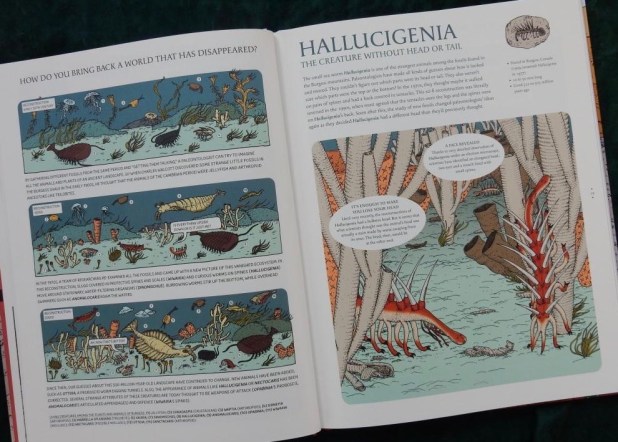
and there was also confusion as to what were tentacles and what were legs. Happily now thanks to electron microscopy these mysteries have been resolved.
The fossilised footprints found in Thuringia (Germany) were a mystery to scientists for over 130 years and it’s since the 1960s that it was decided that these were made by the reptilian Ticinosuchus.

The last animal we encounter is possibly the largest ever land mammal Paraceratherium, the hornless cousin of the rhino thought to have a flexible upper lip which it used to pluck leaves and grass in similar fashion to rhinos of today.

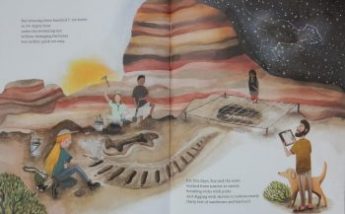
Every one of the animals represented is allocated either one full page depiction or a full page illustration opposite which is a sequence of smaller panels adding to the overall visual appeal of the book. Each is also accompanied by a written description as well as helpful bullet points setting out where the fossil remains were found, crucially, its size and when it lived.
Alongside the animals, we also meet some of the associated palaeontologists including Georges Cuvier, Othniel Charles Marsh, Clive Forster-Cooper and the person whose name is familiar to most readers, Mary Anning, each of whom is introduced in amusing graphic style comic strip format.
The final two double spreads comprise a time line of palaeontology from the 5th century to 2017.
Most young children are dinosaur and prehistoric animal mad; this book will take those with an abiding interest in the topic, deeper in and further back in time.
 Red Reading Hub - Jillrbennett's Reviews of Children's Books