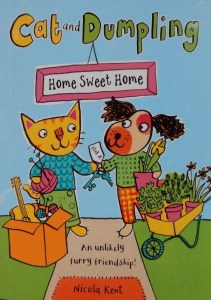
Cat and Dumpling: Home Sweet Home Nicola Kent Oxford Children’s Books
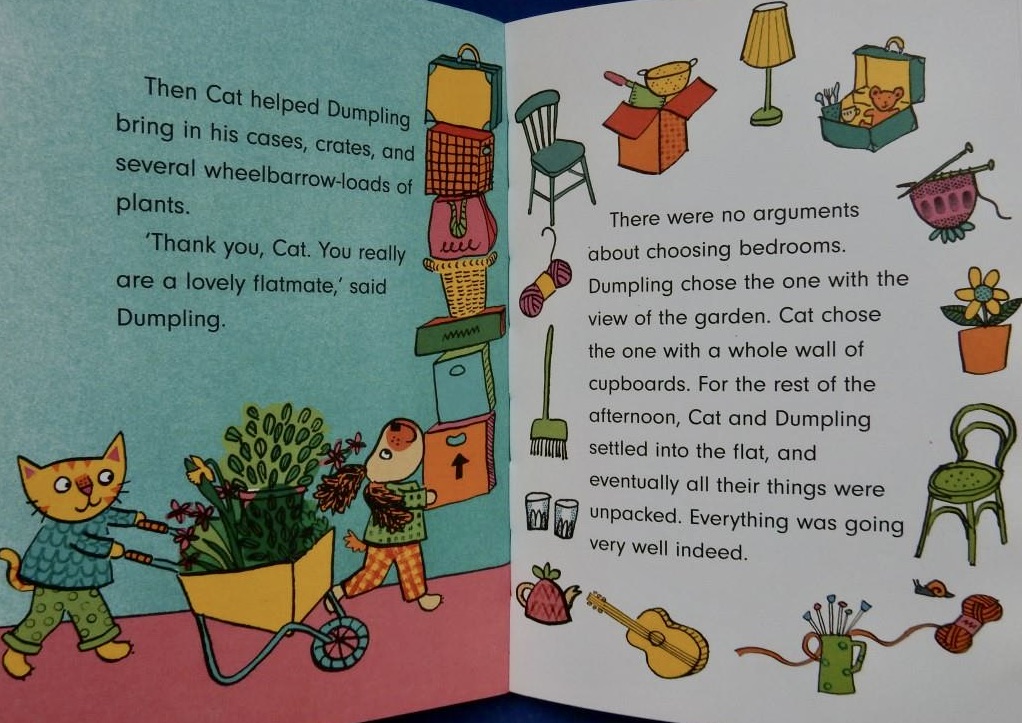
Meet Cat, knitting fanatic and enthusiastic guitar player, who badly needs a new place to live that has plenty of cupboards. Then there’s dog, Dumpling, an ace gardener whose vegetables make delicious feasts. He too needs somewhere new to live, but it must have a garden sufficiently large to accommodate all his plants. They both set out house hunting, visiting several places that are quickly crossed off their respective lists. Feeling downcast they each decide to take a walk and almost simultaneously come upon a sign advertising a flat to rent. Both think this ground floor abode is ideal for their needs, even more so as Delores from upstairs shows them around. Delories thinks they’re both too noisy but is persuaded by their offers of gifts and Cat and Dumpling end up becoming flatmates. All goes well when they move in,
at least initially, but it takes a bit of compromising and kind deeds before come bedtime, it’s truly a case of home sweet home.
Nicola Kent’s sweet story with amusing, full colour illustrations at every turn of the page and short chapters is just right for new solo readers who will assuredly enjoy meeting these new characters and be pleased to know further adventures are in the pipeline.
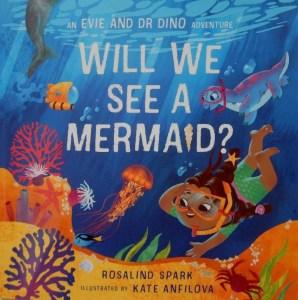
Will We See A Mermaid? Rosalind Spark and Kate Anfilova Oxford Children’s Books
Little Evie is at the beach with her parents and best friend, Dr Dino. Last on her list of things to do that day is to find a mermaid. Dad thinks she has a great imagination whereas Mum tells her she’ll need to look very carefully. So begins Evie’s ocean adventure with Dr Dino. They pack the necessary gear, then before diving deep, the two go and check the rock pools. They’re certainly full of interesting marine creatures but no mermaids.
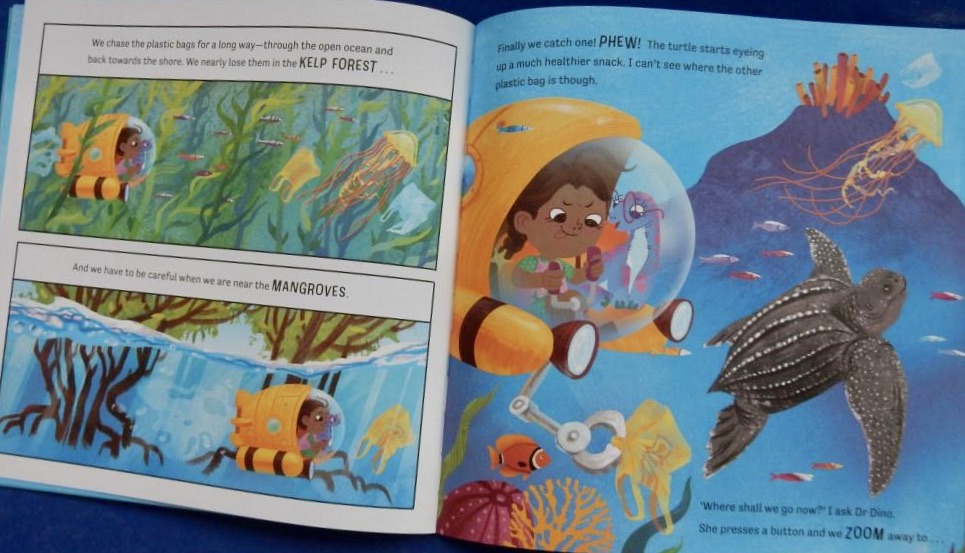
The two build an Ocean Explorer Submarine, launch their craft into the waves and head out to sea. Dr Dino talks about the dolphins they see; then deep underwater they dive and Dr Dino informs Evie and readers about the behaviour of the anchovies and whales they spy. Unfortunately among the marine fauna are some plastic bags and the explorers are determined to prevent a turtle from eating them in mistake for jellyfish. Their bag chase sees them visiting a kelp forest
and a coral reef and diving way way down into the darkest depths until … at last, it’s mission accomplished. But have they seen any mermaids:? Maybe. …
Back on the beach, Mum and Dad help the adventurers collect rubbish left by thoughtless people and Evie offers her definition of mermaids.
This book is full of interesting information, including a gate-fold spread about marine life that will fascinate KS1 children. However, it would also work well as a straightforward story for preschoolers if the reader aloud shares only the main narrative.
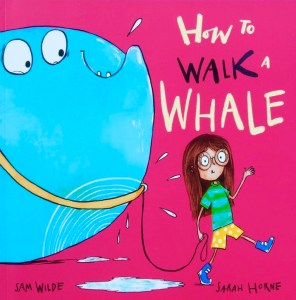
How To Walk A Whale Sam Wilde and Sarah Horne Oxford Children’s Books
This fourth title in the Peculiar Pets series is narrated by a girl who takes her grandmother’s advice, thinks big and advertises for a whale to come and share her abode. Sure enough, what should appear outside the front door but a blue whale. It’s as well that Granny has a book on whale care to make matters easier. Providing a ‘happy’ environment means that the creature cannot spend more than a couple of hours on land. Then there’s the issue of diet: an abundance of krill is what’s needed and lots of exercise is vital;
but when it comes to accompanying your whale as it swims thousands of miles to find a mate and give birth; and communicating your love often, it becomes evident that as strong as that love is, what is even more important for the pet whale is to rejoin its family in the vast ocean. Of course there’s always the hope that he’ll come back to visit his human friends before too long.
As well as being vibrantly and humorously illustrated by Sarah Horne,, author Sam Wilde has included lots of facts about blue whales in the text. Did you know for example that they filter the krill through big bristles in their mouths. There’s also a final double page spread giving the ‘Top (10) blue whale facts.’ Yes, the book is humorous but it also contains an important message about the responsibilities one takes on when having a pet animal of any kind.
Both these are additions to series ideal for newly independent readers – thanks to the publishers Oxford Children’s Books for sending them for review.
Gordon Starts a Band Alex Latimer
Gordon the goose is back and despite being dubbed the meanest goose on earth, he’s still trying to be good: that’s thanks to his now best friend, piglet Anthony. However to say Gordon is a totally reformed character is perhaps over-stating things, despite his best intentions. After a day of kind deeds Gordon cannot sleep, so when he meets up with Anthony the following morning he’s in a honkingly bad mood thanks in no small part to the terrible noise that kept him awake all night. A noise so bad Gordon feels that unless he discovers what’s making the sound and can put a stop to it, he’ll revert to his former mean self.
So he and Anthony start to follow the noise until they reach the darkest part of the forest and in a nearby clearing there is the perpetrator. It’s Edgar the Moose and what he reveals to Gordon and Anthony shocks both the friends. However the former thinks he should try to put things right but this proves much more challenging than Gordon could ever have imagined. It even involves a rendezvous with members of the Meanest Goose Society so Gordon can enlist their help in a scheme he has. With a considerable amount of thumping and banging, la-la-ing strumming and singing, all ends on a high with Gordon slightly further along the road to redemption.
Alex Latimer serves up another slice of delightful wry silliness that will have young solo readers backing Gordon all the way to the final page whereon we see a blissfully sleeping goose – err?
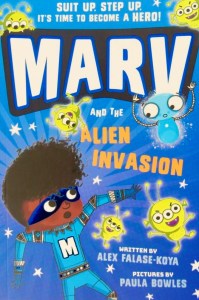
Marv and the Alien Invasion Alex Falase-Koya, illustrated by Paula Bowles
Marvin’s seventh adventure is set in a Space Centre that his class visits; it’s a trip involving an overnight stay. On arrival their tour guide Jessie greets the group and shows them where to leave their bags. This means that Pixel, Marvin’s tiny robot, will have to remain stashed in his backpack until all his classmates are asleep. First they go to the planet room where a display of the solar system’s planets hangs from the ceiling. Suddenly Jupiter falls from its fixing almost crashing onto Marvin’s friend Joe: was it mere accident or something else?
Next comes the rocket room wherein there stands a gigantic replica of a space rocket, alongside which is a life-sized replica of a control room. Unexpectedly the control panel lights up and starts beeping loudly -a loose connection? The final surprise before bedtime is when their guide dims the lights and projected onto the ceiling are the constellations. As they gaze upwards a potato hits Joe on the head and shortly after there appears the figure of supervillain Cosmic, and his little alien friends. Chaos ensues in the form of a food fight.
Time for Marvin to don his super-suit and morph into Marv the superhero. Out of Marvin’s bag too comes Pixel. But then Cosmic snatches up Pixel saying he’s going to take her to robot planet where she belongs and hauls her into the centre’s rocket. Can Marv do something before the rocket blasts off into space?
Another episode of MARVellous fun for those just taking off as solo readers from team Alex and Paula.
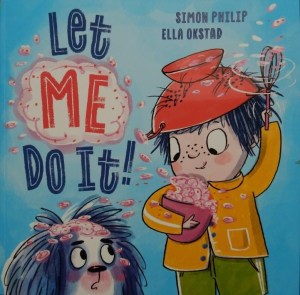
Let ME Do It! Simon Philip and Ella Okstad Oxford Children’s Books
Teddy, so he tells us is NOT a baby any longer; he’s ‘actually very grown up’. The trouble is that everyone still insists on fussing over him,; they want to wipe his nose, make his breakfast, fasten his jacket and tie his shoe laces. Frustrated, our narrator decides to take matters in his own hands letting his family know in no uncertain terms that HE will be the one to do all those tasks. And so he does. Indeed he becomes super confident, so much so that when as he makes his own breakfast and Mum announces a trip to get his hair cut, Teddy decides to give himself some tonsorial treatment with interesting results …
If only he’d left the cutting craft there, as well as quite a few other ideas that he has, washing the family’s whites for instance. OOPS!
Simon Philip’s hilarious first person narrative in combination with Ella Okstad’s equally hilarious, dramatic scenes of Teddy’s ambitious actions will appeal to both young children and the adults who share the story
What The Crow Saw Below Robert Tregoning and Greg Stobbs Oxford Children’s Books
As the story starts we meet a curious young crow who is doing as she’s told, looking down and squawking a warning at anything and everything she sees beneath her on the forest floor. while the others are asleep though, our young crow looks around to see what’s going on. Seemingly there’s nothing sinister at all: could her elders be mistaken?
Then, tired of looking for supposed dangers below she finds the courage to look up and see what she can discover. The older crows are horrified but this doesn’t stop the youngest corvid not only looking but moving upwards. Bravely she takes to the air and then accepts the invitation from a different kind of bird to join them.
Deciding that she can then return to the other crows and encourage them to ‘throw caw, caution to the wind’, she finally leads them all upwards and life begins anew, with a positive, hopeful attitude (and of course, a modicum of caution.)
A terrific rhyming telling with descriptive language that excites and includes alliteration and other clever word play by Robert Tregoning and Greg Stobbs’ illustrations that wonderfully complement the words, this is a joy to share with young listeners. I love a book like this one that encourages children to think for themselves and to focus on the positive things in life. Definitely one to enjoy and talk about both at home and in the primary classroom.
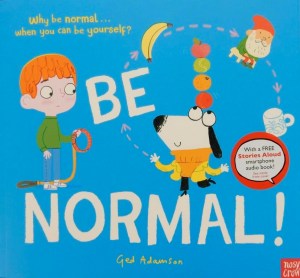
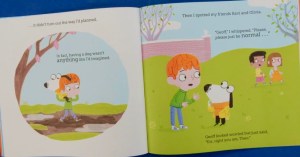
Theo, the story’s narrator, is hugely excited at the prospect of the arrival of a dog of his own and has prepared well. However one thing he hasn’t prepared for is a dog like Geoff Thorndike; he’s a dog like no other. Geoff arrives clad in trousers and jacket and pulling a wheelie case, turns down the offer of water and makes smoothies – delicious ones at that. Come bedtime he turns his nose up at the special doggy bed and usurps Theo’s bed instead. Time passes and it’s evident to Theo that Geoff is anything but keen on the normal doggy things though he does accept a walk in the park
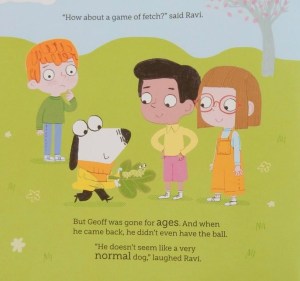
His response to ‘sit’ is well let’s say, something of a surprise. Then Theo’s pal Ravi suggests a game of fetch; this Geoff participates in – kind of –
and after the squirrel incident Theo has had enough. Embarrassed, he tells his friends that his pooch just doesn’t do many normal doggy things but he’s kind and funny and that’s perfectly fine with him. ‘I’m lucky to have you,” he tells Geoff. Having now come to appreciate his dog,Theo accompanied by his friends go home and have smoothies – you can guess who makes those and then Geoff offers to perform his one silly trick …
It’s great to have a story for young children wherein being different is valued. It’s a vital life lesson and Ged Adamson’s fun book conveys this message brilliantly.
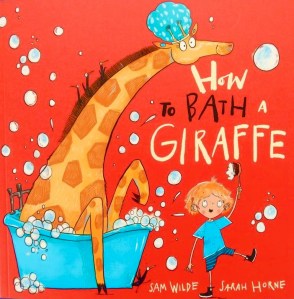
How To Bath A Giraffe Sam Wilde and Sarah Horne Oxford Children’s Books
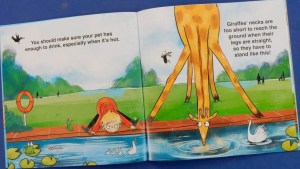
The latest in team Wilde and Horne’s How To series features another pet of the peculiar kind – a giraffe. This one appears in response to the poster displayed in the neighbourhood and astounds the boy narrator’s family with its stature. Clearly there are likely to be issues when caring for such a creature – drinking might be one;
but the most challenging of all is giving the giraffe a bath. The whole story is pretty ridiculous but it’s lots of fun, gently informative and it’s also inclusive (the child narrator has a hearing aid).
Sarah Horne’s illustrations are a hoot and Sam Wilde’s narrative includes lots of interesting facts about giraffes as well as a ‘Top giraffe facts’ final spread. Astonishingly, giraffes and humans have the same number of neck bones (seven).
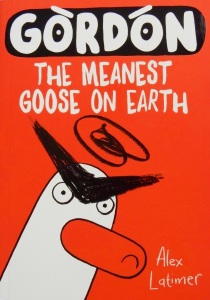
Gordon the Meanest Goose on Earth Alex Latimer Oxford Children’s Books
Gordon the goose is thoroughly mean, way more mean than any of the other geese on the entire planet biting and snapping, shouting and imposing impossible tasks on his fellow geese and any other creature unlucky enough to encounter him. He even goes so far as to make lists of mean things to do before setting out each day to make life miserable for anyone and everyone in the seaside town of Grover Gardens.
On this particular day he heads first to the zoo where, having donned a zoo-keeper’s hat and shirt, sets about his mean activities. These he continues throughout the day until having departed the zoo, he makes for the promenade, there to scare the wits out of a baby. As he rehearses his nasty words he finds his path blocked by Anthony the Piglet, the very same piglet that he’d directed towards an open tiger’s cage earlier. In his trotter Anthony holds a flower; this he hands to a surprised Gordon.
With his chance at shouting at the baby gone, Gordon heads for home and having placed the flower in water, lies awake all night pondering upon having been given a kind gift.
Next morning he sallies forth determined to forget the flower and resume his mean acts, in particular punching a shark in the belly from within. The result is utter failure: could Anthony and that flower be the cause? Maybe a consultation with fellow members of the Meanest Goose Society will help. A plan is made and Gordon confronts Anthony demanding to know why he gave him the flower. How the piglet responds causes Gordon to set out for the beach again the following day, where a startling understanding suddenly dawns as he chats with Anthony.
Another day goes by with the writing of an invitation, another meeting with Anthony and the utterance of some words that the goose finds very difficult to say. Could saying ‘I’m sorry’ be the bravest thing Gordon has ever done in his entire life.? And could it mean a very different way of being for a certain goose?
This is picture book creator Alex Latimer’s first foray into books for new solo readers and with its numerous laugh-out-loud moments and comical, cartoon-style illustrations made with a few deft strokes of his pen, he’s got a winner here.
Gloria Goes For Gold Marina Firth and Annabel Tempest Oxford Children’s Books
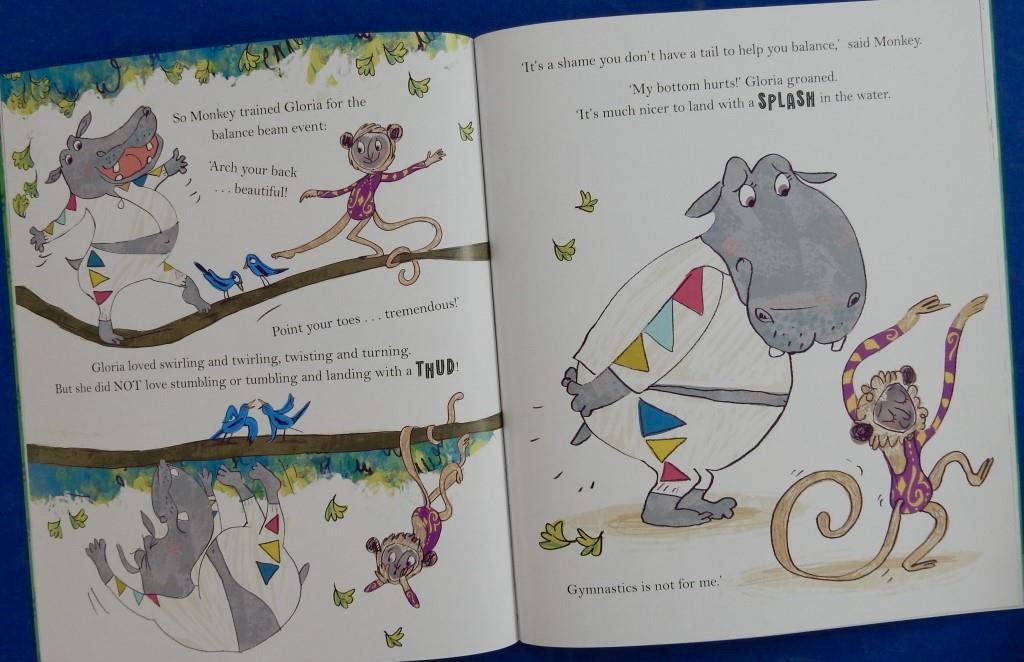
Of all the unlikely animals to be called graceful it’s Gloria the hippo and her family members, a champion- winning team of synchronised swimmers that always comes away with gold at the Artistic Swimming Championships. However Gloria is not as happy as the others about this: she longs for a prize she doesn’t have to share. Then comes a letter about the upcoming Savannah Games and Gloria decides to find a sport she can win solo. Off she goes leaving the other hippos to practise their routine and before long bumps right into sprinter Cheetah going so speedily she fails to see Gloria. The hippo decides she’d like to try sprinting and Cheetah offers to coach her. Pretty soon Gloria realises that this sport isn’t for her and as she sits beneath a tree contemplating what next, down swings Monkey. He makes gymnastics appear great fun but Gloria quickly discovers that she’s not cut out for being a gymnast.
Nor does she take to distance swimming. In fact she decides that after all, she’d rather be part of the family team; but feels too ashamed to ask.
The next day sees the start of the Savanna Games and Gloria tucks herself away among those watching the artistic swimming.
While so doing she overhears something her brother says to their cousin. Is there a situation that needs saving? If so, what should she do?
Priceless pictures by Annabel Tempest are for me the real winners in this book. No matters whether one aspires to be a solo winner or part of a winning team, it’s important for children to see that it’s participation and doing one’s best that really count the most and Marina Firth’s telling shows this in a fun, non-didactic way.
Albert and the Flood Ian Brown and Eoin Clarke Graffeg
It’s a truly eventful day for Albert and his friends despite the sporting event Games Day being rained off. Actually that’s an understatement for it’s a thunder storm that is responsible for rescheduling of the Games, despite what the ant commander says as the rain starts. However the steady rain rapidly turns to a torrential downpour that causes severe flooding of many of the creatures’ homes. Fortunately Albert quickly starts leading a rescue mission, aided and abetted by Frog, a group of ants and some spiders. Before long, Albert’s shell was packed with minibeasts, while others of the rescued found safety elsewhere.
Then suddenly the rain eases off and the storm clouds pass to reveal a glorious sight in the sky. The ant commander makes an announcement that pleases most of the creatures; and then Albert too makes an announcement. Can you guess what he said: it concerned something of vital importance.
This is Albert’s seventh adventure created by team Ian and Eoin and it’s one that contains an important life lesson for young children. Eoin’s illustrations are very amusing and both adult readers aloud and their audiences will laugh at many of the scenes.
Croaky: Search for the Sasquatch Matty Long Oxford Children’s Books
Young frog Croaky Hopper longs for adventure, wanting to be like his hero, TV adventurer Tennessee Toad. However, his Aunt Lilly dismisses his desire for riding rickety mine carts along rusty rails and hopping across crocodile-infested rivers and instead sends him off to join the Woggle Scouts. The sort of friends Croaky wants to make though aren’t the kind that tie knots and bake biscuits; rather he wants adventure-loving pals. All he finds when he arrives are clever-clogs mouse Sheena, intent only on acquiring badges, and Winston a rather old-looking puffin. Croaky is not impressed, nor does he believe that the other members of the group are out selling biscuits to old people.
However things change dramatically as a result of the newcomer deciding to ignore the ‘Ultimate Danger’ notice on the door beside the store cupboard. Down he tumbles into a secret adventuring museum full of bits and pieces from only Winston knows where. While down below Croaky also comes upon a map and come the weekend the three scouts embark on a camping expedition to Crystal Creek National Park. The hope is that they will track down the long lost Sasquatch.
Things don’t get off to a very good start though for the wind whisks the map right out of Winston’s wing. Lost in a huge forest sans map is not in the plan, a plan that quickly turns into a survival mission, especially when the compass is broken. Deciding sleep is their only option, they huddle round a fire and things start looking rather better until Winston disappears and operation search begins.
Endlessly enthusiastic, Croaky leads the two towards a mountain, one he climbs using his tongue while Sheena takes the longer route. What do they discover next? … And will they all make it safely back to base camp?
Madcap humour abounds and Matty Long’s new characters are a terrific trio. Long live the Woggle Scouts: this account of their adventuring is smashing fun for new solo readers.
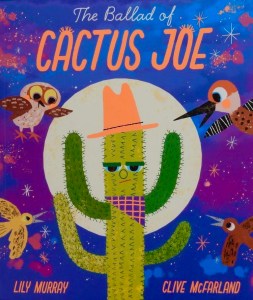
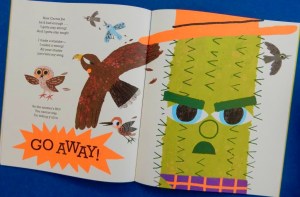
The Ballad of Cactus Joe Lily Murray and Clive McFarland Oxford Children’s Books
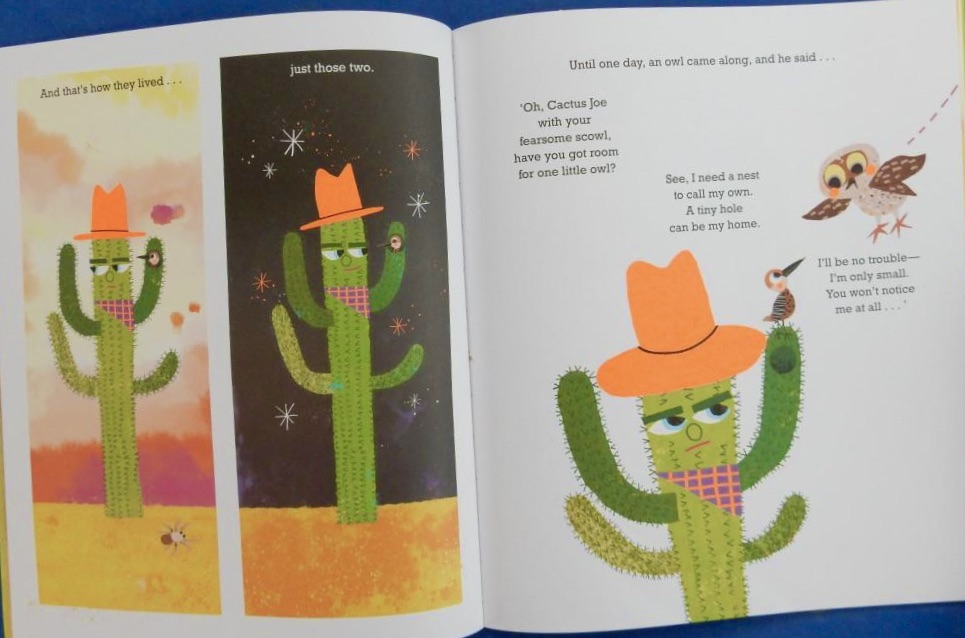
Cactus Joe is ‘lean ’n’ mean’, and every night he happily sings all alone in the desert. Until that is, along flies a woodpecker. Using its persuasive powers the woodpecker exhorts the cactus to let him live on one of his branches and a deal is struck. However, despite what Joe says to his lodger it does not remain ‘Just Woodie and me / till the day I die.’ All manner of birds start making overtures to the erstwhile loner: first it’s an owl,
then a hawk that nests, followed by more and more that flock to stay on Joe. By now our spiky plant has earned a great reputation as ‘the place to stay’ but Cactus Joe has had enough. “Go away!” comes his order and they all take flight leaving Joe on his lonesome once again.
Surprisingly to our protagonist, it’s lonely sans the companionable sounds of his chattering congregation. However that isn’t the only surprise; another is forthcoming thanks to Woodie et al.
This rhyming tale of adapting to different circumstances and being open hearted is, with its surprise ending, huge fun. Clive McFarland’s characterisation of the cactus is wonderful: I love his bright orange colour pops especially that hat and bandana.
The final spread gives information relating to Cactus Joe being a saguaro cactus, a kind only found in the Sonoran Desert of Southern Arizona and northern Mexico and the animals likely to be found near to such a cactus. Share with individuals or a class: there’s plenty to talk about.
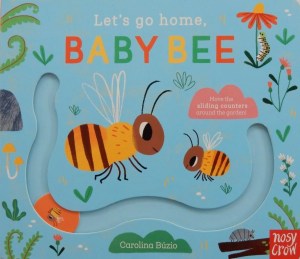
Baby Bee has to get safely to the hive and needs the help of little humans to do so. The same is true of some other baby minibeasts: baby ladybird wants help getting to a home log,; baby snail resides in a flower pot; and baby worm also needs guidance back home. There are plenty of things relating to the natural world to spot on each journey and each can only be completed with the help of a small human hand to guide the moving disc that depicts the named baby. Interactive fun that gives little children a sense of autonomy as well as delight at the brightly coloured spreads, each of which has the route on the recto and small, labelled images on the verso.
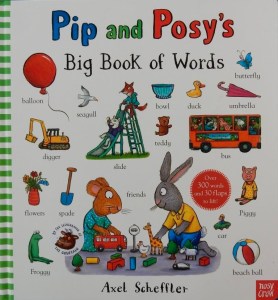
Pip and Posy’s Big Book of Words Axel Scheffer Nosy Crow
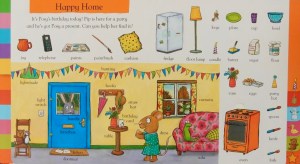
Little ones can learn and read more than three hundred words with friends Pip and Posy in this large format book. Its ten spreads have different themes each with flaps to lift and a multitude of labelled images both in and surrounding the scenes, the first being Garden Games. Here we see Pip busy planting seeds and Posy ready to entertain visitors by playing some musical instruments. Next comes At the Shops where we find customer Posy, clutching a coin to buy a new toy. Sunny Seaside is the third destination and the two friends are enjoying a beach visit. Back at Posy’s Happy Home, Pip arrives bringing her a birthday present.
Christmas, Snow, Bubbles, Night Night follow and the final spread Learn with Pip and Posy presents colours, seasons, numbers (to 10)basic 2D shapes, and four examples of opposites. Offering lots of potential for discussion, as well as vocabulary building and honing their visual skills, there’s a wealth of toddler learning possibilities between the sturdy covers of this book.
Also helping to enhance young children’s vocabulary are recent titles in a popular series:
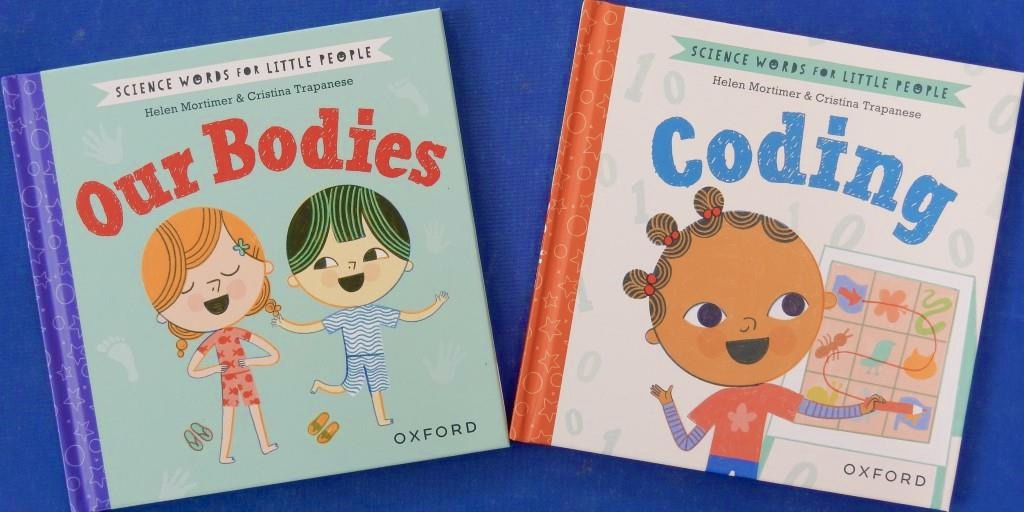
Science Words for Little People: Our Bodies Science Words for Little People: Coding Helen Mortimer, illustrated by Cristina Trapanese Oxford Children’s Books
In Our Bodies children can take the plunge and have a day at the swimming pool where they can learn a wealth of body-related words from the brain to bones and senses to growing. Coding presents basic language such as commands, sequencing, chain reaction and inputs and outputs. Both books feature a diverse cast of child characters, are engaging both visually and verbally and are worth adding to home shelves or collections in early years settings.
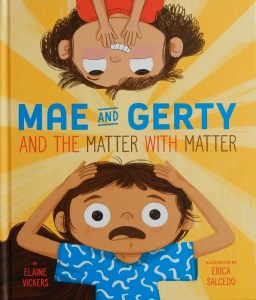
Mae and Gerty and the Matter With Matter Elaine Vickers and Erica Salcedo Beaming Books
Science and story come together in this picture book.
Mae and Gerty are sisters but they are very different. Mae, the elder of the two becomes increasingly annoyed when her parents constantly talk about their notions that Gerty is showing a scientific bent at so young an age; indeed the very first word she said was ‘madda’. Dad is forever drawing attention to her actions: “Look at all the ways she can manipulate matter: pushing, pulling and colliding!” he comments one bath time.
Gerty certainly does love mess making,
trying things out, constantly asks questions. These are exactly the things scientists do and during the story, both siblings discover that this is so, for Mae decides to show her mum and dad that she too can do all that Gerty does. They start exploring together and soon they become a true science team taking every opportunity to experiment, asking Why? Why? Why?
Some of their experiments in the kitchen produce matter of a very tasty kind but most important of all is that with their parents’ encouragement the siblings’ eyes and minds are always open to the scientific possibilities the world offers.
After the narrative, the author provides some questions adults might discuss with young listeners and there’s also a bubble recipe. Erica Salcedo’s wonderfully expressive scenes of the girls’ interactions with matter really brings out the importance of letting children explore the world with all their senses.
These are both additions to the Science Words for Little People series. In Let’s Build, the children are going to make a car wash and the book takes us through the stages involved in its construction from drawing up a plan to the finished building. The simple text is split between a straightforward narrative and speech bubbles containing the child constructors’ comments. Key words – materials, invent, tinker, forces, magnets, strong foundations, machines, movement solving problems, energy are used as headings for each of the twelve spreads, the twelfth being ‘all about building’ whereon readers are asked leading questions to get them thinking about their own projects. The final spread gives ideas to adults to help them get the most from this book and Weather. Similarly organised, the latter uses key terms including meteorology, atmosphere, various cloud names, cyclones, hurricanes, tornadoes and hurricanes in the brief narrative that has spreads on sun, clouds, rain, a rainbow, wind, storm, snow, seasons, weather watching and climate.
Visually and verbally engaging with a diverse group of child characters, both titles are worth adding to early years collections.
Little Bear Little Dragon Sarah Cordingley and Kamala Nair Oxford Children’s Books
If you’re a parent or carer who is having trouble getting a young child off to sleep then these, the first two in a series of calming Sleep Stories intended to help young children prepare for a good night’s sleep, are worth trying
In the first we join a restless Little Bear as he sallies forth from Old Slumber Tree in search of the perfect sleeping place. During his meanderings he discovers several possible spots: there’s the reedy banks of Hush-a-bye-River, on the edge of Snoozy Shore, the sand dunes of Moonlit Meadow for instance but in each place there’s something preventing the bear from falling fast asleep. Eventually he comes to Rockabye Treehouse wherein resides a wise owl. Owl’s question proves just the right thing to send the wandering Little Bear to the place most suitable for a cosy night of slumbers.
One night in the Misty Mountains way up high Little Dragon is also beset by wakefulness. His friend Bedtime Bird accompanies him off on a search for the perfect sleep-inducing hug. First stop is the Lullaby Trees but the tree trunks can’t provide a ‘squeeze hug’ so the dragon continues alone along the woodland path to Starlight Hollow and thence to Rainbow Falls where he encounters some bubble blowing music making frogs. Could one of their bubbles transport Little Dragon to slumberland?
Calming and reassuringly written, with a wealth of descriptive language by Sarah Cordingley and illustrated in luminescent hues by Kamala Nair, these gentle stories are just right for the very young. Both are preceded by a yoga breathing exercise and some tips for adult sharers and end with a mindfulness activity. (There’s also a QR code to scan for an audio version of the story, mindfulness exercises, a soundscape and a lullaby.)
These are both new titles in Oxford Children’s Books series for young readers – thanks to the publisher for sending them for review.
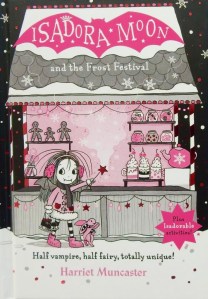
Isadora Moon and the Frost Festival Harriet Muncaster
Isadora Moon stars in – can you believe it – her 18th adventure and it starts on the morning of Midwinter’s Eve, a very special time for the entire Fairy Realm. With an invitation from her Aunt Crystal and Uncle Wren to stay in the Winter Fairy Realm, Isadora is super-excited. Having dressed in her warmest clothes (and dressed her beloved Pink Rabbit) she’s ready to depart just in time for Uncle and Aunt to pick them up in their sleigh. Once at Aunt Crystal’s and Uncle Wren’s home, there’s just time to build a snowman before they fly off to the Frost Festival.
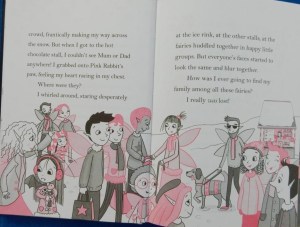
What a lot is going on when they arrive. Isadora meets a silver fairy who introduces herself as Estrella and tells Isadora that she’s lost the star that’s needed to go atop the ice rink fir tree at midnight.
Isadora offers to help her look but in all the excitement she loses her parents. The two now have another search to undertake. As midnight draws ever closer Pink Rabbit takes it upon himself to climb up the very fir tree that still lacks Estrella’s star. Will this turn out to be the magical night that all those attending the Frost Festival had hoped?
With its gentle humour and theme of kindness, this will enchant Isadora’s followers and likely be responsible for starting a fair few other children on the road to becoming independent readers. Best read with a mug of hot chocolate, perhaps made to the recipe given at the end of the book.
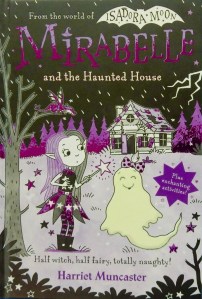
MIrabelle and the Haunted House Harriet Muncaster
One autumn morning Mirabelle’s Mum urgently needs dragongrass flower petals to make some special eyeshadow and it’s finally agreed that the family should combine going on a picnic with hunting for the dragongrass flowers Mum requires. Off they all fly and having found the perfect picnic spot, Mum and Dad lie back and fall fast asleep. Almost immediately Mirabelle and her brother, Wilbur, fall out and the two part company.
Before long Mirabelle discovers a single dragongrass flower but just as she’s going to pick it, Wilbur reappears and stamps on the plant rendering it useless for potion making, claiming it was an accident. Then Mirabelle’s dragon, Violet, flies off frightened by a sudden thunderstorm and when she follows him, Mirabelle finds herself in a clearing outside a tumbledown house. Shortly after, Wilbur arrives and following another squabble the two enter the house. Further bickering ensues and eventually Mirabelle gets so irate she cries, “I wish you’d just disappear!” And Wilbur does.
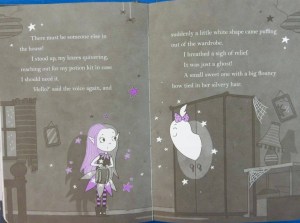
Can she discover what’s happened to him and find Violet? Perhaps, with some assistance from a friendly ghost, named Luna.
What about that dragongrass flower: can Luna help with that too?
Young readers, especially Mirabelle’s countless human friends, will delight in this the ninth adventure starring the little half fairy, half witch. They’ll also enjoy trying some of the activities after this story.
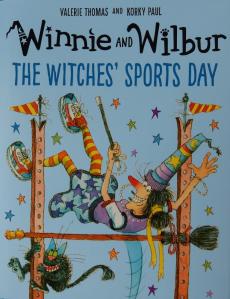
Winnie and Wilbur: The Witches’ Sports Day Valerie Thomas and Korky Paul Oxford Children’s Books
Excitement is building at the prospect of a sports day for both witches and cats; Winnie has her eye on first prize for the main event, a broomstick obstacle race for witches and their moggies. To that end, she undertakes some serious training on the practice course she magics in her garden and is pretty confident about getting that all important prize.
Come sports day, there are ten contestants in the broomstick obstacle race which was to be a timed event with one witch at a time doing the course. Should any cat or witch fall off, the pair would be eliminated. This happens to two of the partnerships but who will be the fastest? Will it be the previous year’s winners Maryam and her moggie Malik or, Winnie and Wilbur?
As the riders await the announcement of the results, a strong gust of wind whips the paper bearing the times far away.
Feelings are mixed regarding the impossibility of declaring a winner, most contestants being satisfied with having thoroughly enjoyed participating and sports day ends with a delicious lunch for all. Now that’s an important notion for young humans to take on board and a great subject for discussion – winning isn’t everything.
As always Korky Paul’s illustrations are rich in delicious witchy detail and the sight of the witches in their sporting attire will take a lot of beating. My favourite Winnie and Wilbur story in a while.
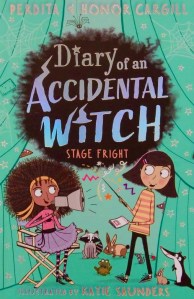
Diary of an Accidental Witch: Stage Fright Perdita & Honor Cargill, illustrated by Katie Saunders Little Tiger
Eleven year old Bea Black, resident of Little Spellshire returns for a fifth sharing of her journal.
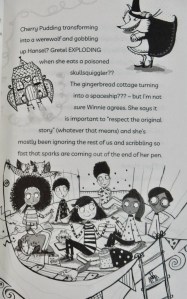
Her Dad is now totally smitten with Taffy so home life is somewhat different. Excitement is high in Bea’s class at the School of Extraordinary Arts when Teacher Madam Binx, an ex actor – famous so she says – announces that the pupils are to put on a play and they have just a few weeks to prepare. The decision is that they’ll perform a very special version of Hansel and Gretel in front of the entire school, adapted and directed by Winnie.
After what seems like an age Winnie has finally finished writing the play and then come auditions for the various roles and every single member of Bea’s class wants to try out for a part. However acting is only one element of a performance; there is also the matter of a song and dance coordinator, stunt coordinator and assistant and a set designer. With all these tasks duly assigned and the cast chosen, it’s a case of work, work and more work. Some pupils will have to hone their ‘behaving like animals’ skills and Bea’s Dad is chuffed to be asked to make all the costumes.
How much spell making of the transformation kind is going to be involved in all of this? And with anywhere inside the school out of bounds following an unfortunate incident, whereabouts will this dramatic enterprise actually take place?
With Bea’s ever more endearingly earnest writing style and Katie Saunders’ even funnier illustrations, this is sheer delight from start to finish.
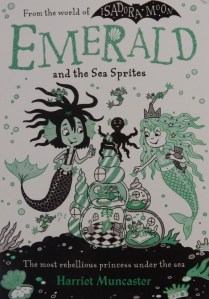
Emerald and the Sea Sprites Harriet Muncaster Oxford Children’s Books
Emerald, a princess since her mum’s recent marriage to King Auster, is now spending half her time living in the palace and the other at her dad’s house on the other side of Scallop City.
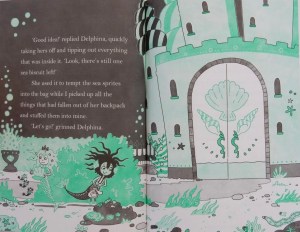
As this second story starts, she’s reading quietly when suddenly into the room bursts her stepsister, Delphina, wanting to play. It’s not long before Delphina has persuaded Emerald to go with her on an adventure to search for sea sprites, something that means sneaking out of the palace which is strictly against the rules. None the less, with backpack stuffed with the necessities for their mission, Emerald swims out of the palace, meets up with her stepsister and off they go into the deep open sea to a coral reef where they pause for a snack. It quickly becomes evident that sea sprites are just as fond of sea biscuits as the little mermaids.
After a playful encounter, Emerald realises it’s time to head back but the sea sprites start to follow them.
Eventually, back in the palace, the little visitors settle into Emerald’s doll’s house where they spend the remainder of the evening all playing together.
However, the following morning, the sea sprites look decidedly sickly and the little mermaids realise it was wrong to take them from their habitat. They must return them to the coral reef, but can they reach there in time to save the sprites? And if so, will they ever be able to see them again?
An enchanting story about letting creatures stay in their habitats, stepsisters bonding, and having the courage to do what’s right and kindness, that young solo readers, especially those who enjoy Harriet’s other series, will love plunging into. (I’d not read the Emerald and the Ocean Parade but it didn’t affect my enjoyment of this story.)
Little Chimpanzee Anna Brett, illustrated by Rebeca Pintos Little Whale Anna Brett, illustrated by Carmen Saldaña Words & Pictures
These are the latest additions to the Really Wild Families series of fun, informative interactive books for children and adults to share. Having introduced itself, Little Chimpanzee invites readers to spend a day exploring its African rainforest home and meeting the sociable family community comprising father, mother, older brother, aunts, uncles and cousins. The creature narrator explains how chimpanzees care for and groom each other and talks about the social structures and relationships in the group , including how they communicate with one another.There’s a spread about chimp conservation and another about the vital work of Jane Goodall and the chimps in Gombe Stream National Park. The narrative is followed by a quiz and a craft activity. A charming, effective way for young children to find out about our nearest relative, while gently reminding them of the importance of caring for creatures in the wild; vibrantly illustrated with gentle humour.
The Little Whale of the title introduces itself and the rest of its pod of humpback whales and readers join their annual journey from warm waters to search for the cold waters of the Antarctic Ocean where there’s plenty of food. On the way we learn about how the creatures move, their external features, breathing, breeding, diet and feeding,
possible predators and whale song. Following the story are the usual factual spread, a look at conservation, a craft activity, a quiz and we meet Migaloo, a albino humpback that lives off the Queensland coast of Australia. Carmen Saldana’s underwater illustrations are beautiful and really add to the book’s appeal.
Narrative works really well as a means of transmitting information to young children and these are additions to the Amazing Animal Tales series that also successfully use this approach along with straightforward facts found beneath the flaps.
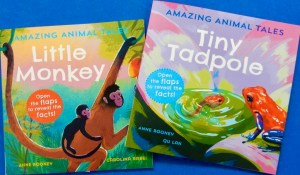
Little Monkey illustrated by Caroline Rabei Tiny Tadpole illustrated by Qu Lan both written by Anne Rooney Oxford Children’s Books
Little Monkey is a spider monkey and we first encounter him high in the rainforest treetops clinging round his mother’s tummy as she moves from branch to branch. Lifting the full-page flap reveals two pages of information and a simple question to further engage listeners. As the story continues there is information about feeding, what this entails.and how it changes as he becomes more independent, an independence that makes him want to go off exploring by himself.
Anne Rooney’s way of presenting the information is appealing and perfectly pitched for an Early Years audience, the special skill being the combination of the two styles, with Caroline Rabei’s delightful illustrations containing just the right amount of detail.
The Tiny Tadpole also lives in the rainforest but further south than the monkey family. Herein we follow the transformation from tadpoles hatching out of the protective jelly eggs and the growth and changes that ensue in their habits and in the care provided by the mother frog,
until the tiny black dot has become a froglet. This one is illustrated using a rich colour palette by Qu Lan and every picture is bursting with life.
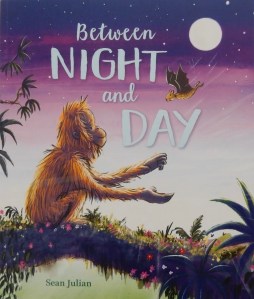
Between Night and Day Sean Julian Oxford Children’s Books
Pongo is an orangutan of the ‘safe-in-the-day’ kind. One day when picking a mango for breakfast, she comes upon Bulu a tiny bat – a ‘safe-at-night’ sort of bat. Narrowly missing becoming a passing eagle’s next meal as it swoops through the forest, Bulu tells his new friend of his dislike of the daytime. His fear is palpable as we see in Sean Julian’s illustration and Pongo senses the bat’s panic right away, deciding to take the tiny creature back home to his dark cave.
En route the orangutan shows her companion some of the things she loves about the forest but all the while Bulu is afraid.
Even more so when they stop for a drink at the pool and he’s confronted with a face staring out at him. His fear turns to pleasure however, and as the two proceed, both of them are enjoying themselves.
At Bulu’s dark cave, it’s Pongo that becomes fearful but he accepts his friend’s invitation to view his home. Now Pongo’s imagination runs wild and it’s Bulu’s turn to allay his companion’s fears
and continue inwards till they reach the bat’s favourite place.
Eventually it’s time for the two to part company but every sunset Pongo fondly recalls their meeting. Is there a way the friends can be together again?
Sean’s tale of friendship and seeing things from another’s viewpoint is beautifully illustrated with scenes that powerfully evoke its steamy tropical rainforest setting and the feelings of the two animals.
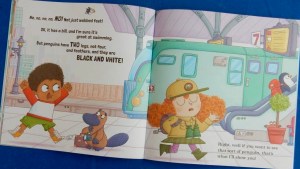
Wanna See A Penguin? Simon Philip and Ian Smith Oxford Children’s Books
A self-declared penguin expert and friend search the city for penguins; they see all kinds of black and white creatures striped ones, furry ones,
animals with fins, horned ones, ones with hooves, four-legged animals and others but none of the eight fit all the penguin criteria. Is there actually a penguin anywhere around?
Yes indeed and that is what makes this book such fun. Hiding in plain sight in every scene is the animal the friends seek. Young listeners will love searching the pages to find its whereabouts as well as guessing the identity of the partially shown animal on each spread and laughing at the misidentifications of the so called penguin pundit.
The author’s manner of telling is gently humorous – the ending a hoot – and Ian Smith’s delightfully droll illustrations include lots of amusing details. There’s a fact file after the story presenting a paragraph each on the zebra, puffin, duck-billed platypus, monkey, orca, goat and dog that appear in the story.,
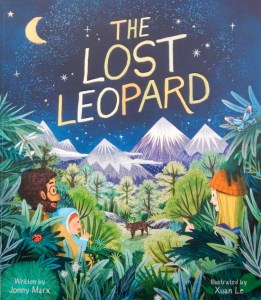
The Lost Leopard Jonny Marx and Xuan Le Little Tiger
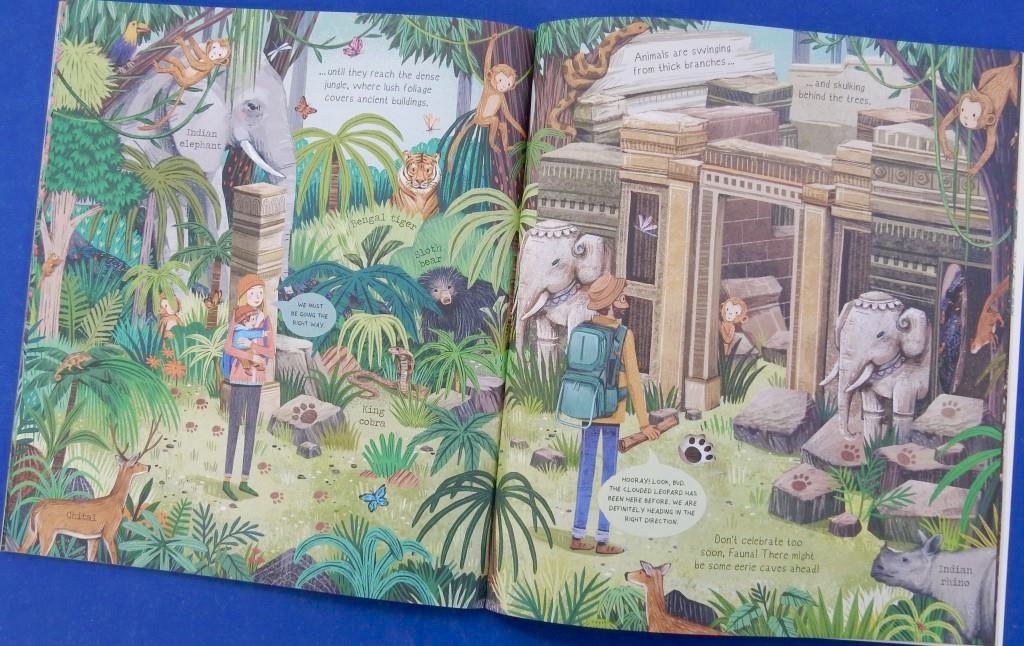
We join Flora and Fauna (dubbed the ‘world’s greatest explorers) and their baby, Bud, on their search for the elusive clouded leopard.
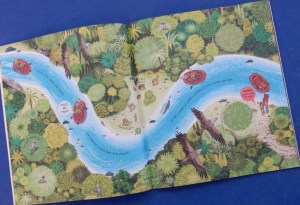
Their journey takes them to various habitats along a river,
over foothills and up the Himalayan mountains, through forests and jungles and a rainforest; even down into caves. Needless to say there’s an awful lot of mud and not everywhere is accessible by road so their quest involves a lot of walking; walking through rain and snow, strong swirly winds and scorching heat until they finally arrive at a tropical forest location.
During their travels they encounter a wealth of amazing wildlife including yaks, langur monkeys, Bengal tigers,Indian elephants,
a King cobra, all labelled. Truly an epic journey but do they find what they have been searching for? Baby Bud has certainly learned a lot and so will youngsters who explore this exciting book.
Xuan Le’s vibrant detailed illustrations, which include lift the flap sections, cutaway pages, die cut surprises and a gate fold, extend Jonny Marx’s engaging, informative text making this a book that is probably best shared with an individual child or small group as there is so much to explore on every spread. Individual, more confident young solo readers will also love embarking on the adventure with Flora, Fauna and little Bud.
Brimming over with wit and humour is this story of young friends Grape and Mushroom. These two have a problem though. Since way, way back in time and for reasons completely forgotten the Vegetables and the Fruits have been bitterly at odds, hurling insults at each other and attempting to put paid to the friendship between Grape and Mushroom.
Now things have escalated so much that the two young ones hide themselves away during the fighting to discuss what, if anything can be done about this constant warfare.
They decide to ask the advice of the Wise Old Cheese – if such a being even exists – said to live, if the legend is correct, on the Top Shelf of the fridge. This entails scaling the heights on a perilous journey through blizzards and quicksands, each encouraging the other through the worst parts. (Beware of the puns). Finally, utterly exhausted Grape and Mushroom reach the object of their search.
Wise Old Cheese, exceedingly old, stinky and a tad mouldy, is fast asleep on that Top Shelf. Having explained their plight, the wedge promises through its moustache to think about the problem, but then promptly falls fast asleep once more. Very disappointed, the friends return, find the Fruits and Vegetables still battling and are about to part company when they become aware of a ‘mysterious milky light’ accompanied by ‘a familiar pungent pong’.
All squabbling ceases as there before them is the wise Old Cheese. The mouldy wedge announces the purpose of his visit and draws their attention to Mushroom and Grape, wonderful examples of cooperation united in a single purpose.
And so it is that the two factions, impressed at what they’ve heard, decide they have rather a lot in common and resolve to try peaceable living.
With a plenitude of wordplay, speech bubbles, splendidly expressive garden produce and instantly recognisable kitchen equipment, this is a delicious story demonstrating the all-conquering power of friendship and the importance of focussing on similarities not differences.
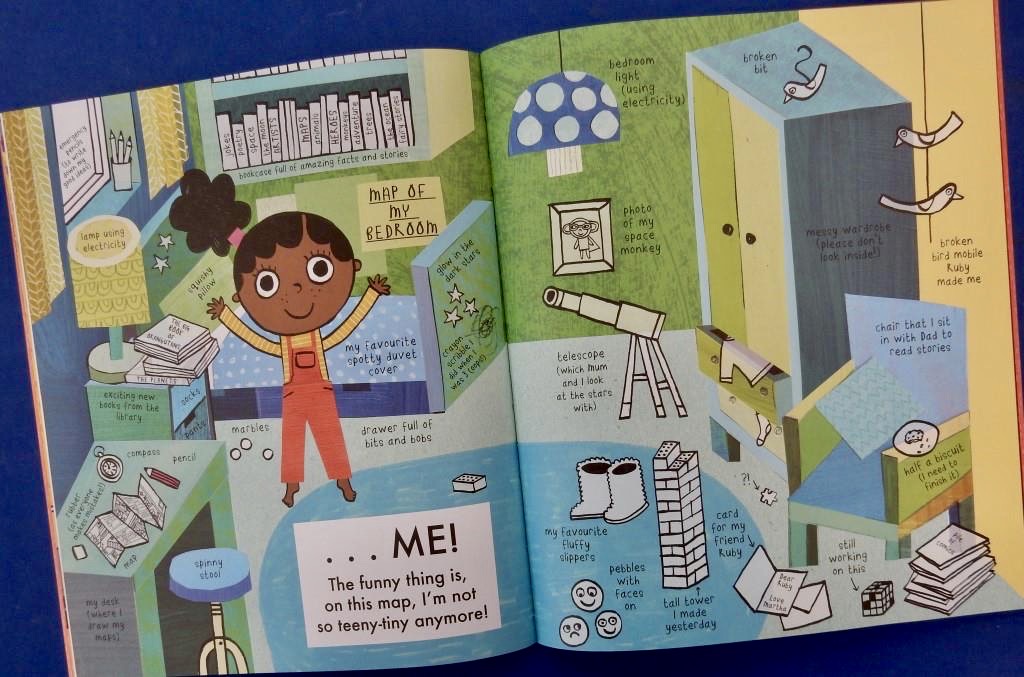
Martha Maps It Out Leigh Hodgkinson Oxford Children’s Books
Young Martha might be small but her thoughts are anything but: her mind full of BIG things. She absolutely loves drawing maps, creating them out of almost everything from the universe to her bedroom in the top floor flat in which she and her family live; she even makes maps of her thoughts, her questions and her dreams.
Through Martha’s cartographic creations readers share with the girl her entire world as she guides us through the pages and beginning in deepest space, we zoom inwards page by page to planet Earth with its awesome flora and fauna, her city, her street and community, her block of flats, her own home and her room.
From there we travel outwards once more through the thoughts, questions and those BIG dreams of a future where absolutely anything is possible: a life of discoveries … excitement,
adventure, wonder, not forgetting of course, love.
Leigh Hodgkinson is brilliant at presenting quirky details in her visuals and this book of Martha’s maps is absolutely alive with them. To these are added a wealth of labels that children will love to explore as they, one hopes, like Martha will share that sense of optimism and excitement about what the future might hold. Bursting with classroom (and home) potential, this splendidly upbeat, and unusual picture book is one to return to over and over wherever you are.



















 Red Reading Hub - Jillrbennett's Reviews of Children's Books