Is It Asleep?

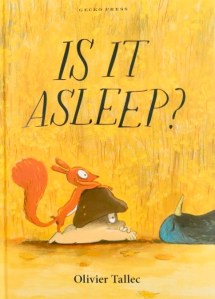
If you’ve read Tallec’s A Better Best Friend, you will already be familiar with best friends Squirrel (the narrator) and talking mushroom Pock. One of the things they love to do is to sit and watch the birds flashing past but on this particular day. having grown tired of so doing, they’ve moved on to the meadow to listen to their favourite bird, the blackbird. However, after searching carefully, eventually they spot it lying motionless on the path; perhaps it’s deeply asleep. After waiting quietly for some time for it to wake up. they decide to try being noisy but this has no effect so they fetch Gunther the mouse. Gunther’s idea of launching the bird into the sky doesn’t work and that’s when Pock suggests that perhaps it’s dead.
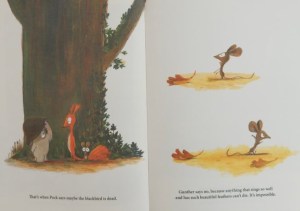
After another long wait they all decide that indeed the blackbird has in fact, died.
Working together the three bury it under a large pile of the prettiest leaves they can find
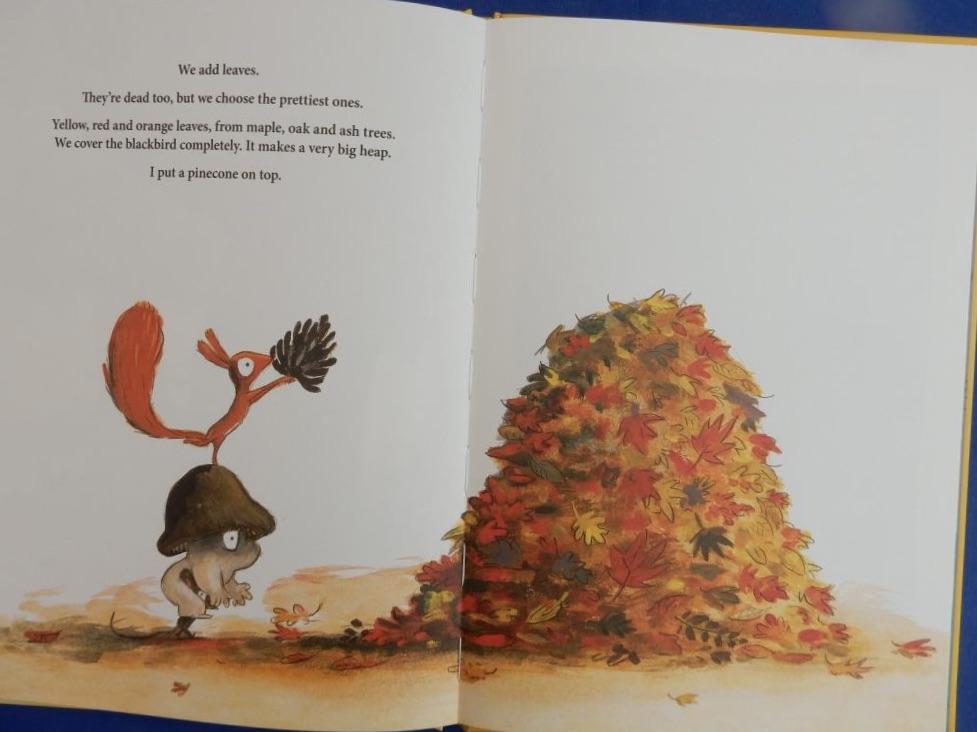
and once this is complete Gunther reads a poem, after which they stand and Squirrel thinks about the beautiful songs the blackbird sang. Having thought about ways to remember the bird, they pay it tribute in the very best way possible and finally a different bird pours forth its beautiful song.

A poignant story that explores death simply and frankly and in so doing, offers possible starting points for adults in school or at home to discuss with young children what can be a very difficult topic. That the book’s creator has given the story an autumnal setting is especially appropriate: the warm red and gold hues of the scenes subtly convey sadness and the sense of an ending.
A Better Best Friend

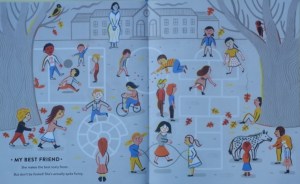
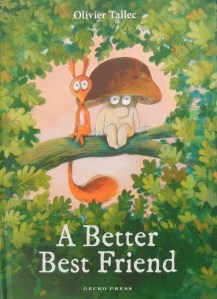
A red squirrel is thrilled to find a best friend while out for a walk in the woods one morning; it’s a mushroom named Pock and has a ‘real best friend face’. Despite not saying much, said mushroom seems willing to comply with the squirrel narrator’s desire to show him “things you wouldn’t show anyone except a best friend” : things such as puddles reflecting the sunlight and clearings with tall grass. Autumn and winter pass and the two stay close to one another doing seasonal things, but with the spring comes Moo.

Moo is a fly, a fly that knows some even better parts of the forest and now the three spend their time together, with Squirrel wondering whether perhaps Moo is a better best friend than Pock.
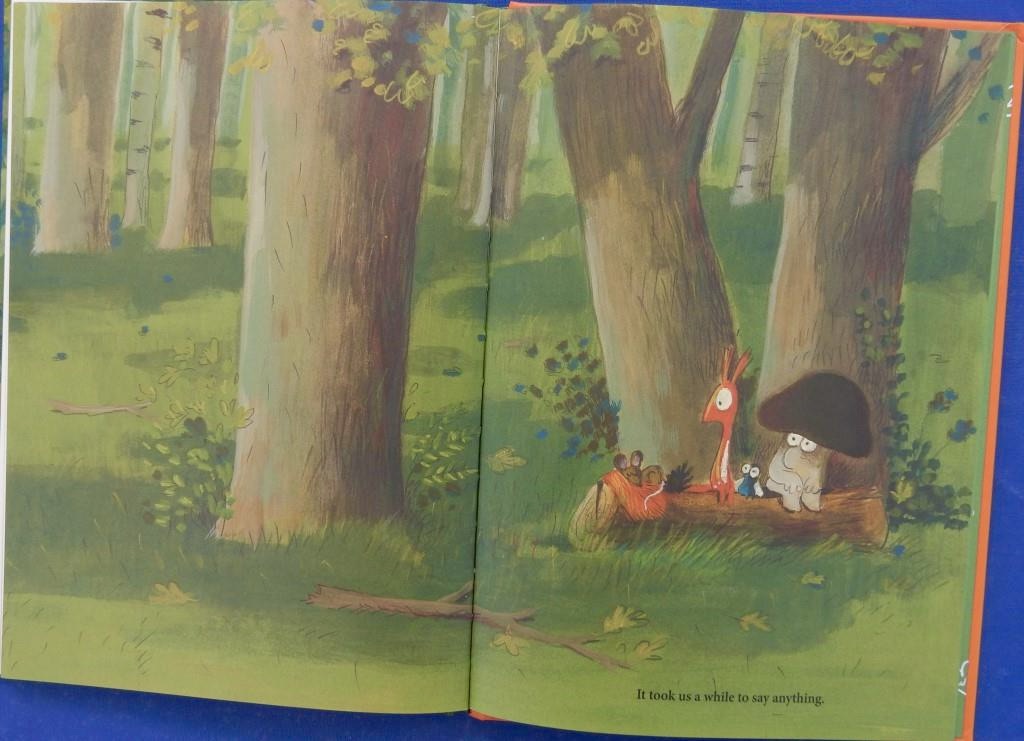
Now Squirrel has a dilemma. ‘I want ONE best friend. Not two!’ he declares. Then one morning along with the sun, Gunther (a mouse) appears. Again it’s a while before much is said.

I’m pretty sure a lot of thinking is going on though, especially by Squirrel before the declaration of ‘The (Better) End’ – I wonder: what do you think? It certainly works for playing cards as the final page shows but for a bestie? Hmm.

Translated from the French by Anthony Shugaar, Tallec’s playful, slightly surreal quirkiness, is evident in his scenes of the characters in this tale which is likely to leave many readers, including this reviewer pondering upon its open-ended nature – or perhaps that’s the creator’s intention.

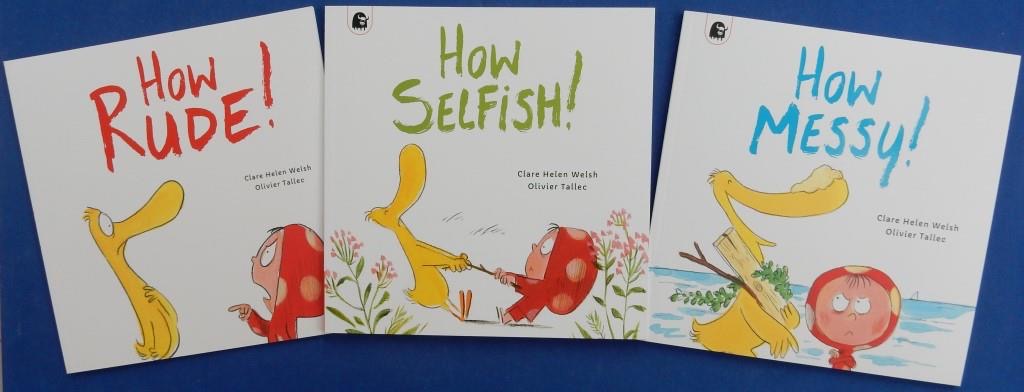
How Rude! / How Selfish! / How Messy!

How Rude!
How Selfish
How Messy!

Clare Helen Welsh and Olivier Tallec
Happy Yak

How superb! are both Clare’s words and Olivier Tallec’s pictures for the books in this series, each being told mainly through Dot and Duck’s dialogue.
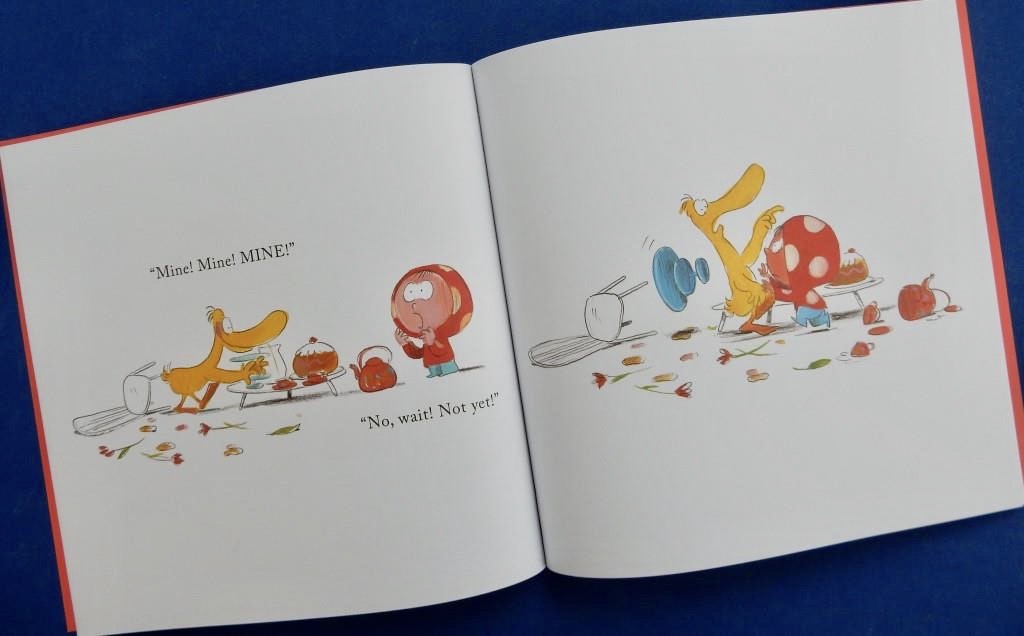
In How Rude! Duck arrives at Dot’s for a tea party. From the start his thoughtless behaviour sabotages Dot’s every effort as he complains about the food and the drink, while Dot does her upmost to keep calm: one can see her frustration mount as her cheeks grow redder and redder until she decides to retaliate.

However, after apologies from both sides, all ends happily with smiles and evidence of an important lesson learned.

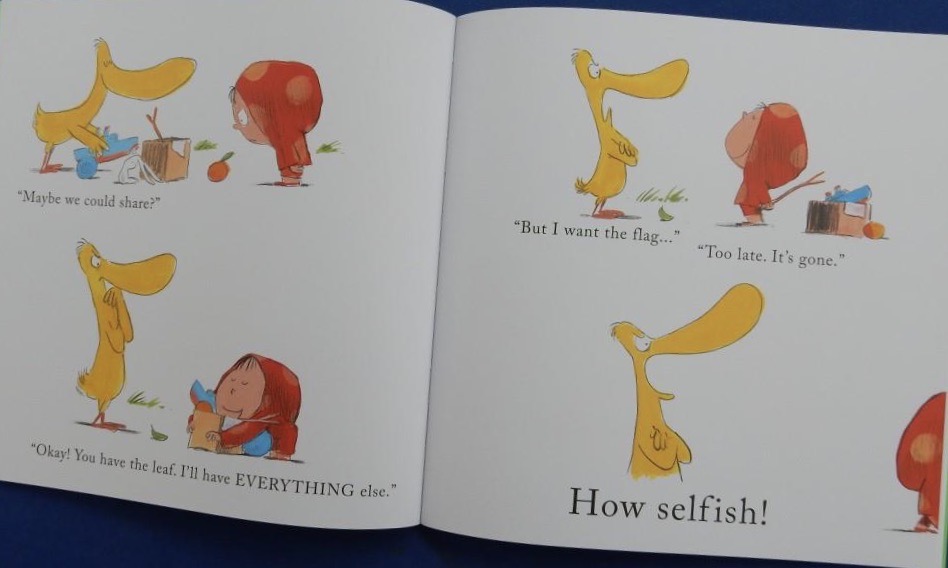
Another vital life-lesson for young children is brilliantly delivered in How Selfish! and now it’s Dot who starts off behaving in a problematic manner. First she destroys the flowers Duck is holding. Then claiming it’s her sword, she snatches the stick Duck has found, hopefully for a flag,. A squabble ensues with yellings of “Flag” and “Sword” and grabbings of said stick. Duck then tries a spot of negotiating: “Swap the flag for a rabbit?” to which Dot responds “That’s MY toy!”
Duck then suggests sharing: but clearly Dot’s notion of sharing doesn’t quite fit Duck’s bill.

Is there a way out of this stand-off? Yes there is, for Duck now delivers the most devastatingly powerful of childhood intentions, “I’m telling on you …”
There’s a rapid acquiescence from Dot that means Duck then has all the toys. Dot though has the stick/ flag but that’s not quite the end of this selfish, crazy contretemps. There are grumps on both sides and pretty soon, boredom. A compromise perhaps? … Definitely one to provoke in depth discussion this.

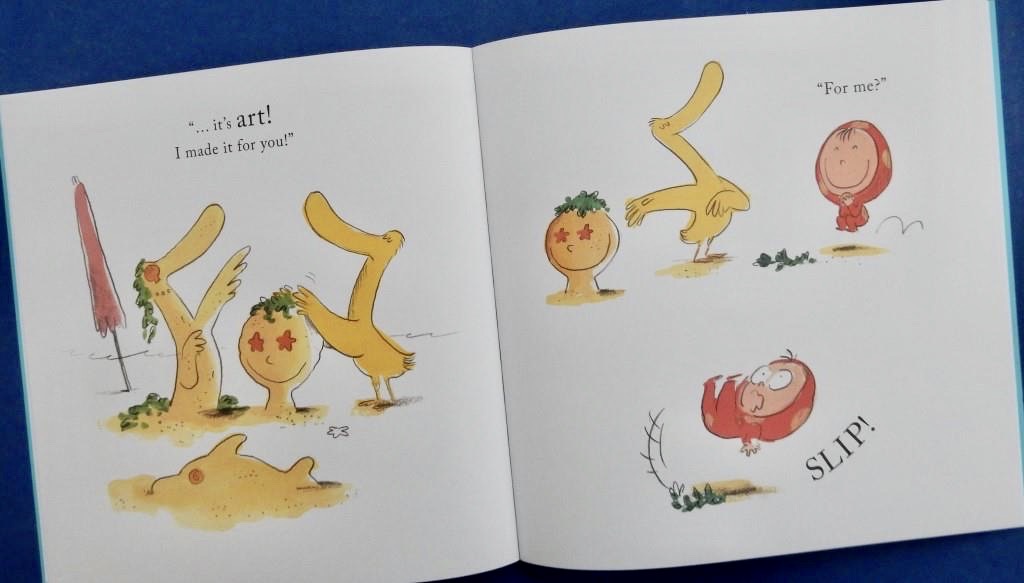
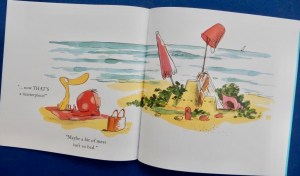
What to do when one person’s messiness is another person’s creativity: that dilemma is at the heart of How Messy! Now Duck and Dot are at the seaside and after a pancake breakfast, sally forth onto the beach to play. While Dot is carefully crafting, placing each item with the utmost precision, Duck gathers flotsam and jetsam and proceeds to make an octopus, which he proudly shows Dot. Totally unimpressed, she tells Duck he’s messy.

“ … It’s not mess …it’s art! I made it for you!” he tells her about his next piece of work and this looks as though it might just win Dot over until …

Now things are indeed pretty messy. Time for a think … followed by a clever piece of collaborative work.

But the best laid creations of Dot and Duck cannot compete with the forces of nature. Could a dip save the day for them both …

Vive la difference! say I.

With oodles of empathy and delightful humour, these books are pitch perfect for foundation stage settings, nurseries and families with young siblings. They’re absolutely certain to result in giggles aplenty and reflections on best how to treat other people.

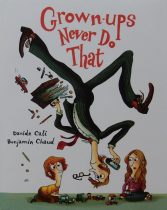
Grown-ups Never Do That / What’s Going On Here?

Grown-ups Never Do That
Davide Cali and Benjamin Chaud
Chronicle Books

‘Adults never misbehave.’ So says the opening line of well-known collaborators Cali and Chaud’s latest offering.
But there’s a team of young sleuths at work who might just disprove the veracity of that statement and we then accompany them through the book.

Of course, they’re absolute paragons of virtue these mature people. So much so that following Cali’s tongue-in-cheek ‘Adults are always good’ on the penultimate spread he concludes with the sound advice, ‘So you really should be just like them.’

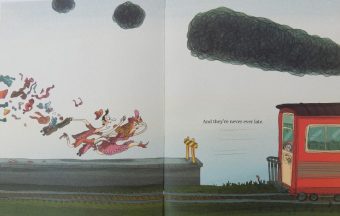
However those youngsters who have been spying on the yelling, bad temperedness, cheating, sulking, messiness, lateness,

bad manners, time wasting and the other grown-up behaviours they’ve witnessed, may well think otherwise.

The brevity of Cali’s ironic narrative is countered by Chaud’s detailed comical visuals

making for a diverting book that will please readers young and not so young.

What’s Going On Here?
Olivier Tallec
Chronicle Books

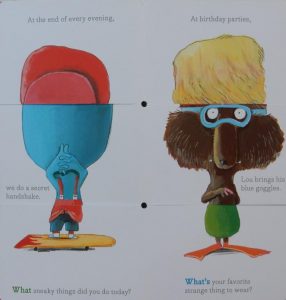
This is a mix-and-match book wherein Tallec, in his typical skittish manner, invites readers to engage in storying with a weird and wonderful cast of characters – animal and a couple of human ones – all of which are sporting rather ridiculous headwear.
You can smile at the attire of each, as you read the related plot piece and ponder the question posed before flipping to and fro to try the plethora of possible permutations that the split pages offer.

I’ve used similarly designed books (three-way split pages) with under-confident readers of all ages needing a morale boost, and I’d do the same with this somewhat more sophisticated one.

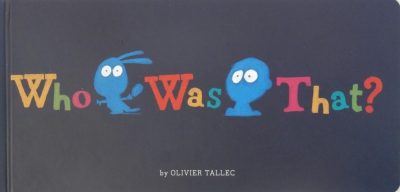
Who Was That?

Who Was That?
Olivier Tallec
Chronicle Books

That Olivier Tallec is a genius in seemingly effortless characterisation was evident in Who Done It? and Who What Where? Now he follows with another equally wonderful memory and observation testing offering, this time making clever use of occasional die-cut holes in the long, narrow pages.

If you ever thought looking and seeing were one and the same, think again.

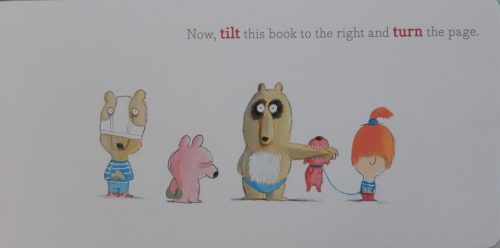
We begin with a spread that introduces a mix of animal and human characters with a child inviting readers to ‘Blow out the candle and turn the page.’
Having plunged them into darkness we’re then asked ‘Who is wearing a yellow scarf?’

The answer to the question ‘What is Olive afraid of?’ on the next spread, is revealed by turning the die-cut page, but then another tester greets us concerning the colour of Oliver’s undies.

The questions are totally unpredictable as for example when we’re instructed to cover a character standing on a diving board and then asked how many teeth he has.

Sometimes there’s a tricky double poser as when the first question asks ‘Which of these friends likes sleeping on both ends of the bed? You think ‘no problem’ but when you turn over you’re faced with ‘But who wasn’t wearing pyjamas?’ Hmm.
The illustrative details are enormous fun in themselves, take this line up here: every one of the characters must surely have a myriad of stories to tell …

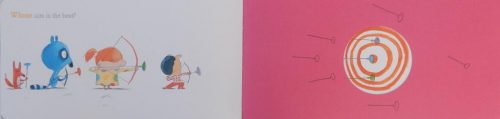
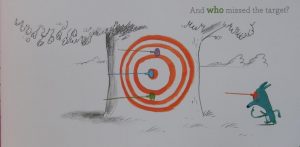
The final scenario is a knockout – literally –it’s as well the archers are using sucker-tipped arrows …

as we discover when the die-cut page is flipped to reveal …

Enormous fun and if you can’t solve the posers, there’s a final visual answer page.

I envisage children inventing their own tricky questions once they’ve solved the posers herein; the potential is huge. Some slightly older readers might even try making their own books along similar lines.

I’ve signed the charter  

Identity Puzzles: My Wild Family/Who Done it?

DSCN5867 (800x600)

My Wild Family
Laurent Moreau
Chronicle Books
On outsized pages, through a first person narrative, readers are introduced to all manner of family members and finally, as she calls herself, the ‘unique’ female narrator.
I have a very special family” we are told on the opening spread and assuredly that is true for the girl then goes on to show each family member as a wild animal. Her older brother is ‘strong and respected’; her younger brother in contrast is ‘flighty and a dreamer, his head often in the clouds.’ Unsurprisingly he’s also an excellent singer.

DSCN5868 (800x600)

Sweet and generous’ her grandmother likes to stay at home whereas her aunt ‘always perfectly primped, never leaves the house without looking her best.’

DSCN5869 (800x600)

The animals themselves are never named; you have to look carefully at the respective scenes – a classroom, busy street, sandy beach, a shopping centre for instance, to discover which one each person is portrayed as.
Friends too get the ‘treatment’: her best female friend ‘makes the best scary faces’

DSCN5871 (800x600)

and, to outrun her record-breaking runner, best male pal, would be well nigh impossible – unless that is, you were another member of the same species.
Audiences will delight in hearing the narrator’s family story and if mine are anything to go by, will be inspired to think about themselves, their own personality traits and those of their families in animal terms. (A lead into the Phillip Pullman daemon idea perhaps.)
Below are two from children I know…

Gracie thought about her younger brother thus

and …

IMG_0283

James’ brother is often very amusing …

The retro-modern illustrations have just the right amount of detail and I particularly like the judicious use of red outlines that give an added dimension to the scenes. For sheer energy, my favourite has to be that ‘Cousins’ ‘scene

DSCN5870 (800x600)

and here the text does actually spill the beans as to the animal identity.
The whole thing is imaginative, funny and splendidly thought- and talk-provoking.

DSCN5797 (800x600)

Who Done It?
Olivier Tallec
Chronicle Books
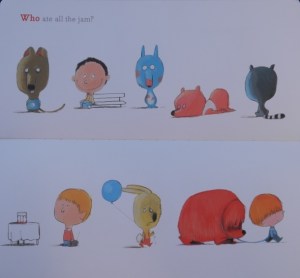
The title question is not one of the twelve posed to young children as they work their way through this unusual shaped book. With his minimalist, not quite static art work, Tallec proffers, all manner of amusing scenarios, interrogating a delightful line-up of characters – human and animal – with such as Who forgot a swimsuit? , Who ate all the jam?


DSCN5834 (800x600)

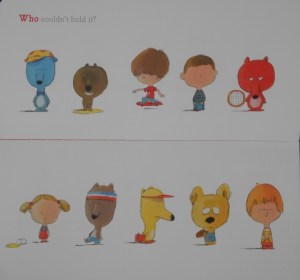
And, the funniest and favourite with my testers, ‘Who couldn’t hold it? ‘ has a delicious degree of ambiguity but that’s half the fun of the whole thing.

DSCN5800 (800x600)

The same is true of the jam spread. Number one suspect is the jam-spattered fox; but equally the dark haired boy has an enormous grin across his face and the rabbit looks decidedly as if he could throw up at any moment. For those who require certainties, the final page supplies all the ‘correct’ answers.
The allure of this one is great and the promise holds good throughout. Every delightful double spread sets the scene for the development of talk and imaginative storying, culminating in what is probably the most tricky poser of all to decide: Who is in disguise?

DSCN5833 (800x600)

The book’s probably best shared with small groups or individually; and in addition, the predictable nature of the text makes this a good bet for beginning readers.

Use your local bookshop            localbookshops_NameImage-2