Evolution

Botanist Sarah Darwin, the great, great granddaughter of Charles Darwin and paleobotanist Eva-Marie Sadowski, in association with The Natural History Museum, London, take readers on an enthralling journey through Earth’s history going right back to its formation around 4.5 billion years ago. This journey is aided by a timeline of the geological eras that stretches (along the bottom of some of the pages of the book) through time until the present.

Guided by the authors and the superb, detailed illustrations, we meet a number of pioneering people – adventurers and thinkers, some of whom in turn influenced the thinking of Darwin and Wallace, people who made vital discoveries about the world around them and shared their theories on topics such as natural selection, the movement of land masses, variation and the changing climate.

Illustrations of some of the flora and fauna which were to be found during each relevant era are included.

A ‘Human-Made’ spread introduces Ugur Sahin and Oziem Tureci who invented one the the first COVID-19 vaccinations and draws attention to the human-made climate crisis. This leads neatly to a reflective spread on the future where we meet several current pioneers who are working to help save the natural world and guide us all towards a more sustainable future.

The book ends with a tree of life, a world map showing almost all the species mentioned, as well as a glossary and index. A fascinating, beautifully presented book for KS2 readers and beyond.

A World Full of Winter Stories

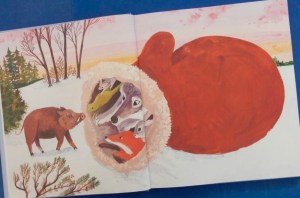
This is a veritable cornucopia of folk tales, myths and legends – fifty in all – gathered from around the world and retold by Angela McAllister. There are six sections: Birds and Beasts, Tricks and Troubles, Ice and Snow, Quests and Journeys, Spirits and Magic and the shortest, Christmas. Each contains stories I was familiar with, but also several new to me. One such was the very first, a tale from Japan telling how snowballs made by the children of the Sky Goddess become the ‘The First Rabbits’. Also new to me, from the same section is an amusing Ukrainian story about a dropped mitten that, unbeknown to its boy owner, becomes a temporary shelter for seven animals.

From the Tricks and Troubles section, a story from Kazakhstan that made me smile was The Marvellous Coat wherein a crafty man tricks another into exchanging coats, ending up with a thick warm coat plus a fine horse, instead of his original holey coat and worn out steed.

Bears feature quite often in wintry tales and this book is no exception. The Long Winter. a Dene story from Canada, in the Ice and Snow section tells how a group of animals struggling from the constant winter climb up into the sky to search for the world’s warmth. There they discover some bear cubs from whom they learn of the whereabouts of that which they seek, although reclaiming it from the mother Bear and restoring sunshine is anything but an easy task.

If you’ve ever wondered why some trees and bushes never lose their leaves, The First Evergreens, a Mongolian tale in section four, offers an explanation that involves a good-hearted swallow.
There’s an Inuit story in Spirits and Magic that took my fancy. It tells how a stolen wife was reunited with her husband, a village chief thanks to an old woman, a special charm and some magic words remembered just in the nick of time.

You might be surprised to learn that a scarecrow features in the final section, in a story from North America, a scarecrow that ends up helping Santa.

This book is a joy to share with children at home or in the classroom during the winter months. The tales are just the right length for a story time session and Olga Baumert’s illustrations, be they large or small, bring an extra touch of magic to each one.

A Dinosaur A Day

A Dinosaur A Day
Miranda Smith, illustrated by Jenny Wren, Juan Calle, Xuan Le, Max Rambaldi and Olga Baumert
Red Shed

Imagine being able to encounter a different dinosaur, or other prehistoric animal, every day for a whole year. That’s what you can do if you plunge into this prehistoric extravaganza. Herein, after a general introductory spread, you will meet all your favourites such as the fearsome Tyrannosaurus, the club-tailed Ankylosaurus and the plant-eating Triceratops and Diplodocus. You’ll also encounter a great many unfamiliar creatures, some of which have only recently been discovered: I have to admit the majority were new names to me.

One such is Aquilops, one of the beaked dinosaurs. It was a herbivore about the size of a cat with a skull smaller than the hand of a human. Another small herbivore was the Nqwebasaurus (found in what is now Southern Africa) Amazingly so we read, ‘fossils have been found with gastroliths in the stomach – stones it swallowed to help grind up tough plant food,’

As well as dividing the contents by months, the author also uses dinosaur groups – examples are: ‘some of the smallest’, ‘duck-billed dinosaurs’, ‘horn-faced dinosaurs’ and ‘largest of them all’. Surprising to me was that all those included here were herbivorous. One such Antarctosaurus never chewed its food, rather it swallowed plants whole.

Key facts for each dinosaur featured include the period it lived, the family it belonged to, diet, length, weight anywhere remains have been found; and there is also a brief paragraph giving key information ; and helpfully, the backmatter includes a pronunciation guide.

If you have a dinosaur fanatic or a budding palaeontologist in your family then you should definitely get a copy of this book. It’s also one to add to school collections: I envisage it being in much demand especially with KS2 readers.