How the Sea Came to Be

How the Sea Came to Be
Jennifer Berne and Amanda Hall
Eerdmans Books for Young Readers

Jennifer Berne divides her rich poetic account into three parts: The Birth of the Sea, The Birth of Life and All That the Sea Came To Be, covering geology, oceanography, biology and evolution over 4.5 billion years – an enthralling journey indeed, especially when set alongside Amanda Hall’s show-stopping mixed media illustrations. The layout of every spread is a joy to explore.

The verbal imagery grips from the outset: ‘Volcanoes exploded from inside the Earth. / They blazed and they blasted and boomed. / And comets and asteroids crashed out of the sky, icy and rocky they zoomed.’

Having presented nature’s violence in storms and volcanic eruptions, the author and artist present the emergence of microscopic life forms – ‘smaller than small, and adrift in the seas,’ that gradually combined and changed into new 
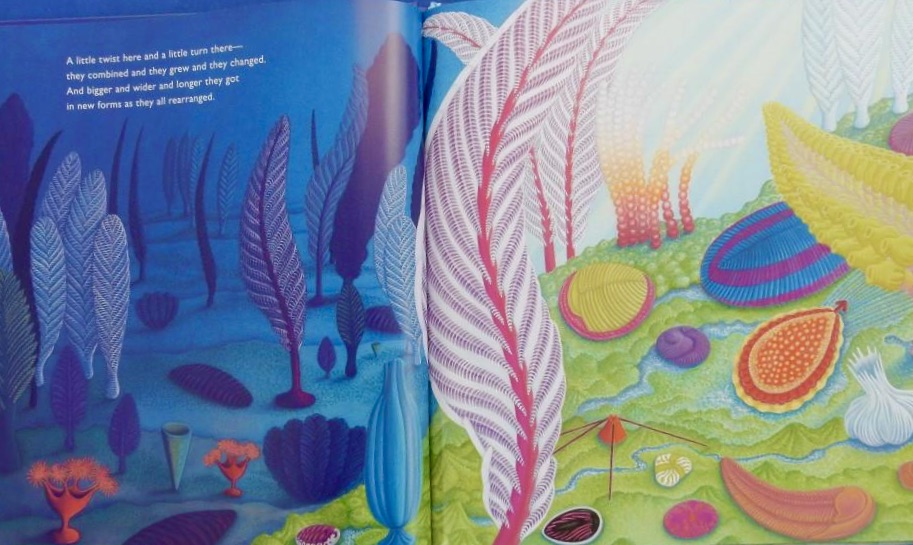
and larger forms: ‘frilled creatures that wiggled and crawled’ as well as drifting, squishing jellyfish with their thread-like tentacles and then came the worm – a creature that ‘points as it squirms’.

Eventually we reach the multi-layered aquatic zones of the present time 

and then slowly return to the surface encountering a wealth of amazing marine flora and fauna to land at last on the shores of now, where people are exploring the rock pools.

Scientifically accurate throughout and written in almost faultless rhyme, there are no labels but it’s not difficult to locate the creatures named if you look carefully. Moreover, those who want to dive deeper can use the additional resources at the end of the book.

Totally immersive and with a wide appeal, this is a book for any collection.
Interview with a Shark

Interview with a Shark
Andy Seed and Nick East
Welbeck Publishing

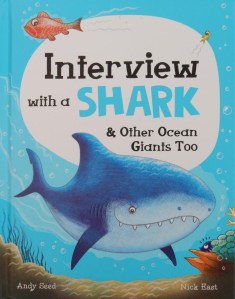
For those who like their information delivered with a degree of quirkiness then the results of Andy Seed’s latest expedition with his ‘tranimalator’ machine will definitely appeal.

In this book he dons his wet suit and dives into the ocean where, feeling more than a tiny bit nervous he faces his first interviewee, a massive bull shark. Like the author, this subject (and the others) seem to have a great sense of humour as they respond to his questions (just the sort of things a child might ask), with more than the occasional leg pull. The answers though are informative too, revealing such things as what they eat, what might eat them, where they live, (I wasn’t aware that bull sharks sometimes live in rivers as well as salty sea water.)

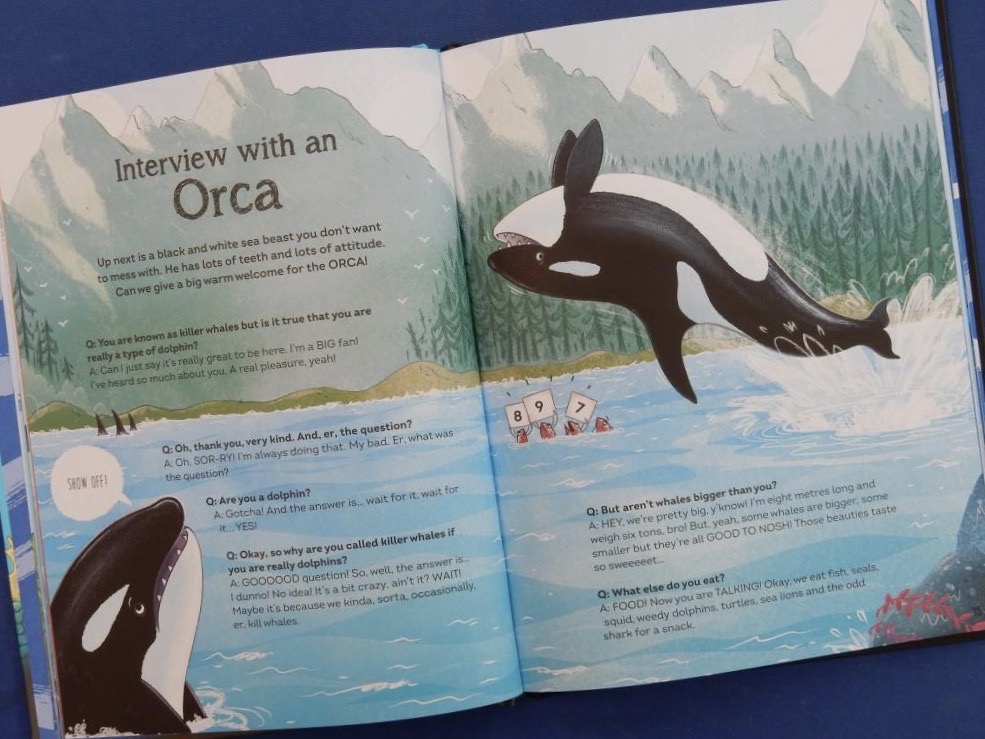
Andy has close encounters with nine marine giants – an awesome blue whale (the kind of whale with no teeth and the world’s biggest poos); a very toothy orca – actually a type of dolphin, 

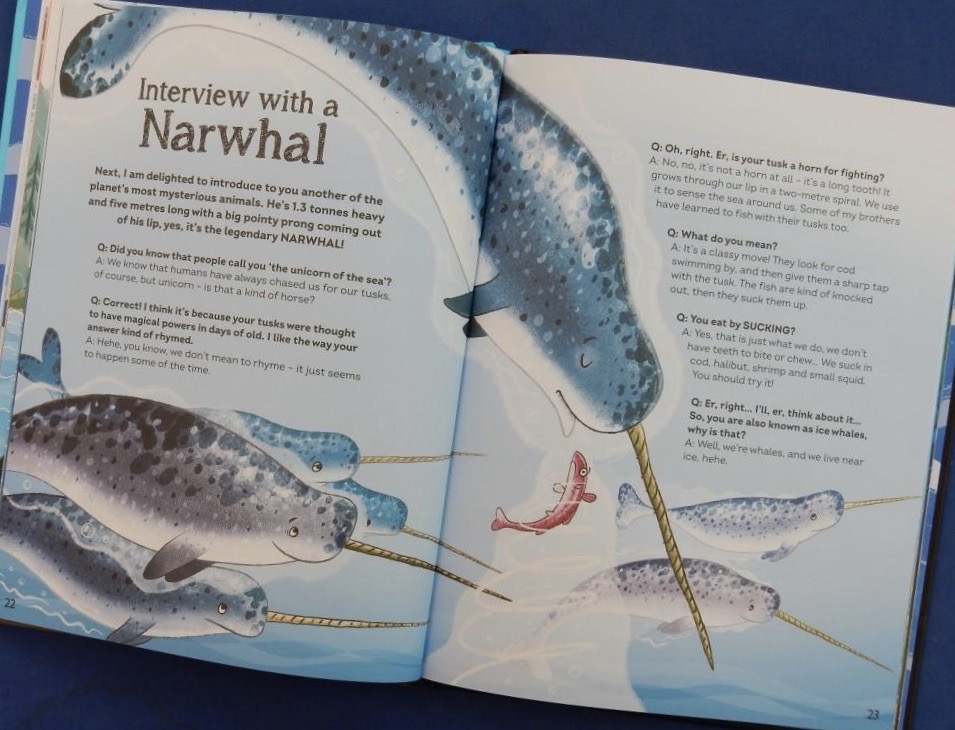
a giant squid, a narwhal (of the stamp collecting, yoga practising variety – told you they have a sense of humour); 

a manta ray – most unhappy about the rubbish we humans dump in the oceans, as are several of the other creatures; an ocean sunfish; an octopus, a conger eel (bites like a bulldog) and finally a creepy anglerfish. 

One of this creature’s claims to fame is its soft bendy bones and stretchy belly that enable it to gobble up BIG things. 

Along with the moans about plastic pollution, we also hear grumbles reminding us of the effects of global warming and fishing (nets and noise). Andy provides a “How you can help’ spread suggesting ways readers can help take better care of our planet and its wildlife; and, there’s a final fun quiz (no cheating).

Nick East provides the visuals – they’re hugely appealing and some almost leap off the page. Young readers (and some adults) can assuredly learn a considerable amount if they dive in with Andy and Nick.

Under Earth Under Water

%0A

Under Earth Under Water
Aleksandra Mizielińska and Daniel Mizielińska
Big Picture Press
First from this duo there was Maps and now back they’ve come three years later with another wonderful non-fiction offering, an exploration of what lies beneath the ground, or – if you turn this massively fascinating book around and begin at the other end – what lurks beneath the surface of the oceans. Even the contents pages are ingenious journey maps.
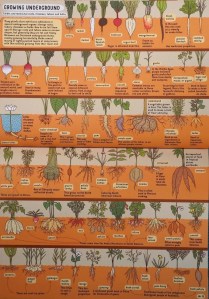
Let’s start with going under the earth where pretty much everything from bacteria, beetle larvae, burrowing animals, storage roots and the like …

%0A

natural gas …

%0A

cables and pipes, sewers, to metro lines are delved into.
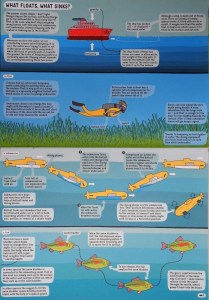
Flip the book over and readers are plunged into lakes, the oceans, and richly coloured coral reefs. Topics such as underwater pressure, diving, submarines, oil platforms and deep-sea fish …

%0A

are covered. The whole thing is a veritable treasure trove chock full of delights scientific …

%0A

geographical, cultural and historical …

%0A

to fascinate and be pored over.
Totally engrossing, lavishly produced, brilliantly designed, visually staggering, this is a volume to be dipped into, enjoyed, cherished: what an amazing journey to the centre of the earth no matter from which end you begin.
It’s beyond brilliant and a must for family bookshelves and class libraries no matter what the age or stage.

Use your local bookshop   localbookshops_NameImage-2

WNDB_Button