Maths is Weird! / The Periodic Table is Weird!

These are new additions to Little Tiger’s Smash Facts series: thanks to the publisher for sending them for review.

Maths is Weird!
The Periodic Table is Weird!

Noodle Fuel, illustrated by Luke Newell
Little Tiger

The creators of these two funky books employ the assistance of a robot and an alien respectively to present the wealth of information contained therein.


The droids at GigaSmartZ BrainBot Academy, the super-weirdest school in the entire universe guide human students through a mathematical maze, stopping to discuss a wealth of vital topics relating to numbers, number operations, numerical patterns and connections(this includes prime numbers); fractions, decimals, percentages and how to work them out, ratios, probability: did you realise that in a group of 75 people, it’s a 99.9% chance two of them will have the same birthday? There’s a look at both the metric and imperial systems of measuring. Recently there was talk of reverting to the imperial system in the UK – perish the thought!
Geometry is the next theme but clearly without being able to do number operations, much of this would be impossible. Both 2D and 3D shapes are covered
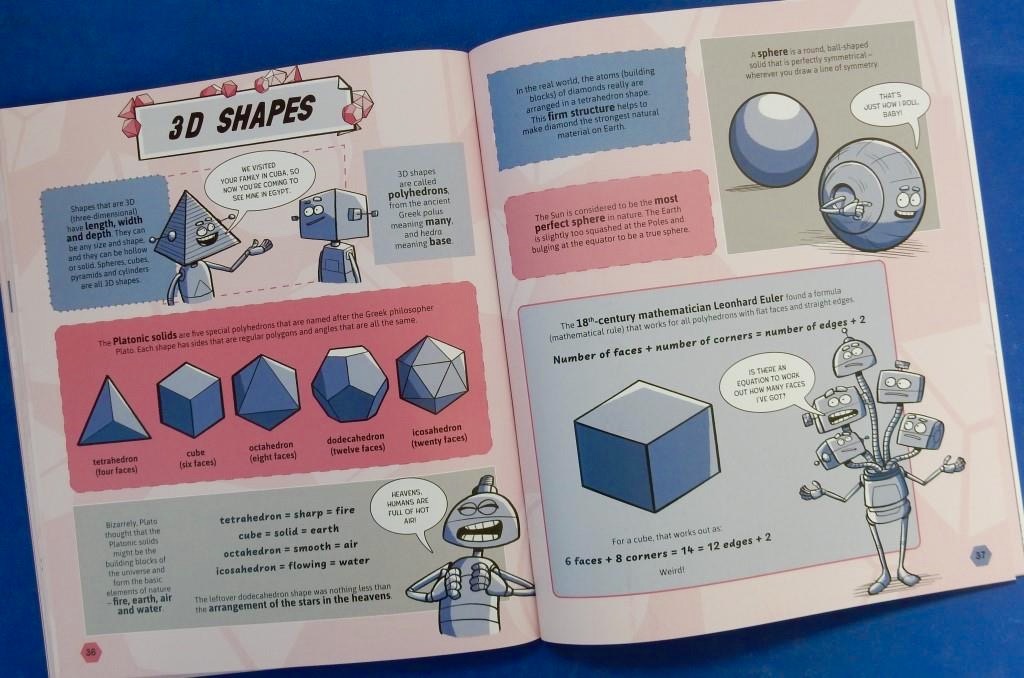
and we’re introduced to some of the ancient philosophers and mathematicians who made vital contributions to mathematics. and there are also ten very weird maths facts and finally some activities to try.

If you want to understand more chemistry, especially about the periodic table, then it’s worth enrolling at Floortlesnazz Grobblesnot Intergalactic Scientific Institute. I’m certain that had my A-level chemistry lessons at school been a fraction as interesting as this whacky book, I wouldn’t have spent a fair bit of my time throwing a netball across the back of the lab to a friend, instead of paying attention to what was being said. In The Periodic Table Is Weird! every element from actinide to zirconium is covered, starting with hydrogen,
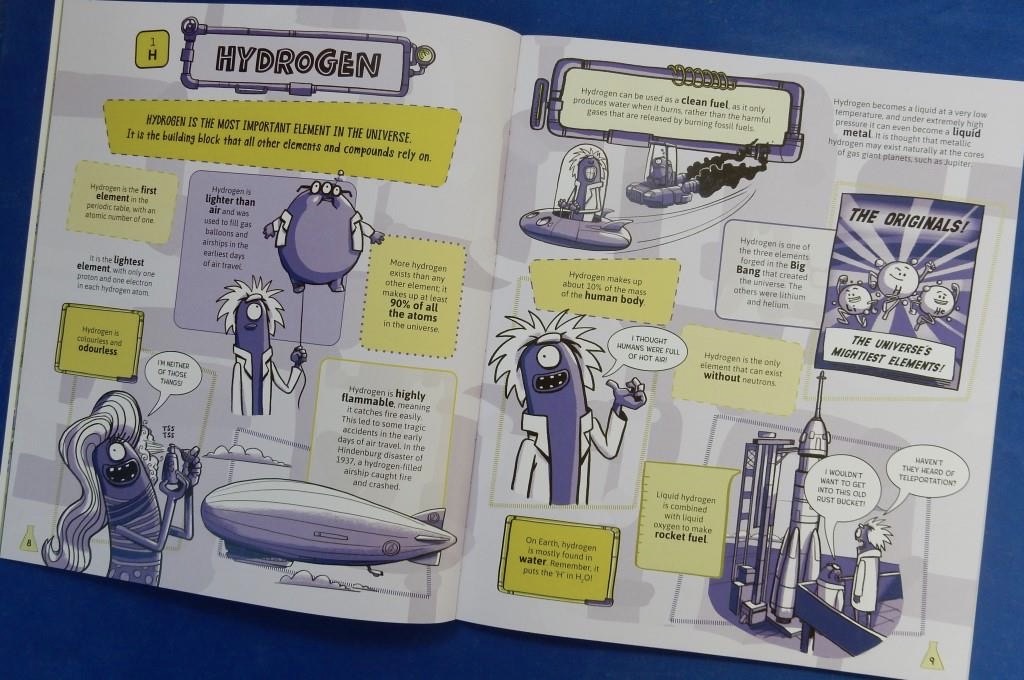
which is pretty amazing as to date that means 118 in total and the way the table itself is explained on the opening spread makes a whole lot more sense than ever it did when the periodic table was just a large chart on the wall occasionally referred to in the lessons I attended. And, I’m pretty sure that one had 10 fewer elements than the present one.
Both books are zanily illustrated by Luke Newell: this is light-hearted learning that readers are unlikely to forget.

Amazing Animal Tales: Little Tiger / Amazing Animal Tales: Baby Koala and Bugs / Space

Amazing Animal Tales: Little Tiger
Anne Rooney and Carolina Rabei
Amazing Animal Tales: Baby Koala
Anne Rooney and Qu Lan
Oxford Children’s Books

These, first of a new series, follow the survival stories of baby animals. You can use them either as narrative stories of each animal baby or, if you open the flaps (four per book) as a combination of story and information. Each has the additional interactive feature of a creature to look for on every spread and sometimes, a question which needs some investigation by the child to answer.
Little Tiger lives in the Asian tropical rainforest and when we first meet him, is snuggled up with his mother and fellow cubs in a safe warm den.
We then see the cub being suckled before venturing outside into the sunlight of the noisy habitat where there’s time for some playful fighting with the other cubs. There’s a near encounter with a noisy elephant after which Mama carries her tired cub back to the den. However this protectiveness can’t continue and Mamma Tiger must teach her cubs to hunt if they are to thrive.

That still leaves time for some playfulness and a quick dip before sleep time.

The Australian Bush is the setting for Baby Koala. This little joey, like other koalas, spends all its time in the eucalyptus trees sleeping and feeding, either suckled by its mother, or about nine months later, eating eucalyptus leaves. Dangers come in the form of hungry owls and forest fires caused by the intense heat but Mum koala still keeps a protective watch on her Baby Koala, even after it’s outgrown her pouch and instead is carried on her back.

The texts are engaging and will hold a young child’s interest and the illustrations from, in Little Tiger, Carolina Rabei and in Baby Koala, Qu Lan include lots of detail of the flora and fauna of the animals’ respective habitats to explore and talk about. Both titles would be good additions to foundation stage collections and home bookshelves.

Written in a totally different style and for an older audience:

Bugs
Space

Noodle Fuel and Rich Watson
Little Tiger

These two titles in a new Brain Bursts series are characterised by comical illustrations, simple, with quirky edge diagrams, and contained within fact boxes, a wealth of information is presented in a light-hearted style, complete with speech bubbles from the bugs themselves.

It’s incredible to read on the opening page of Bugs that insects make up almost three quarters of all animal species on Earth. Then after an introductory spread readers meet among others, bees, ladybirds, grasshoppers and crickets, damselflies and dragonflies, moths and ants. Can you believe that there are estimated to be ten quadrillion ants on our planet – 10,000,000,000,000,000 – that is indeed a ‘very big number’. I was amazed to discover that there are more than 10,000 different ant species.

Among the most bizarre facts though is one found on the ‘Top Ten Weird Bugs’ spread: did you know that honeybees have hairy eyeballs? There’s also a fun activities page, instructions on how to play Beetle – a game I’ve not played since I was a child – and a final glossary.

Space is similar in tone and covers such topics as stars and star maps, satellites, space travel, space junk (apparently there are such unlikely things as a pair of pliers and a spatula floating around somewhere in space), black holes and red dwarfs. Several space scientists and cosmonauts make an appearance and the book ends with some activities and a glossary. 

‘Boredom-free guaranteed!’ is claimed on the cover: I can’t imagine any child being bored by either of these books.