Kaya’s Heart Song

Kaya’s Heart Song
Diwa Tharan Sanders and Nerina Canzi
Lantana Publishing

From the cover illustration it’s evident that the little girl – her name is Kaya and she lives in the Malaysian rainforest– is truly savouring the moment.

As the story begins Kaya observes her mother sitting yoga style and humming. “Mama, what are you singing?” Kaya wants to know.

Her mother explains that it’s her heart song and that having a heart song makes anything possible. Kaya’s response is that she doesn’t know hers: her Mama encourages her to learn to listen for it and sends her daughter off to play outdoors.

Maya follows a butterfly into the jungle and it leads her to an unfamiliar spot but there she discovers someone who is familiar – her friend Pak.

Pak is the guardian of a gate behind which, nestling among thick foliage, is a broken elephant carousel.

Intrigued, Kaya decides to investigate and as she untangles the vines from around one of the elephants her mind begins to quieten and become still. A soft rhythmic beat sounds in her ear as with a Boom taktak boom taktak boom / Shick shak shook / Boom taktak boom taktak boom / Shick shack shook’ the carousel begins to rotate and the elephants move in time with the music.

Suddenly Kaya understands that she has found her own heart song and then, just as her mama had told her, magic happens …

Grounded in the practice of mindfulness – being fully in the present moment – this is a truly mesmerising picture book.

With a lush colour palette Nerina Canzi depicts Kaya’s magical world, creating a truly immersive place both for the main protagonist and for the reader. Her spreads work in perfect harmony with the author’s words and to lose yourself between the covers of the book is to be, like Kaya, in the here and now throughout the experience.

The final page explains simply the practice of mindfulness, linking it with yoga and meditation, and also reminding the reader what brought Kaya to a mindful state.

From the time they start school children today live in an ever more pressurised and often stressful world and this beautiful book demonstrates to both children and adults the benefits of cultivating the mindfulness habit. It can help them change their own world and perhaps that of others. Just a few minutes a day: no distractions; just being fully present in the here and now.

It’s a state of being that young children absorbed in their play (especially with creative materials) reach when adults stand back and watch without interrupting or trying to guide what they’re doing: watch that total concentration, nothing else matters – that’s mindfulness. When I taught 4 and 5 year olds I saw it many times every day; it wan’t taught to them, it’s just how they were.
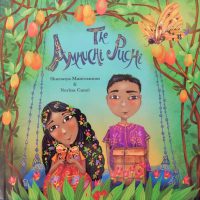
The Ammuchi Puchi

The Ammuchi Puchi
Sharanya Manivanna and Nerina Canzi
Lantana Publishing
To visit India, no matter which part, is an assault on the senses, especially that first time: the sights, sounds, smells, the sheer seeming chaos that surrounds you is almost, though not quite, overwhelming. But somehow, for me at least, there is something about it that gets right into your spirit and doesn’t want to let go; so, you keep on going back again and again and … then, you realise that you’ve fallen in love with the place. This picture book evokes some of the wonderful sights, sounds and smells of the country.
Now one of the most striking things about India, particularly the southern part is the dazzling, dancing array of butterflies and it’s something my partner and I both appreciate every time we go. I happen to have picked up a few words of Malayalam and thought I recognised Ammuchi as mother but then realised that word is ‘ummachi’ ; I know grandmother, or rather maternal grandmother as ‘ammacci’ in Tamil (having taught some Tamil speaking 5 year olds in my reception classes) and my Hindi, which is much better, tells me that ‘puchi’ means kiss. So, before even opening this gorgeous book, I was making lots of connections and deciding the title means ‘grandmother’s kiss’.
Let’s get to the story then: the setting, I think, is rural south India; and its narrator is Aditya who lives with his younger sister, Anjali, their parents (Amma and Appa) and grandmother, Ammuchi.

The two children adore their paan-chewing grandmother, despite being somewhat scared by her ghost stories – “Don’t you see it sitting there, with eyes big-big like two moons?” until that is, they grow out of being spooked and join in with her tales of ghost sightings, furnishing their own details to add to her descriptions of the mango-tree dwelling manifestation.

Just as Aditya’s tenth birthday approaches, Ammuchi gets ill, has to go into hospital and dies. The two youngsters, like their parents, grieve and the children in particular struggle to come to terms with their loss: that constant ray of sunshine no more illuminates their lives …

But then one evening a beautiful butterfly flies down and settles on Anjali’s head. It’s “Ammuchi Puchi,” she tells her brother. Next day at school, he tells his classmates of the event, saying, “Ammuchi Puchi is an insect who is our grandmother.” Despite their ambivalence, back home that evening, Aditya ponders further and becomes convinced that the butterfly is in fact his grandmother. His parents’ response and seeming lack of understanding, result in the Ammuchi Puchi becoming the children’s secret. It turns out though, that it’s not only the children who have a secret: the Ammuchi Puchi has one too: one that she reveals to the brother and sister one rainy night;

and so begins the healing and the understanding that Ammuchi’s love will always permeate their lives, no matter what.
Grandmothers have a very special place in Indian families in particular, but grief is a universal phenomenon. What Sharanya Manivannan’s moving, thought-provoking narrative offers for all readers is, ‘a place from which to become aware’. Yes, it’s deeply sad in part; but ultimately it’s about much more than heart-breaking loss and grief: this is a joyous celebration of love, of a very special person who relished life; of family; of the beauty of the natural world; and of the power of the imagination. No matter your feelings about, or understanding of, reincarnation, the author’s symbolising of the grandmother as a butterfly both comforts the child characters and allows for open-ended responses from readers everywhere.
Nerina Canzi’s illustrations complement the telling beautifully. The predominance of vibrant hues in the lush flora and fauna, the fabrics of the clothing, the kolam design on the school floor, the carpets and rugs, underscores the Indian setting while at the same time, reinforcing the message that the story is essentially, about abiding love and the way children have a propensity to transcend deeply upsetting events. In contrast, almost all colour is leeched from the spread dealing with Ammuchi’s dying, reflecting the palpable desolation her death brings to the whole family, and rendering it all the more affecting for readers, not least this reviewer.
A must have book for all family bookshelves and primary classroom collections.

I’ve signed the charter