Amazing Treasures

Amazing Treasures
David Long and Muti
What on Earth Books

In this the second in the Our Amazing World series David Long presents a veritable wealth of amazing things in his mind boggling assortment of 100+ objects and places.

Some are naturally occurring, others are not and the author’s definition of treasure is sufficiently broad to encompass personal items such as a photograph and a favourite book; the tulip fields of Holland, the Lascaux cave paintings, the Amazon Rainforest, moon rocks (some of which have gone missing) and Bugatti cars from the Schlumpf collection.

Items such as the cars, and the abandoned city of Machu Picchu in the Andes are given just a paragraph, whereas Tikal the ancient Mayan site,
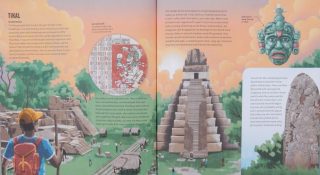
and China’s Forbidden City each have an entire double spread devoted to them. There’s also a world map gatefold as the centre spread that when open shows a list of all the 105 items included.

No matter whether your interest is in architecture, fossils, rocks and gems or the natural world, readers will likely find something new to wonder over here.

The Muti team has used a relatively subdued colour palette for their illustrations most of which are relatively close up depictions; others including Windsor Castle,

Machu Picchu and Masada are shown in aerial views of different sizes.

With topics both ancient and modern (ownership for instance), this fascinating book is one to include in KS2 class collections particularly.

Wonders of the World

Wonders of the World
Isabel Otter and Margaux Carpentier
360 Degrees

The world is a truly amazing place and its wonders, some of which were formed naturally and others made by humans, are really a sight to behold. In this book author Isabel Otter and illustrator Margaux Carpentier present them for us all to see and appreciate without even moving from our seats. Better still is being able to see them with your own eyes but I as a fairly well travelled individual have visited only two of them, India’s Taj Mahal

and The Colosseum in Rome and some of them I think are no longer in existence.

In all we pay a vicarious visit to twenty one wonders thanks to the stand out bright images, descriptive text and lift-the-flap details.
We’re shown seven ancient wonders including the Temple of Artemis in Turkey, the Colossus of Rhodes and the Hanging Garden of Babylon.

Look out for the wheel feature on this page.

Those representing the modern world include the Great Wall of China, which was actually started in 221BCE and said to be the longest structure ever built by humans, having grown over 2000 years to it enormous present (21,196km) length.

Sadly of those presented on the final spread of Natural Wonders one, the Great Barrier Reef, is in great danger on account of global warming caused by we humans.

Each of these wonders could be a starting point for further exploration by interested readers and the whole book would make a great discussion topic with groups or individuals presenting their particular favourite to the rest of the class.

I personally would love to see those Hanging Gardens but there isn’t any chance of that since no trace of them has ever been found. Instead I’ll just have to do with imagining them.