The Wild Outside

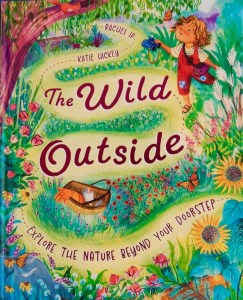
There’s nothing little Tulip likes better than to be outside exploring. She observes carefully the flora and fauna using all her senses and never stops asking questions to increase her knowledge. Then she comes upon a trail of muddy footprints on the path and a sign saying Nature Trail. Written in chalk in various places are labels naming lots of the plants, some she’s already familiar with, but lots that are new to her.
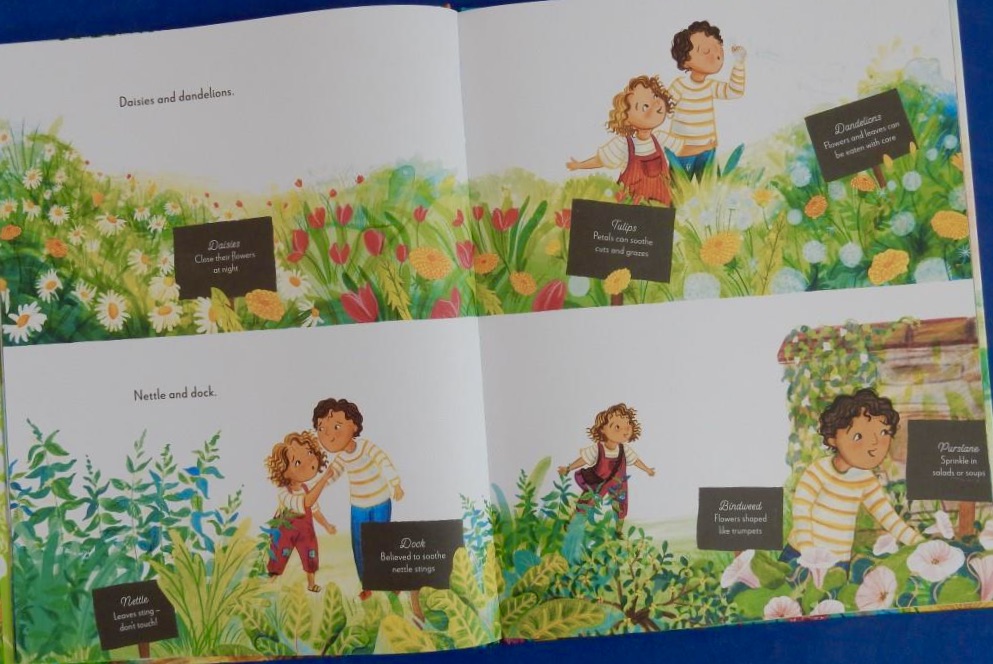
Who can possibly have made this trail, she wonders as she catches sight of somebody’s back retreating. Having filled her pockets with flowers and catkins, Tulip and her elder sibling return home and on the doorstep is a parcel with Tulip’s name on and inside is an illustrated botanical guide and a note encouraging her to keep on exploring.

On opening the book, Tulip is excited to find lots of plants and trees she recognises and is inspired to do some labelled drawings. This keeps her engaged until bedtime when she falls asleep wondering where the following day’s explorations will take her. However, come the morning it’s raining hard and so she further explores her book instead, visiting Asian mangroves and forests, the deserts and plains of Australia, African rainforests and grasslands, mountainous regions of Europe,
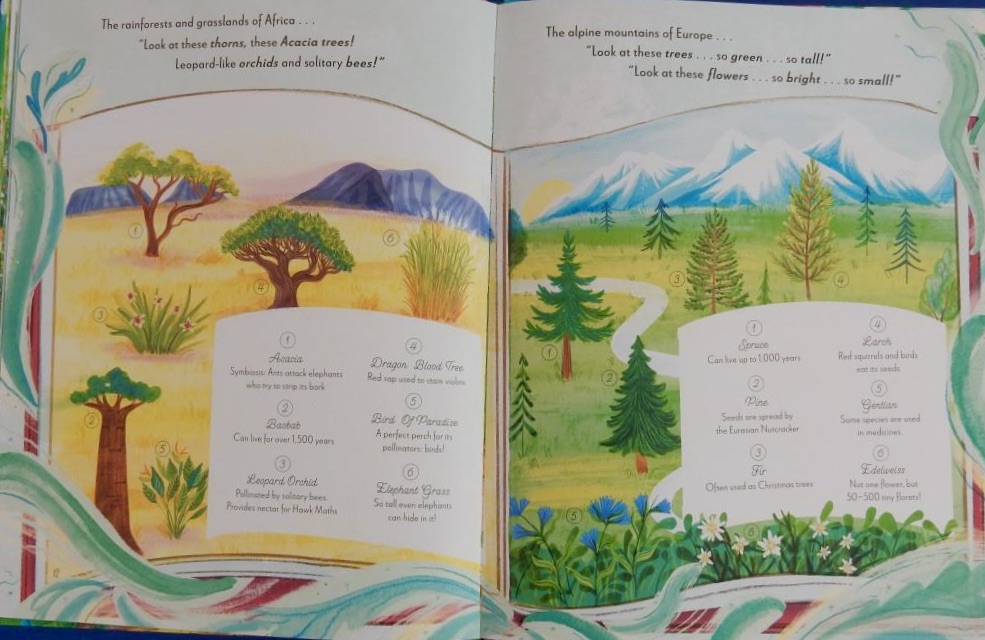
the North American tundra region, various South American habitats and the cold Antarctic deserts. A clever device this for introducing to readers habitats the world over.

The following day the sun returns but rain has washed away the chalk markings of the trail. However someone has created a new one: who could that be? Tulip chalks a list of plants from the trail, leaving question marks for some she can’t name. On her return walk she discovers somebody else has written the names of those plants and left a trail of footprints. Who could it be? Tulip is delighted to discover the identity of her fellow nature lover and she makes a very special floral thank you using the contents of her pockets and bag.

A smashing way of encouraging young children to emulate Tulip and become natural history enthusiasts. The vibrant illustrations show the abundance of flora Tulip encounters as she explores and the labels are accompanied by brief captions with additional information about each plant. A wonderful combination of story and non-fiction.
Amazing Rivers

Amazing Rivers
Julie Vosburgh Agnone and Kerry Hyndman
What on Earth Books

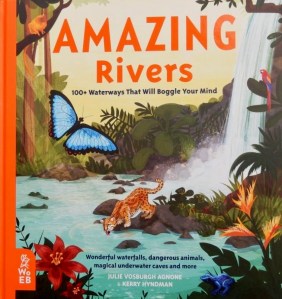
Author Julie Vosburgh Agnone starts by giving a general description of a river and then takes readers on an exploration of freshwater waterways all around the world. She and illustrator Kerry Hyndman then present more than a hundred rivers explaining as they go subjects including measurement, source and flow,

as well as what is to be found in and also around rivers, and the humans living and working in their vicinity.

Crop growing has long been an important activity with dates and other fruits, grains and vegetables having been watered by water from the Tigris and Euphrates Rivers since ancient times when Sumerian farmers designed irrigation methods to divert the river water.

Many rivers, we’re told, contain fish species in abundance including perch, catfish and trout while others yield freshwater crabs and shrimps that can make a tasty meal.
I was fascinated to read about pancakes – not the edible variety but ones made of ice that are occasionally formed in the River Dee in Scotland.

In contrast the Boiling River in Peru has water hot enough to cook an egg.

Some rivers – the Amazon, the Yangtze and another Chinese river, the Li – are allocated a spread each while other spreads are topical including treasures found in rivers, industry, feats of engineering and threats to divers with short titled paragraphs presenting the facts set into or around stylised illustrations.

Kerry Hyndman uses a variety of visual layouts that include vignettes,

close-ups, arial views and broad river scenes as well as making good use of texture and shadow to help maintain readers’ interest throughout. There’s also a central foldout map showing the location of each river mentioned as well as giving some fun river-related lists. A glossary, index and resource list comprise the four final pages.

Altogether a fascinating and informative resource book for individual browsing and KS2/3 school collections.

Fanatical About Frogs

Fanatical About Frogs
Owen Davey
Flying Eye Books

For this fifth book in the series Owen Davey has chosen to focus on our amphibian friends the frogs.

Frogs in all their glory (and here Owen includes toads) can be found on all continents except Antarctica. Thus far about 7000 species have been discovered but that number is not static especially since many are very small and well camouflaged. All this and more we learn on the first spread.

On the second spread, (Warts and All) focusing on the northern leopard frog, the author discusses the particular abilities and features of Anurans – their eyes and eyelids, the tympanum, legs, feet (sometimes with sticky pads) and where appropriate, their warty bumps.

Other topics each given a spread concern the skin; feeding;

colours, pattern camouflage and other means of self-protection; ectothermic regulation (the means by which frogs regulate their temperature).

Communication,

metamorphosis; a focus on the Red-eyed tree frog, some of the ‘weird and wonderful’ varieties each occupy a spread. Next there’s a look at size – the biggest and smallest species – and a gallery showing the actual shape and size of 19 different frogs, each one having its own unique beauty.

Then, as in all Owen’s titles in this series comes ‘And the award goes to …’ show-casing the most transparent frog, the loudest, the best impersonator, the creepiest, the best jumper and the most dangerous frog. Hmm, I wouldn’t like to encounter that golden poison arrow frog; it exudes a lethal poison 20 times more deadly than any other frog.

Also characteristic of the books, along with the playful topic and paragraph headings, is a spread of associated mythology that gives paragraphs on four folklore frogs. The vital topic of conservation is the final focus and there’s a concluding index.

Informative, fascinating, absorbing and as always, stupendously well illustrated and enormously enjoyable, is this excellent non-fiction book for home or school.

Say Hi to Hedgehogs! / We’re Going on a Bear Hunt: Let’s Discover Bugs

Say Hi to Hedgehogs!
Jane McGuinness
Walker Books

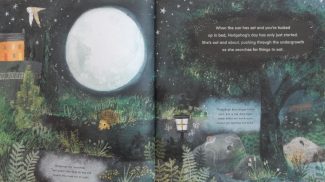
Would that we could, is my immediate response to the title of this lovely addition to the Walker Nature Storybook series. I’ve not seen a hedgehog in the wild for a very long time and they used to be fairly commonplace little creatures foraging in suburban back gardens and I know they are now an endangered species.
All the more reason to get to know something about them; and here’s just the book from debut author and illustrator Jane McGuinness to help youngsters do just that.
The main text takes the form of a narrative ostensibly by a small girl pictured at the start of the book. She introduces readers to a particular hedgehog and her babies (hoglets)

and their everyday life, habits, diet …

and behaviour through the year.
This is presented in a large, easy to read font and includes some lovely playful language such as ‘sniffling and snuffling and snaffling … whirring and churring and purring’ making it a great read aloud. Additional, more detailed factual information is set out in a smaller script throughout the book.
The final spread has advice on how to make your home hedgehog friendly, an index, a short bibliography and a list of useful websites.
Hedgehogs are truly endearing creatures and Jane McGuinness’s illustrations, which look to be rendered in pastel, paint and crayon, do full justice to their charms; and her scenes of their nocturnal meanderings are absolutely beautiful.

Jane McGuinness is definitely an illustrator to watch.

We’re Going on a Bear Hunt: Let’s Discover Bugs
Walker Entertainment

Following on from the success of We’re Going on a Bear Hunt Adventure Field Guide, Walker have added new titles to the series of which this is one.
Before sallying forth on a bug hunt, it’s wise to make sure you’re prepared and the opening page is devoted to so doing,
Thereafter it’s bugs all the way, first in the garden and then further afield into the woods, to the pond and finally, out into the meadows.
Each location introduces several minibeasts and offers related activities and some basic factual information.
Everything is clearly and attractively presented and at the back are several pages of stickers to be used in some of the activities.
This clever and fun book is ideal for children who love to explore the outdoors. It’s just the size for popping into a rucksack and likely to make outdoor forays all the more interesting and rewarding.

Trees / We’re Going on a Bear Hunt My First Adventure Field Guide

Trees
Lemniscates
Walker Books
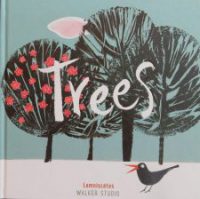
Published under the Walker Studio imprint, this is a gorgeously textured, digitally worked, tribute to trees. Through elegant illustrations and a succinctly worded text, homage is paid to trees. We see them in all their changing seasonal glory;

trees with ‘their heads in the clouds and their feet on the ground.

And we learn something of the functions of their roots; their various locations and something of the important environmental roles they play: homes for a plethora of birds and other creatures, providing shade for humans and other animals, cleansers of the air we breathe; and providers of a bounty of fruits. In the last few spreads we are in the company of a child in various tree interactions both rural and urban.

Share this lovely book with young children and then go outside and start to observe, enjoy and appreciate the wonderful trees around.

We’re Going on a Bear Hunt My Adventure Field Guide
text by Hannah Peng/Walker Books
Walker Entertainment
Somebody somewhere has had the clever idea of capitalising on the popularity of the original Rosen/Oxenbury We’re Going on a Bear Hunt picture book and the more recent success of the animation of the same and come up with this natural history adventure guide using some stills of scenes from the latter.
Like all good adventures, it takes a bit of planning and making sure one takes the appropriate things along in the way of clothing and protection, together with a handy notebook. Then it’s off into the big wide world of explorations, be they at home, school, countryside or seaside, by day or perhaps, night, always accompanied of course, by a responsible adult.
High in the Sky’, ‘Down in the Ground’ in that ‘thick oozy mud’; Further Afield to caves, through woodlands and forest (stumble trip) and onto the shore are other possible places for spotting a plethora of flora and fauna, large and small. Doing weather observations, making mud bricks, collecting fruits for scrumptious baked apples, creating a special plant habitat at home and measuring the heights of trees are just some of the numerous possibilities included; and I’m sure children will relish the idea of a poo hunt.
With its wipe-clean cover, this backpack-sized beauty concludes with some important words about the impact of certain kinds of human activity on the natural world, ways to help combat these and a final glossary.
For any child with a taste for adventure, either at home or in school.

I’ve signed the charter 

A Nest is Noisy / Secrets of Our Earth / Secrets of Animal Camouflage

A Nest is Noisy
Dianna Hutts Aston and Sylvia Long
Chronicle Books
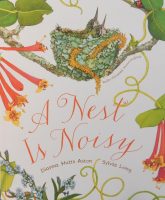
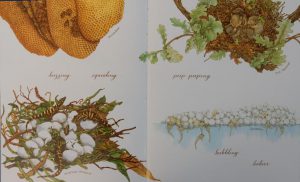
Full of fascinating information, poetically presented, (like its companion titles from this super-talented duo) is this rivetingly illustrated look at the irresistible world of nests. Who could resist Dianna Hutts Aston’s opening ‘ … it’s a nursery of chirp-chirping … (Ruby-throated Hummingbird) buzzing … (honeybees) squeaking … (American Alligator) peep-peeping … (Fox Squirrel) bubbling babies (Gourami)’ …

Did you know for instance that the world’s smallest nest – that of the bee hummingbird – is golf-ball sized and normally wrapped in spider’s silk, the stretchiness of which allows the nest to expand as the babies increase in size?
Or, that orang-utans braid beds of strong branches high up in the rainforest canopy and on rainy nights a woven umbrella of leaves keeps them dry? I certainly didn’t, nor was I aware that lampreys make underwater nests from pebbles varying in size from a pea to a base-ball; and that the temperature of an alligator’s nest determines the sex of the baby alligators.
A splendid introduction to a captivating topic, this is sure to inspire awe and wonder at nature’s creativity while at the same time prompting children to revisit its contents over and over.

Secrets of Our Earth
Carron Brown and Wesley Robins
Ivy Kids
A recent addition to the cleverly conceived Shine-a-Light series of non-fiction titles that makes reading all the more exciting as you need a torch or flashlight, in this instance, to reveal the secrets of our earth from the outside in.
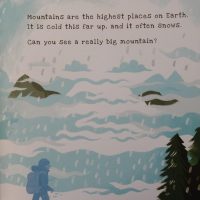
Readers are shown topographical features such as mountains …

and volcanoes, rivers and oceans, deserts and grasslands, rainforests and even cities: Holding the light behind the page gives a behind-the-scenes look at each destination.
Just the thing for Early Years and KS1 topic boxes and ideal for those youngsters who prefer to read information books. Build your topical role play area, then place the book strategically inside with a large torch and see what happens.
Other titles in the series include:
Secrets of Animal Camouflage
Carron Brown and Wesley Robins
Ivy Kids
This is another one of the series. Here you need your torch or flashlight to reveal the hidden world of arachnids, stick insects, Bengal tigers, tree-trunk hiding owls, amazingly camouflaged butterflies and more. Each of these creatures and others are hiding in plain sight in its natural habitat and by holding a light behind the page the camouflaged animal is revealed.

A clever and fascinating, interactive introduction to the vital topic of adaptation made all the more so by Robins’ alluring art work.

On the Plane
Carron Brown and Bee Johnson
This one features everything airport-related from the airline staff at the check-in desk to the pilots who, with the help of a computer, fly the planes.
This is one to read just before that first flight, or next trip.
The Human Body
Carron Brown and Rachael Saunders
This takes readers below the skin to see the skeleton and muscles, and then resurfaces to look at skin patterns, before going internal again to find out about the respiratory system, the nervous system, digestion, excretion, teeth, reproduction and more.
It’s almost a case of whatever topic happens to be your focus, there’s one of these books to illuminate it. Perfect for inquiring minds and show me a young child that doesn’t have one of those.

I’ve signed the charter 

The Ladybird / Make and Move Minibeasts / Build a Butterfly

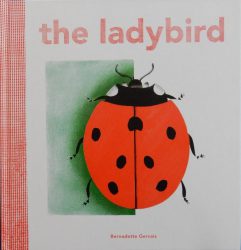
The Ladybird
Bernadette Gervais
Laurence King Publishing
I knew that the ladybird season was about to burst upon us when I noticed several that had emerged, and died on a window-sill of one of the spare bedrooms of my house a few days back. Before disposing of them I took a close look: I think they were a variant of the invasive Harlequin species from Asia. My first go-to was this little book waiting for me to write a review. It’s a wonderful introduction to the little insects, beautifully produced and illustrated, biologically accurate with parts properly labelled; and with judiciously used flaps that add to the effectiveness of the information given.

Topics covered include the insect’s anatomy, defence, nutrition, hibernation and reproduction. The latter takes readers through the entire life-cycle from mating, via the larval stage to the emergence of the new spotless ladybird; the spots and red colour develop fully after about an hour.

There are also spreads devoted to the variety of ladybirds; and a ‘spot the difference’ observation game. The whole thing is printed on thick matt paper, which further adds to the quality of the whole. Altogether a class act; add it to your early years topic box or KS1 collection.
Make and Move Minibeasts
Sato Hisao
Laurence King Publishing
I’m not generally a great fan of ‘pop-out, create a whatever’ kind of books; they generally require way more manual dexterity and know how than the target age group indicated, but this one is definitely worth a look.
It’s the most recent of a Make and Move series by this artist and contains nine pre-coloured creatures; and a butterfly, a stag beetle and a dragonfly to which users of the book can add their own designs and colours. The coloured images are textured, and although texturing the uncoloured ones, while not impossible, might be something of a challenge that’s no bad thing and certainly something a six or seven year old could do.

Bee

They might need a little help with putting the animals together though and the projects increase in difficulty from first to last.
When completed the minibeasts do move easily, partly due to their being printed on thin card. Now while I don’t suggest buying a whole lot of these books, I know that many schools have a focus on minibeasts at some time during the summer term and a copy of this in the classroom could well prove inspiring for children to perhaps use as a source book, with an adult creating an example or two from the book itself. There’s a whole lot of mathematical learning potential as well as biological (and technological) learning herein.
Alternatively, it’s an interesting way to spend a few hours at the weekend or during say, a half term holiday.

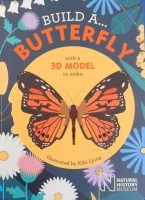
Build a Butterfly
illustrated by Kiki Ljung
Frances Lincoln Children’s Books
Published in collaboration with the Natural History Museum, this is a board book and activity book combined.
Young readers are invited to find out about the Painted Lady butterfly (Vanessa cardui) and to use the press-out pieces, following the step-by-step instructions to build a card model of the butterfly. Starting with its life-cycle, information is given about finding food including the role of the eyes in locating same, as well as finding a mate; the butterfly’s diet;

emergence from its chrysalis; habits; and how it migrates.
The names of the insect’s various body parts are supplied – these are crucial when constructing the butterfly model – as well as a simple explanation of the function of each part. Young fingers may require the assistance of an adult in fitting the eleven pieces together.
My knowledge of this butterfly species is that there’s a slight inaccuracy in the portrayal of the adult, which here has been given white markings to the upper surface of the hind-wings making it look like a Monarch butterfly. A curious slip considering the endorsement given by the Natural History Museum; ditto the use of a capital C in the specific name; the paragraph about the butterfly’s emergence from its chrysalis has inaccuracies too. These factors will not however detract from the enjoyment of creating the insect. This book, I suggest, is best seen as helping readers to understand the basic anatomy of the butterfly.

I’ve signed the charter  

Lots: the Diversity of Life on Earth

Lots
Nicola Davies and Emily Sutton
Walker Books
Subtitled ‘The Diversity of Life on Earth’ the enchanting large-sized book looks at biodiversity and interdependence on our planet.
The ‘LOTS’ herein encompasses over a hundred different animals as well as numerous plants and one enthusiastic little girl narrator.

By giving voice to the child, Nicola Davies cleverly explains what would otherwise be an abstruse topic in words that pre-school and KS1 age children can engage with and enjoy.
We visit a variety of locations from deserts to tropical islands; and zoom right in to such microbial habitats as beneath the feathers of birds, on the backs of lichen beetles

and even boiling volcanic pools. Counting all the different kinds of flora and fauna is far from easy on account of sheer numbers; but sometimes it’s a very difficult task due in part to the comparative inaccessibility of particular habitats – the tops of tall jungle trees or the bottom of the coldest seas for instance. But also there’s the fact that some young creatures – the Queen Angelfish – for one, look quite different from the adult; or alternatively things that look virtually identical are entirely different species such as here:

The Viceroy Butterfly and the Monarch look almost identical

All this is explained in a straightforward narrative that as well as providing youngsters with a wealth of information, is likely to engender awe and wonder in the ‘almost two million different kinds of living things’ already identified; and the millions that probably are yet to be found.
In the three final spreads, crucial ideas about extinction and the importance of preservation of living things are introduced, leaving readers much food for thought about the vital stewardship role humans have in the whole scheme of things.
This follow up to Tiny also has wonderful detailed, painterly illustrations by Emily Sutton. A must for primary school classroom collections and family bookshelves.

I’ve signed the charter 

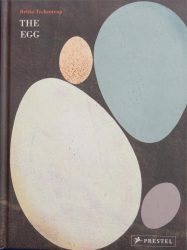
The Egg

%0a

The Egg
Britta Teckentrup
Prestel
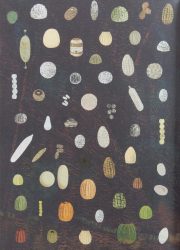
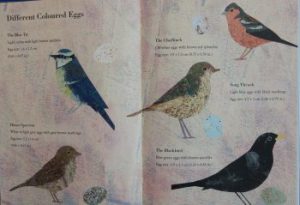
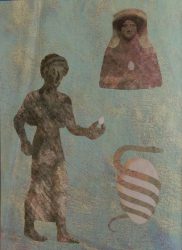
Many aspects of oviparity are explored in this fascinating book along with spreads on the egg in art, religion and mythology;

%0a

a look at traditions involving eggs, the famous Fabergé egg and the symbolic golden egg of wealth and fairy tales; and there’s a look at decorating eggs.
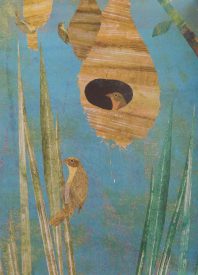
Caliology is an engaging aspect and obviously interested Britta Teckenetrup who devotes a dozen double spreads to various kinds of bird’s nests from the colonial nest building weaver birds, whose amazing nests are often built suspended (as a safety precaution) from trees over water,

%0a

to the ground nesting Snowy Owls that make shallow nest bowls where the snow has gone, during the Arctic summer.
Other egg layers include insects, there being a multitude of marvellous shapes, colours and textures;

%0a

spawning amphibians, reptiles – these mostly lay soft-shelled eggs incubated by natural heat rather than by the adult; turtles, fish and the mammalian sub-group which includes the platypus and echidna, the latter two being termed monotremes; and are indigenous to Australia and New Guinea.
The book’s blurb says of the egg, ‘Its beauty has inspired artists since ancient times’:

%0a

it has clearly inspired Britta Teckentrup, the creator of this handsomely produced, (it has a wonderful feel as well as look) enormously engaging and informative ‘eggthology’. As with many good information books it leaves you wanting to know more.
One for the primary school bookshelf, as well as for interested individuals.

Charter logo FINAL.indd

Over and Under the Pond

%0a

Over and Under the Pond
Kate Messner and Christopher Silas Neal
Chronicle Books
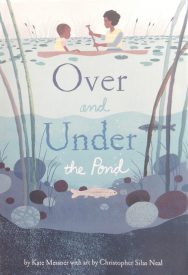
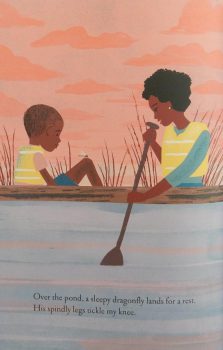
In this follow-up to Up in the Garden and Down in the Dirt we join a mother and child as they take an evening row across the pond :‘Over the pond we slide, splashing through lily pads, sweeping through reeds.’ The boy narrates using a beautifully attentive, almost meditative voice that immediately connects us to the watery setting: ‘The water’s a mirror, reflecting the sky, /Sunshine and clouds – then a shadow below.
Unhurriedly, the pond reveals its riches, both hidden and more clearly visible, as the two people in their craft skim, ‘lift and dart and pull past a row of painted turtles on a waterlogged tree‘ …

dscn0237

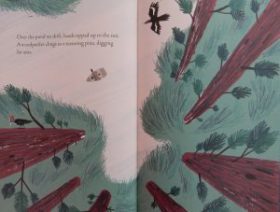
On they go, with occasional help from the wind, passing a great blue heron about to dive for minnows, a woodpecker clinging to a ‘teetering pine, digging for ants.’;

%0a

dragonflies skim the water’s surface below which dragonfly larvae seize passing minnows in their jaws. How skilfully, occasionally using onomatopoeic phrases such as ‘splash – gurgle – splosh!’ ‘to heighten the dramatic effect, author, Kate Messner, reflects that way young children can be ‘in the moment’ excluding all else as they immerse themselves in the here and now.

%0a

Gradually the shadows engulf the scene as dusky darkness falls over the pond and it’s time to return ‘swish – bump!’ to the shore and home, leaving nature still watching and waiting …
Neal’s richly hued, mixed media illustrations show us the pond from every possible perspective both above and below causing readers, like the rowers, to pause and linger over every scene, taking in its stark beauty.
In the final spreads, the author provides notes about some of the fauna inhabiting the pond, especially useful for readers in the UK who may not be familiar with all of them. A book to inspire, enthuse and send readers (accompanied by an adult) out into the wonderful natural world to find out for themselves what lies Over and Under the Pond.

Charter logo FINAL.indd

Wild Animals of the South

%0a

Wild Animals of the South
Dieter Braun
Flying Eye Books
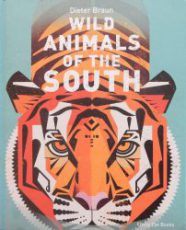
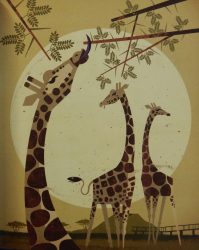
This companion volume to Braun’s Wild Animals of the North takes readers to Africa, South America, Asia, Australia and finally, Antarctica: it’s equally stunningly beautifully illustrated and almost every page would make a wonderful poster. How does a reviewer choose just a few pictures to show; a pretty impossible choice in this case as every one is magnificent in its own way. I’m starting in Africa with these beauties …

%0a

and I was surprised to discover that despite their necks being over two metres long, they have, like humans, only seven vertebrae. What a wonderful dusty, colour palette Braun has used here. Indeed each and every one of his poster-like images is strikingly composed of elegant, naturalistic detail and textural artistry.
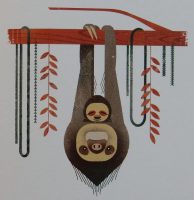
Moving on to South America, this little Two-toed sloth is perfectly constructed …

%0a

to allow rain water to run off it more easily.’ I was surprised once again here, to learn its fur hosts algal growth, which has a double use – as a food source and as camouflage.
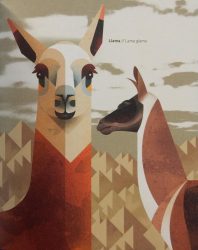
Cubism is, I think, the influence for this magnificent Llama portrait–

%0a

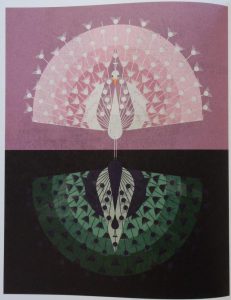
Indeed one can detect many artists styles herein. These incredible Indian peafowl (representing Asia)

%0a

have a definite Art Deco look about them
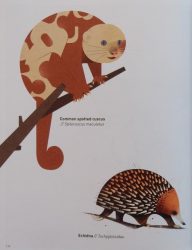
From Australia we have among others, the Common spotted cuscus and the Echidna: I love the way the curved shaped backs are juxtaposed on this page, as well as the use of geometric shapes. …

%0a

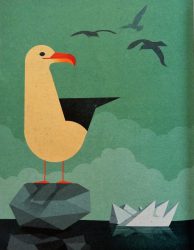
As with the ‘North’ volume, Braun allows his visuals of some of the animals to stand alone, such as this Kelp gull from Antarctica …

%0a

the region from which unsurprisingly, fewest animals are portrayed.
This is a book to keep, to give, to share and to inspire.

Charter logo FINAL.indd

Charles Darwin’s Around the World Adventure

%0a

Charles Darwin’s Around the World Adventure
Jennifer Thermes
Abrams
In this introduction to the work of Charles Darwin, the author focuses on his five-year long voyage aboard HMS Beagle, the ship on which he served as naturalist. Before that though we’re given brief details of his earlier life leading up to his departure on the ship whose mission was making maps of South America.
The young man was absolutely fascinated by the sights and sounds around. He kept a journal, writing in it detailed daily observations of what he saw and heard –‘big observations about the tiniest of creatures’ we’re told.

%0a

So delighted by the wild life was he that Charles would often choose to remain on land while the Beagle sailed up and down the coast. This delight is portrayed in Thermes’ detailed watercolour portraits of the young man at work, work that set his imagination on fire and would later contribute to his ideas and writings on evolution. Her narrative fills in other details, particularly that of Darwin’s observations on individual creatures: ‘He saw a rare bird called a rhea that used its wings to steer as it ran, but could not fly’, and later in Tierra de Fuego, on the interconnectedness of all wild-life, indeed all of nature itself.

%0a

The stop on the volcanic Galápagos Islands particularly amazed Charles with its 200 pound tortoises big enough to ride on, but most notably the different kinds of finches he came across.

dscn9287

In addition to a detailed cross-section of the departing Beagle, there are large, colourful maps charting the exciting voyage for readers to enjoy …

%0a

Further information is given about Darwin’s life and work, and other related facts in the two final spreads.
All in all this does a very good job of capturing the excitement not only of the voyage, but of the wonders of nature as a whole. Definitely one for the primary school bookshelves and for individuals interested in wildlife in general.

The Big Book of Bugs/A Beetle Is Shy

DSCN7510

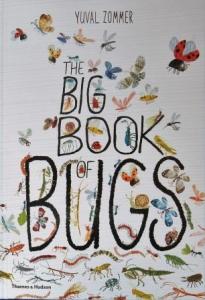
The Big Book of Bugs
Yuval Zommer and Barbara Taylor
Thames & Hudson
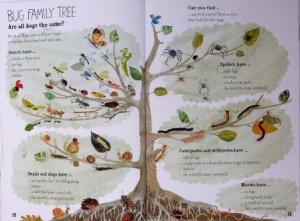
Now is the time of year to go in search of all things buggish and armed with inventive illustrator, Yuval Zommer’s and bug expert, Barbara Taylor’s fantastic book, you’ll be in a position to find out all about them. It’s absolutely packed full of fascinating facts and some figures relating to minibeasts of all kinds – insects, snails, spiders, centipedes and worms and indeed we are given a classification explaining how to tell what’s what …

DSCN7511

as well as some other general bug-related information, before moving on to look at particular species in greater detail. This, the author does by posing intriguing questions such as ‘Does a dragonfly breathe fire?’ or ‘Just how slow does a snail go?

DSCN7516

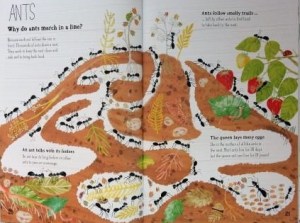
as leads in to double spreads on over twenty-five topics. Most spreads look at one kind of mini creature, say spiders, where among the facts we find that spiders have 48 knees (I’ve never thought of spiders having knees before, I have to say); or Ants ‘the queen ant can live for 15 years!

%0A

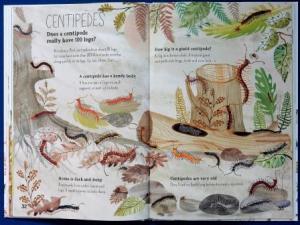
Or, Centipedes where we discover ‘most of these creatures have around 30 legs and can have over 300.

DSCN7515

And, in relation to Bugs on the Move, ‘A horsefly (my most unfavourite bug) can fly faster than a car on the motorway.’ That’s as maybe, but the one that bit me and caused an infected wound on my back that grew to the size of a duck’s egg and needed daily lancing for over a month, certainly wasn’t doing that!
Each spread is beautifully illustrated by Yuval Zommer, who adds touches of humour here and there, making bug discovery and factual learning a fun activity for all. Zommer even extends his creativity and readers’ enjoyment by including a ‘search and find’ element throughout, asking on the title page, ‘Can you find exactly the same fly 15 times in this book? Watch out for imposters.’ And he’s also hidden a couple of stripey wasps on the Bees spread …

%0A

This is exactly the kind of captivating, treasure trove of a book that will turn youngsters into bug lovers, effervescing with enthusiasm to go on a minibeast hunt. It’s a must have for all family bookshelves, primary schools and early years settings – most of the latter two include some kind of minibeast theme in the curriculum.

Also on the topic of minibeasts, focusing on one category of insects is:

DSCN7520

A Beetle Is Shy
Dianna Hutts Aston and Sylvia Long
Chronicle Books
This one is vibrantly illustrated in glowing watercolours by Sylvia Long, and the poetic text is provided by Diana Hutts Aston. Although originating in the US,(and so some of the species may be unfamiliar to say, UK readers) the book has plenty to offer everyone with an interest in the subject. And some species just have different names ‘Convergent Lady Beetle’ is a ladybird.
The author uses attention-catching phrases such as ‘A beetle is kaleidoscopic’ …

%0A

or ‘A beetle is telegraphic’ …

DSCN7508

to introduce particular characteristics that are then further explored on the spread in text that is perfectly pitched to engage and keep readers involved and wanting to know more.
We learn of the helpful things some beetles do (ladybirds eat aphids for instance), others can be a food source (in India some people eat stag beetle chutney. I’ve never come across this despite frequent visits). But some kinds such as weevils devastate crops like cotton and lettuce.

%0A

A good one for individual reading or for sharing – it reads aloud so well.

localbookshops_NameImage-2

WNDB_Button

The Wonder Garden

DSCN5275 (800x600)

The Wonder Garden
Kristjana S.Williams and Jenny Broom
Wide Eyed Editions
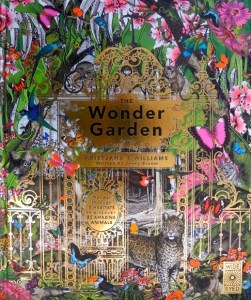
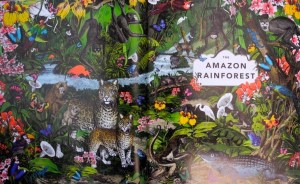
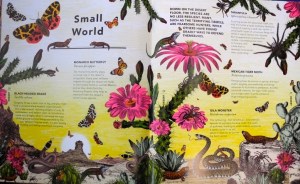
Prepare to be dazzled when you open up this sumptuous volume; it truly is a wonder to behold. Then, step through the shiny golden gate and you’re inside the wonder garden that is our planet earth and thence, explore five amazing ecosystems. First is  …

DSCN5276 (800x600)

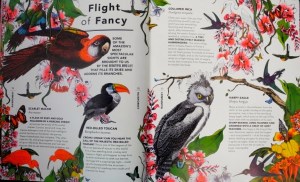
with its superabundance of reptiles and amphibians and its plethora of beautiful birds large and small.

DSCN5277 (800x600)

Next destination is the Great Barrier Reef where we learn amongst other things, of the interdependence of coral and elaborate fish.
The Chihuahuan Desert with its hugely fluctuating temperatures is the next stop. It’s a place where harsh conditions and food scarcity make survival difficult for many of its 130 mammal and 3,000 plant species.

DSCN5278 (800x600)

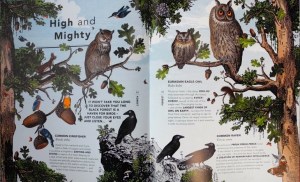
The Black Forest with its tall pines (a bird haven), mountains, eight rivers and several hot springs, all of which help make a place that has a rich variety of flora and fauna is featured next.

gbDSCN5279 (800x600)

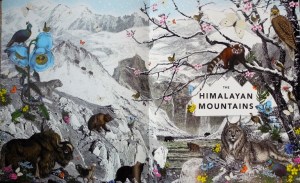
And the final stop is the mighty Himalayan Mountains and the only one of the locations I’ve visited and so recognize some of the animals and plants shown.
DSCN5280 (800x600)

Every one of the locations is spectacular in its own way and the overall experience is one of awe and wonder, but there’s also an almost magical feel to the whole thing. At every turn of the page Kristjana Williams presents a visual feast of insects, reptiles, birds, mammals (or marine species) set against land- (or sea-) scapes of greens and browns splashed with vibrant carmine and fuschia.
Four double spreads are given to each habitat: the first being a spectacular panoramic view jam-packed with its living inhabitants so powerful one can almost for instance, hear the croaking of tropical frogs in the Amazon Rainforest. Every location is introduced by a verbal visualization of what one might feel, see and hear on first arrival and panels containing factual information about the habitat. On the subsequent pages, filling the spaces between the stunning artwork, are blocks of text giving factual information about the habitat.
The superabundance of fauna and flora at every location means that comparatively few species get a mention and that’s fair enough in a book of this kind, though as someone with more than a passing interest in botany I would have liked some more details about the glorious flora depicted.
Assuredly a book to return to again and again and one that might well spark a lifelong interest in some aspect of the living world in the person fortunate enough to come upon this in a bookshop or library or even better, receive it as a gift.

Use your local bookshop      localbookshops_NameImage-2

Up in the Garden and Down in the Dirt

DSCN4190 (600x800)

Up in the Garden and Down in the Dirt
Kate Messner and Christopher Silas Neal
Chronicle Books
A little girl narrator shares with readers a season in the garden. Beginning in the springtime and with her hands clutching seeds, the girl is eager to start planting. Her Nana however cautions her to wait for the ground to warm and dry out.

DSCN4191 (600x800)

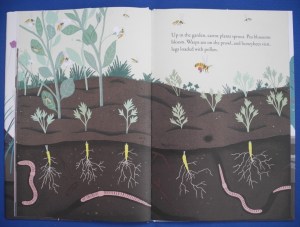
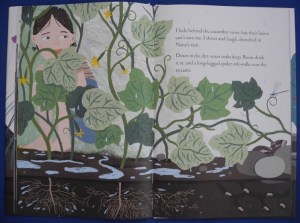
Meanwhile there’s much to learn about happenings under the ground. “Down in the dirt is a whole busy world of earthworms and insects, digging and building and stirring up soil.” she is told and more. Above ground too there is work to be done – human work, weeding and composting until it’s time to plant.
As spring turns to summer, tiny shoots appear and pea blossoms bloom – a boon for honeybees and wasps, while down below there’s more activity, plant and animal.

DSCN4192 (800x600)

Gardening can be hot work so it’s a good job Nana has a sense of humour and the hose …

DSCN4193 (800x600)

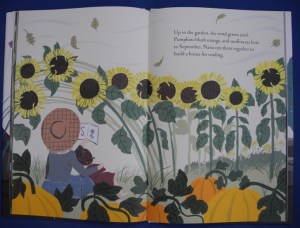
Through the summer there is food in abundance for both humans and small animals and soon it’s time to harvest the squash and cucumbers. Come September the sunflowers are in their full daytime glory

DSCN4194 (800x600)

and at night the orb web spider is busy spinning to catch her night-time prey.
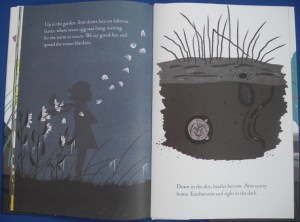
With that autumn chill in the air, the two need to finish collecting the harvest overground while the ants are busy beneath them storing food against the winter cold. Before long the garden has its first frost and down in the dirt beetles burrow, ants scurry and earthworms curl themselves up to sleep.

DSCN4195 (800x600)

In wonderfully poetic words, Messner proceeds to remind us that, even though ‘the wind smells like winter … the ripe days of summer still rest in the garden beds’ and the insects ‘dream of sunshine and blossoms and sprouts.’ : a new garden awaits the spring under the bare trees and down in the dirt.
There is just so much to celebrate about this beautiful book: the manner in which the two artists – one verbal, the other visual have worked in harmony with one another and nature to create this garden in a book: a garden that one wants to share, to visit and to reproduce. It’s a celebration too of the relationship between old and young, the peace to be found in a garden through the changing seasons and much more.
Both author and artist show such amazing attention to detail: the whole thing is just a joy to have and to share. The colours of the mixed media illustrations are gorgeous, the language lyrical, the production and design excellent and there is also an author’s note about the communal nature of any garden, suggestions for further reading and the final pages are devoted to short paragraphs giving details about the garden animals – residents and visitors.
Celebrate words, celebrate pictures; celebrate nature, celebrate life – that’s what this book so subtly teaches us. As Robert Frost says, ‘I shan’t be gone long. – You come too’.

Use your local bookshop localbookshops_NameImage-2

Flight of the Honey Bee

DSCN4088 (800x600)

Flight of the Honey Bee
Raymond Huber and Brian Lovelock
Walker Books pbk
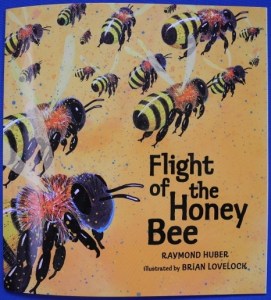
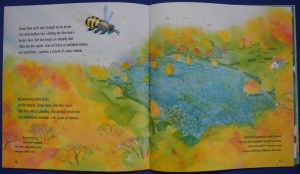
Did you know that ‘Bees can smell in “stereo,” each antenna smelling in a different direction.’ I certainly didn’t. Nor (despite having a partner who is a natural history fanatic) did I know that their eyeballs are furry; but these are just two of the fascinating details I learned from this absorbing book. Essentially it documents the story of a honeybee, ‘Scout’ from the time she leaves the safety of the hive and, as autumn approaches, flies out into the world in search of pollen and a nectar source.
One almost feels like a participant in Scout’s journey, such is the quality of the detail in Lovelock’s watercolour, pencil and acrylic ink illustrations

DSCN4087 (800x600)

and the descriptions of Huber’s (himself a beekeeper) writing: ‘ Scout flies swift and straight as an arrow. The wind buffets her, ruffling her fine hairs on her face … Eyes as black as polished stones are searching – seeking a splash of colour below.’
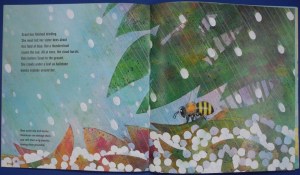
Each stage of the search is vividly described using that present tense narrative voice: the narrow escape from a hungry blackbird, the nectar locating and sipping, pollen collecting in the ‘sea of flowers’. Then comes Scout’s battering by the hailstorm,

DSCN4086 (800x600)

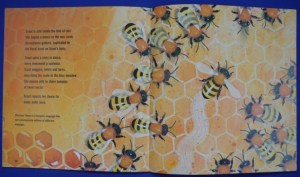
the encounter with a wasp and her re-entry to the hive where she communicates with her sister bees describing in her dance language the route to the meadow.

DSCN4085 (800x600)

Next she passes her nectar to the house bees, transmits the pollen from her body to the ‘babysitter’ bees that mix it with honey to feed the babies, before settling down for a recuperative rest. A rest that will enable her to join her fellow bees for the autumn harvest in that ‘blue meadow’ she has located.
Sadly, here in the UK, honey bees are declining in numbers: the author ends by giving readers some brief tips on how they can play their part in helping these vitally important insects survive and thrive. An excellent, exciting and educative book.

Use your local bookshop localbookshops_NameImage-2