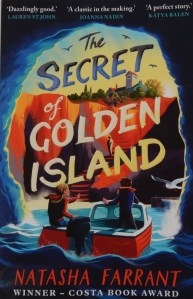
The Secret of Golden Island

Yakov has had to leave his war ravaged home country and now is staying with relations. He struggles to fit in at school and cope with being away from his loved ones. Skylar’s struggles are with how she feels after her grandfather’s stroke (he’s always been her rock) and a bullying incident at school for which she is suspended.

Skylar: ‘I’m not crying.’ Yakov: ‘I know.’ These are the very first words the two children exchange and somehow this brief interaction is the beginning of a friendship, one they both desperately need. Both of them too have a strong desire to change things for the better and not just for themselves but for those they love. It’s this that brings them even closer to one another as they enter a competition, the prize for which is the ownership of the nearby Golden Island. How though can two children compete successfully against adults with schemes and plans of their own?

Certainly, the call of the island is very strong but the quest they embark upon must be kept secret from family members and they only have one another to rely upon for their safety. As the adventure progresses Skylar and Yakov’s friendship deepens, they reveal more about themselves allowing things they’ve kept deep inside to be exposed.

Trying to solve the clues they’ve been given, the pair come up against some competitors who will go to any length to achieve what they want. Can they overcome all the obstacles that arise during their quest, including a desperate race against time with way more at stake than the competition?

Totally gripping, compassionate and exquisitely told, this book swept me away and as I reached the final paragraphs I felt tears welling up, such is its power.

A wonderful read for older KS2 readers and beyond.
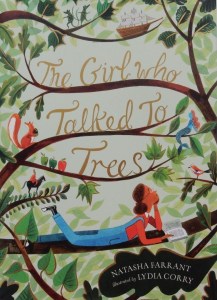
The Girl Who Talked To Trees

The Girl Who Talked to Trees
Natasha Farrant, illustrated by Lydia Corry
Zephyr

Olive is eleven, so shy that she is overwhelmed when she has to talk to people but is comfortable talking to trees especially her old oak in the meadow. Said oak tree is four hundred years old and in great danger from Olive’s father, Sir Sydney. He has resolved to build a new summerhouse in the meadow so that he can impress friends when they visit. When Olive learns of this, so distressed is she that she finds the courage to speak out in defence of her precious friend oak. Surprised by his daughter he gives her until teatime to think of something more impressive than his proposed summerhouse and if she can, he promises not to cut down the oak. With that he departs for the day leaving Olive with just seven hours to come up with something. Full of determination, she dashes outside to think and falls asleep beneath her oak tree.

Thus, fuelled by arboreal magic, begins a truly wonderful adventure wherein Olive listens to a series of enchanting interlinked stories told by seven different trees from various parts of the world (one for each hour she has) every one at a particular stage in its development. She finds herself scaling ivy to the topmost branches of an oak and helping a prince; then she hears in turn tales told by a linden tree, an alder, a London plane, a wild apple, a tulip tree and finally a grudge-bearing box tree. She hears of such things as mermaids, a storyteller who shows a duchess something unexpected, sisters escaping from unwanted marriages

and more, each imbued with the stuff of fairy tales as well as crucial messages about conservation and especially, the vital role of trees to our planet.

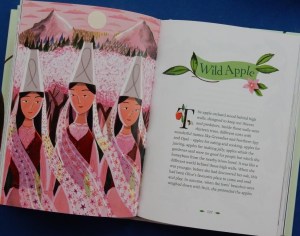
Between each is a superbly illustrated double spread giving information about the next tree to regale Olive and readers with its story. Both these and the colour illustrations throughout the narrative are the gorgeous work of Lydia Corry, helping to make Natasha Farrant’s stories within a story, a book that will delight lovers of the natural world, fairy tales and captivating literature. If you want to know whether Olive succeeds in saving her oak, you’ll need to get a copy so I suggest you buy to keep and buy to give.

(The botanist in me noticed that the Linden is misnamed as Talia, not Tilia and several of the trees given both genus and species names have capital letters at the beginning of both eg Liriodendron Tulipifera rather than Liriodendron tulipifra – a shame in such a super book).