100 Forest School Activities / Bird, Bee & Bug Houses

Team Naomi and Dan, who run Outback2Basics, bring their ardour for the outdoors to the pages of another book.

Forest School should be part and parcel of the curriculum for every primary school child and the activities herein offer a wide range of ways to get youngsters connecting with the natural world.
It’s divided into five main sections, the first being Connecting With Nature. I particularly like something I’ve not tried before – making a camouflage cape. It will involve some cutting and sewing so make sure you check the ‘You Will Need’ list before setting out.
Chapter two Fire, Food and Shelter has more than ten food-related suggestions including making feta rolls, which sound tasty and something I plan to try.
Decorating leaves as per the instructions for one of the Nature Crafts is a creative idea that has lots of potential and once decorated said leaves can then be used to make for instance, greetings cards, a mobile or leafy butterflies. Another leafy possibility is to mould a leaf bowl using air dry clay and it can be done during any season of the year.
It’s great to see that most of the Games in the section of the same name are designed to get children working co-operatively and who wouldn’t want to try creating a ‘twiggy owl’.

There’s a template given at the back of the book but children might like to create a much larger owl so they could start by drawing their own template. Equally delightful is the leaf bat also made from sticks and leaves. All members of your forest school group could then leave one leaf bat dangling somewhere to create a collaborative display.
Before the five chapters are an introductory spread, followed by some general practical information including safety preparation, basic knots and vital pages about knives and fire.

Teachers and others working with children, this latest book by the Walmsleys is well worth adding to your resources.

Our local community-built forest play area for young children contains two bug hotels. Little humans and their carers who may be inspired to open heir own establishments would do well to get hold of a copy of this enticingly illustrated book. Therein are practical, clear instructions on how to do so, as well as a dozen or so other projects to help and encourage wild-life from birds to beetles, bats to butterflies.
Some projects such as making a bird box or a bat house

will need considerable adult involvement but others, a bird bath, a butterfly puddle area or a mini meadow for instance, require minimal adult intervention. Alongside the projects there are spreads with useful factual information relating to terminology and about some of the creatures likely to be encountered including owls, bats and frogs.
Esther Coombs supplies clear visual support and relevant illustrations of the animals. Backmatter includes a glossary and lists some conservation websites.
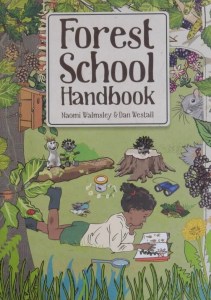
Forest School Handbook

Forest School Handbook
Naomi Walmsley and Dan Westall
GMC Publications

It’s great to see husband and wife team Naomi and Dan, who run Outback2Basics bringing their passion for the outdoors to the pages of another book.

As a teacher, I’ve long been a firm believer in the vital importance of outdoor education for children right from their early years and consequently many of the activities in this handbook are not new to me. Nonetheless, it’s always good to be reminded of things as well as to discover fresh ideas.

After an introduction, which talks about the purposes of forest school activities and the benefits from playing outside and interacting with the natural world, the book is divided into ten sections, each with an abundance of colour photographs, and the age appropriateness, time, materials and tools needed for every activity.

Controlled risk taking and developing social skills, both of which are fundamental to forest schooling are two of the most vital elements of education and the sessions this book offers are so much more worthwhile than being cooped up all day in a stuffy classroom. What would you rather your child(ren) did: make charcoal (and perhaps use it to draw with), build a shelter from the materials lying around in the environment or spending hours staring at a screen?

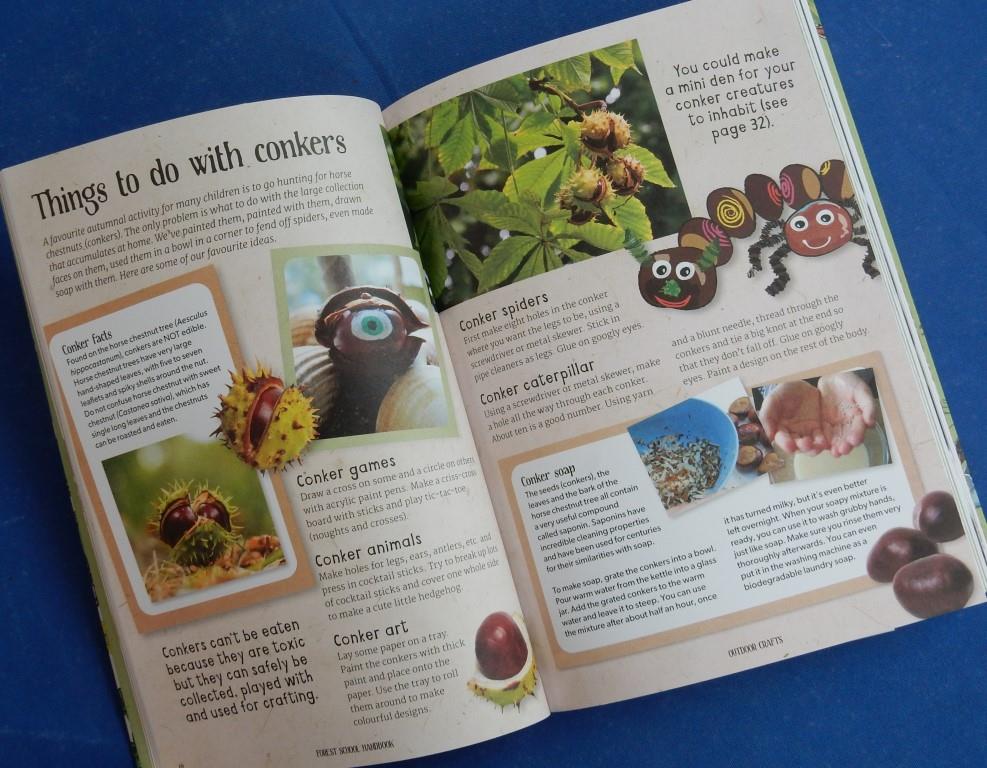
One activity that appealed to me especially from he ‘Things to do with conkers’ spread is creating conker animals, in particular a conker caterpillar.

Making soap from conkers also sounds interesting .

Altogether a smashing little book that deserves to be in every family and class collection.

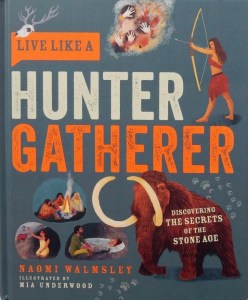
Live Like a Hunter Gatherer

Live Like a Hunter Gatherer
Naomi Walmsley, illustrated by Mia Underwood
Button Books

If you think that early humans were not very clever, or that they frequently said, ‘ugg’ and not much else, then this book will dispel those myths along with providing a considerable amount of fascinating information about how they lived, starting with a map of the Stone Age people’s movements and a timeline showing the three main periods of the Stone Age.

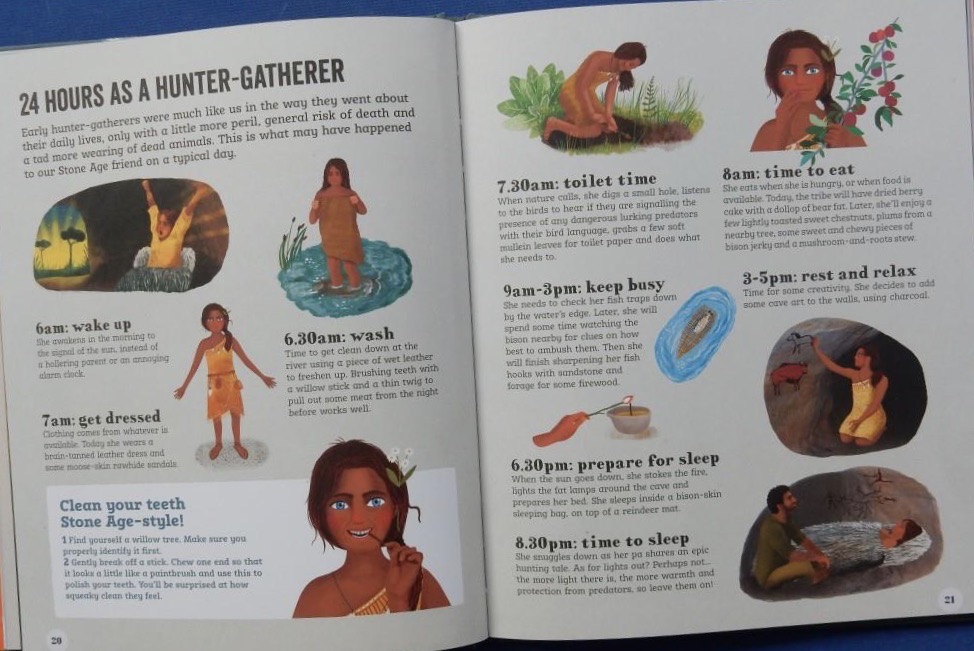
Readers are in the company of an eight-year old girl from a fictional tribe who at various times throughout the book, talks directly to us, sharing her feelings about such things as fishing trips and beginning to use her own bow and arrows. We also get a glimpse of how our stone age ‘friend’ might have passed her time during a typical day, sharing her feelings too,

and realise that the everyday needs of our Stone Age ancestors’ were quite similar to ours – how to keep warm, where to sleep safely and what to eat and drink.

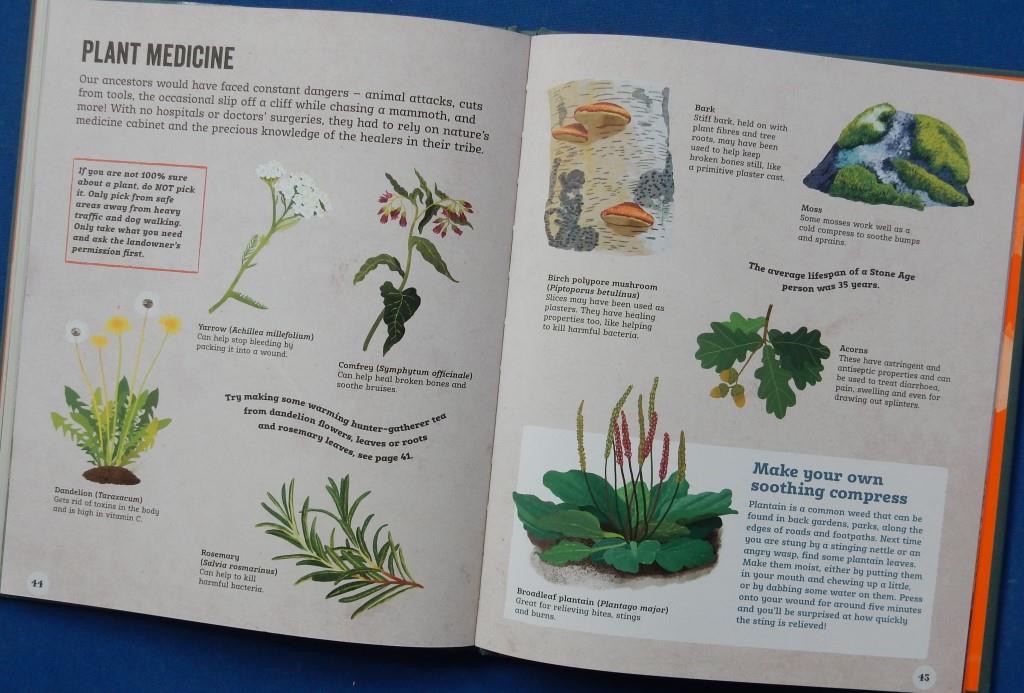
There are spreads on how those basic needs were met, and we learn how they made use of everything from an animal hunted; such a creature provided food yes, but also the means of making weapons, tools, jewellery, clothes and more. Constant danger surrounded these ancestors of ours and without doctors or hospitals, they had only the knowledge of healers in their particular tribe and the medicines nature provided; it’s hardly surprising that the average life of a typical Stone Age person was just thirty five years.

It wasn’t however a life without any fun: early humans made music, engaged in occasional celebrations and made art in the form of small sculptures and paintings especially on cave walls.

Mia Underwood brings all these activities and more to life in her detailed illustrations large and small; while in addition to providing a wealth of factual information, author Naomi Walmsley (who is a forest school and bushcraft instructor), also gives step-by-step craft activities and recipes offering readers first-hand experience of some vital Stone Age skills including making a Mesolithic shelter, some fat lamps, a digging stick and creating cave art.

An intriguing, gently educative resource for home and primary school users.

Urban Forest School

Urban Forest School
Naomi Walmsley and Dan Westall
GMC Publications

Wow! What an absolute treasure trove of ideas this is for anyone who wants to include forest school and all that this has to offer into an urban school or nursery setting. That, one hopes (unless it’s already embedded into their curriculum) includes all early years and primary teachers and other staff.

Equally during this time when many parents are faced with home schooling their children, this book by a husband and wife team totally dedicated to outdoor learning, offers a wealth of activities across the whole curriculum and most could be used with a very wide age range.

After an introduction explaining what urban forest school actually is and where to look for urban nature, why it’s important to do so, and giving instructions on how to tie some useful knots, the main body of the book is divided into four sections.

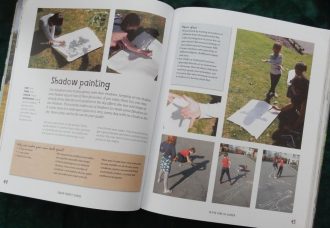
We start with In the park or garden (a quiet street or a porch would suffice) where one of my favourite activities is shadow painting. Strangely enough as I was walking with my partner the other day past a patch of stinging nettles I remarked that their shadows looked much more striking than the actual plants. Then two days later I found this idea in the book. I’ve had children draw around their own or a friend’s shadow many times but never thought of using plants – love it!

Moving further afield Around the city or town has a nature focus and includes such things as cloud spotting and I really like the idea of the city sit spot – an opportunity for mindfulness of whatever your surroundings might be. From that sit spot or walking around, children can begin to get to know about the trees and the flora and fauna close by.

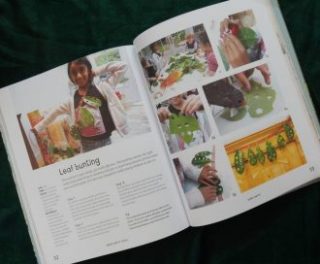
The third section – Home crafts – offers a wealth of creative activities: the leaf watercolour printing can be fun in its own right but also the starting point for other arty projects. I can’t wait to try the leaf bunting activity with children – I have to admit to having a go myself with some leaves and hole punches.

Recipes comprise the final section and there you’ll finding such diverse ideas as stinging nettle smoothie – this one might be an acquired taste, and spiced blackberry sorbet – more up my street I think, but the blackberry plants are still at the flowering stage just now.

Packed with enticing illustrations and photos, and covering so many areas of the curriculum, this bumper book includes something for all ages from the very young upwards, and is a fantastic encouragement to get children outdoors learning about and through nature.

Forest School Adventure

Forest School Adventure
Naomi Walmsley and Dan Westall
GMC Publications

The husband and wife authors of this book are passionate about introducing children (and adults) to their wild side, to connect them to the natural environment. The book of more than 170 pages is profusely illustrated with photographs and after an introduction extolling the benefits and importance of outside play in nature, is divided into four sections.

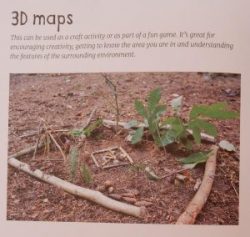
In the first, Nature Awareness, there are such activities as making a bug hotel, creating natural collages and sculptures, leaf and flower plaques, playing with clay and making 3D maps.

Each activity is introduced with the suggested age range, likely time needed, the tools required and the materials to be used. My favourite in this section is Sit Spot – finding a place to sit quietly for ten minutes or more to take in the sights, sounds and smells of the natural surroundings.

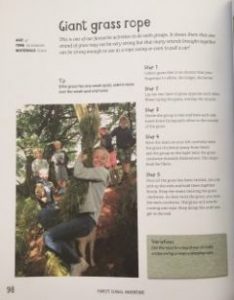
The next section, with more than 80 pages, is Bushcraft and covers knots, shelter building all aspects of fire from lighting one without matches, types of firewood and fire lays, and carrying fire, collecting water, making cordage

and rope, using a knife safely, wilderness first aid, arrow and spear making, making pots and even making a lamp from nuts.

Section three has 25 pages on Wild Food including foraging tips and recipes for cleaver and nettle cordial, nettle tea, methods of cooking chicken and fish over a fire and cooking inside fruit and vegetables.

The final, briefest section, is devoted to games. My favourites were ‘seven second camouflage’ and ‘egg drop’ – making a protective nest around the egg so it doesn’t break when dropped from around 2metres.

Interspersed with all this are half a dozen episodes from the authors’ 5 months stone-age immersion experience in the USA.There’s also a list of resources at the back of the book.

I believe that forest school should be part and parcel of children’s early years and primary curriculum. However, despite the enthusiasm for it, particularly with early years staff, many schools stop offering it for older children claiming pressure from the supposedly more academic curriculum. Perhaps reading a book such as this could re-enthuse or introduce all adults working with children to the benefits of, and learning potential across the curriculum, of forest school.

Every primary school should have a copy.