The Hug Button

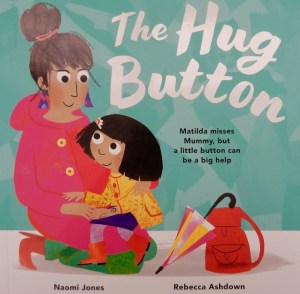
On Matilda’s first day at The Meadows she wakes up excited at the prospect of starting school and her upbeat mood continues all the way to the school door as she and her Mummy sing together, jump over bubbles and count birds. However when they arrive Matilda’s tummy feels ‘all squirmy’. Her mum gives her a reassuring hug but Matilda finds saying goodbye very difficult. Moreover, she’s at a loss to decide what to play when her teacher, Miss Cartwright, asks. Eventually she plays with small world dinosaurs with Ana and draws pictures beside Leo but nothing stops her missing her mum.

The following day Matilda is anything but excited as she leaves home to walk to the Meadows and clutches her mum’s hand tightly at the door. When asked what is wrong, she tells her mum that she doesn’t like saying goodbye and misses her when she’s in school. Her understanding mum finds a pen in her bag, draws something on Matilda’s wrist and the same image on her own. “This is a hug button,” she tells her daughter and explains how they work. This helps her feel better as she goes into class. There are times during the day when she needs to use her special button and it definitely helps with her tummy wobbles. She even forgets the button as she has a fun time at the water tray

but then needs it at story time only to discover that it’s washed off. Tears start welling up but Matilda remembers that her mum had said that love is always there, even if the person you miss isn’t. Can she send her Mummy hugs without that button and will her mum know? And will that help button continue to work its magic until it’s no longer needed. When a new boy starts and Matilda sees him clinging to his dad at the gate, what do you think she does?

Starting nursery or school is often a tricky, anxious time for young children and the idea of a special hug button is definitely worth trying. The story is one that will help a beginner feel confident as they take those first big steps

Thunderboots

Thunderboots
Naomi Jones and Rebecca Ashdown
Oxford Children’s Books

What she lacks in stature, young Trixie makes up for in sheer joie de vivre. She dashes up the stairs in her home, cartwheels along corridors and generally makes her presence felt to the other residents of her apartment block who call her Thunderboots.

When it’s time for her to start school, Trixie is excited and she loves school, her teacher, the new friends she makes and playing on the outdoor equipment. Moreover she really enjoys learning, especially listening to stories but her favourite of all lessons is PE.
One thing she finds really challenging though is learning letters and writing. School isn’t such fun any more ; everything feels hard, so she tells her empathetic Dad.

Dad says that everyone learns differently and that is perfectly fine; he sees things and thus learns differently from others: he calls this a ‘superpower’.

Next day at school Dad and Trixie’s teacher chat and make a learning plan to help his little girl, who has dyslexia, with the things she finds tricky.

This includes a class circle time where everyone highlights something their neighbour is especially good at. Now at last Trixie decides that having a superpower and learning differently is just a part of who she is.

Drawing on her own experiences of growing up, the author has created an empowering story of a neurodivergent child, who happily, had the understanding and support she needed. In this celebration of everybody’s unique abilities, Rebecca Ashdown portrays Trixie as a thoroughly endearing character, bursting with energy and enthusiasm for life and I’m sure young children will love exploring the fun details in every one of her scenes be they at home or in school.

How To Make A Story

How To Make a Story
Naomi Jones and Ana Gomez
Oxford Children’s Books

When Milo asks his mum for a brand new story, she suggests he should make one up for himself. This presents a problem for the boy who worries about getting it wrong but Mum assures him that ‘you can’t get stories wrong’. She mentions the need for a beginning, middle and end, and supplies a prompt to get his ideas flowing.Having named his protagonist Wolf, Milo dashes into the garden in search of ideas and there he finds his Nana. She supplies the next prompt which really gets the boy’s creative juices flowing.

Then back indoors, Dad’s comment about the middle of a story sets him off again, conjuring forth tumbling rocks and hungry monsters.

Further ideas come and by now Milo thinks his story is amazing, but how to end it.

In his room once more, he puzzles over this, recapping and then starting to play with his bricks. Can this further stimulate his creative muse enabling him to come up with a really satisfying ending. It surely can and even better, he finds an audience with whom to share his story, ‘Wolf’s Big Adventure’.

Ana Gomez presents Milo’s tale complete with child-like art on the penultimate spread and the book ends with him finding a safe place to keep his book until next time, but is it quite as safe as he thinks …

What a lovely way to explore story-telling with young children. Naomi’s narrative together with Ana’s illustrations make a superb starting point for children’s own storying.

The Odd Fish / How to Spot a Dinosaur

Introducing two recent Farshore picture books – thanks to the publishers for sending them for review.

The Odd Fish
Naomi Jones and James Jones

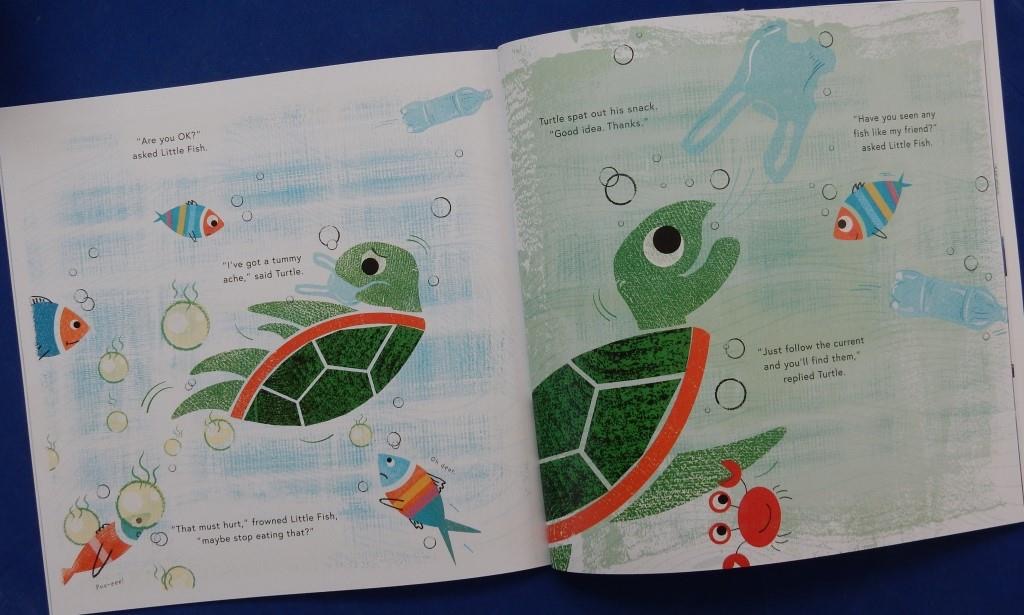
The inspiration for this eco-tale came from the author and illustrator’s then two year old son watching Blue Planet 11 and being unable to differentiate between the real fish and the plastic floating in the ocean. Equally unable to do so is the helpful Little Fish out swimming with her family who comes upon Odd Fish bob, bobbing along alone and assumes that he’s become separated from his family and must be lonely. She suggests she and her shoal help find them and while searching they come upon a seashorse who says that if they follow the current they will find others like Odd Fish. They swim on and come upon and untangle Octopus caught up in a fishing net, have a narrow escape, come to the aid of a turtle endeavouring to eat a plastic bag

and finally there in front of Little Fish is a whole school of odd fish of various shapes, sizes and colours: ‘There’s too many odd fish to count! Where did they all come from?’

The placing of text and images ensures this gentle story flows along beautifully and it’s impossible to avoid the fact that sadly we humans have to take responsibility for what Little Fish encounters – a huge mass of plastic that is a constant danger to the creatures of our oceans. Naomi reminds readers of this on a final spread stating that around 12,000,000 tonnes of plastic finds its way into the ocean every year and asks everyone at home and in school to help reduce this terrible, potentially deadly, pollution.

How to Spot a Dinosaur
Suzy Senior and Dan Taylor

In Suzy Senior’s bouncy rhyming tale of dinosaur hunting in the park we join two dino-enthusiasts, a sister, and her brother who acts as narrator,. Armed with a book of dino-facts and binoculars, the siblings are sure they’re going to find a fair few of these stomping, roarsome creatures. However after several incidences of mistaken identity,

their enthusiasm turns to disappointment and despair; but then the snack man suggests another location to try. Off they go again until they reach a huge building and lo and behold …

Suddenly a fearsome “ROAAAARRRR!” sends them fleeing for their lives, so they think, but perhaps this too is a case of mistaken identity that can only be relieved by slices of cake and cold drinks. Perhaps then the siblings could be persuaded to take another look inside that large building they dashed from.
After an exciting day it’s time to head for home, safe in the knowledge that there’s no need to bother looking out for dinosaurs as they died out long, long ago …

There’s a gentle nod to We’re Going on a Bear Hunt in this lively quest for prehistoric reptiles that continue to be many young children’s favourite storybook creatures. Such dino-fans will definitely love the various misidentifications shown in Dan Taylor’s humorous scenes of the determined dinosaur seekers.

How to Catch a Rainbow

It’s exciting to be part of the blog tour for this uplifting book – thank you to the publishers for inviting me.

How To Catch a Rainbow
Naomi Jones and Ana Gomez
Oxford Children’s Books

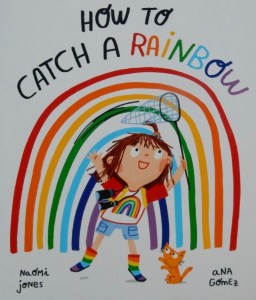
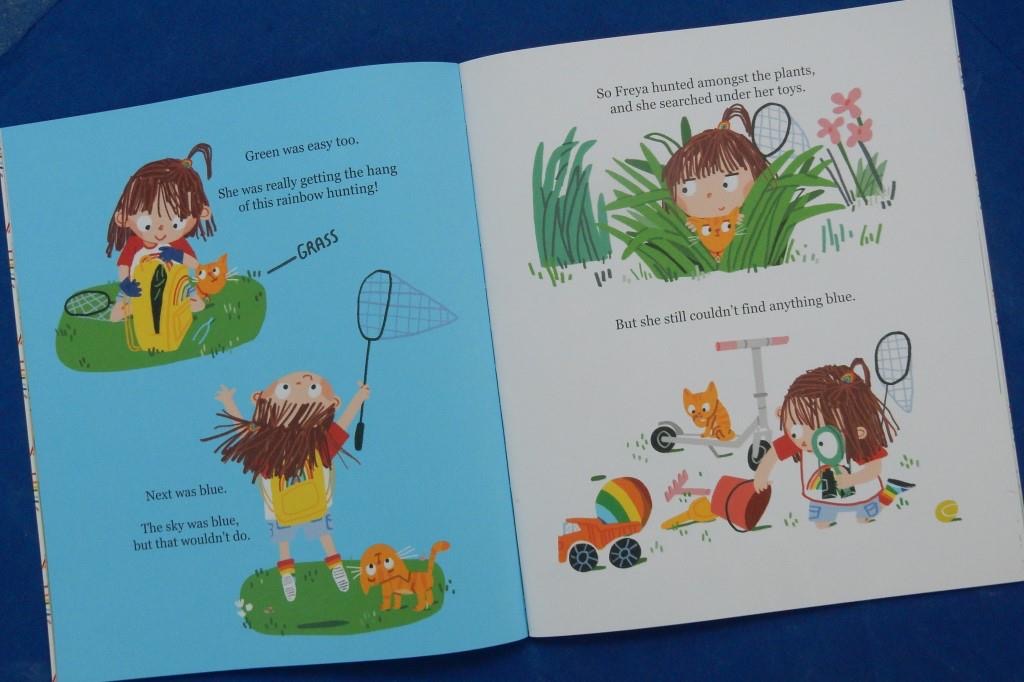
Meet the adorable Freya, a rainbow lover: she delights in its bright colours and its curved shape. In fact her greatest wish is to have a rainbow of her very own..After searching everywhere she turns to science to make one herself; however she has no success. Refusing to give up on her dream, she comes up with another idea. Clad in her rainbow-hunting attire, clutching a net and with a rucksack of equipment off she goes to collect items of the constituent colours. This task is not without its challenges 

but resilience is key and mindfulness helpful; eventually Freya has gathered something for each of the seven colours.

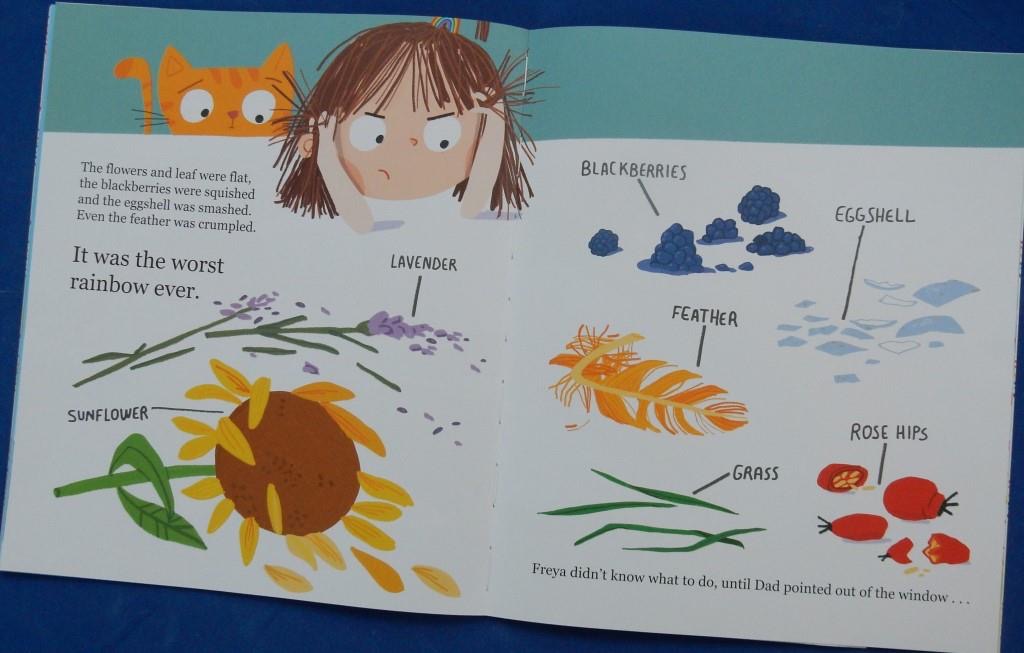
Inspecting her rainbow colours back at home, Freya is disappointed.

Will she ever get that longed-for rainbow? Can she find yet another way to obtain her heart’s desire? Perhaps, with the support of an understanding Dad.

Try your upmost to follow your dream but equally, be ready to adapt and widen your horizons are key messages in this enchanting story of an imaginative girl who will surely capture your heart as she uses her creativity and determination to fulfil her wish. Ana Gomez’s portrayal of the spirited Freya truly captures the ups and downs of her rainbow quest. Listeners will love her attire and relish the opportunity to go on a rainbow hunt through the book’s pages once they’ve heard the story.

Before sharing the book I asked for some suggestions for the colour I was representing and these are the responses:
A bunch of lavender from the fields of Provence.
Violets collected from a forest. I’d put the petals in an airtight container and they could last up to a month.’
I would go out and find red berries and blueberries on the bushes, squeeze them together over something to catch the juice, then add water if the colour is too dark.
A scabious flower from the common.
A huge thistle flower.’

One More Try

One More Try
Naomi Jones and James Jones
Oxford Children’s Books

Mightily impressed with the tall tower the squares and hexagons are building during a play session, that Circle invites triangle and diamond friends to co-construct a tower of their own. They soon discover that easy as edifice erecting might appear, it’s nothing of the sort; indeed it’s fraught with problems of the balancing kind.

However circle, diamond and triangle aren’t giving up that easily; they decide to undertake a training regime to build up their strength. Now although this additional strength helps a bit, a tumbling tower soon results. Perseverance is the name of the game where Circle is concerned, so can a bit of studying improve things? It does, but the tower still wobbles much more than that of the squares and hexagons.

Down but definitely not out, Circle takes time out to give himself a new angle on the challenge.

While so doing, he receives a message from above and although it takes a bit of re-enthusing all the others, they agree to give it one final try working with Circle’s plan. Will success be the reward for refusing to abandon their aim?

In a manner similar to The Perfect Fit, the Jones partnership cleverly combine themes of problem-solving, determination, imagination and mental toughness with mathematical concepts relating to shape. Naomi’s amusing narrative with its plethora of speech bubbles, mainly of the uplifting kind, together with James’s shape characters that while appearing two-dimensional on the page, prove themselves to be anything but, work in perfect harmony: it can’t be easy to give simple shapes personalities but this illustrator has certainly found a way.

The Perfect Fit

The Perfect Fit
Naomi Jones and James Jones
Oxford Children’s Books

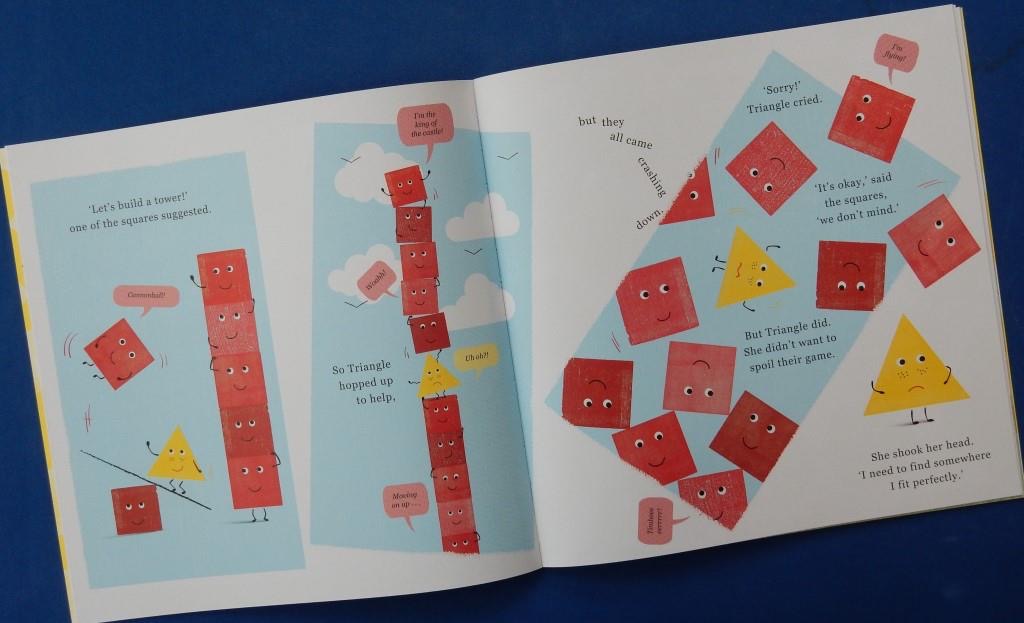
This is a story about what happens when a triangle that feels different among the circles decides to embark on a journey to find a community wherein she feels she belongs.

The squares are welcoming and invite the newcomer to play with them. With high hopes she joins in their building but then despite encouraging comments from her fellow builders, Triangle feels she must move on …

The hexagons are similarly accommodating though still Triangle worries about being different and continues her search. Increasingly despondent she begins to feel that perhaps she’s the only triangle there is, but then a star speaks and hope returns. On goes the search till finally there before her …

However there are limits to the games that triangles can play – no rolling for instance. Triangle remembers the fun she had with all those other shapes and …

A smashing celebration of difference and diversity showing that to fit in, doesn’t mean you have to be like everyone else: a variety of experience leads to a richer community. Life is much more enjoyable when people welcome those who are different, enabling everyone to feel comfortable about themselves. The key is to go beyond the confines of your perceived identity.

This seemingly simple story inspired by author Naomi and illustrator James son’s struggle to fit in when he started nursery, is a perfect foundation stage book for fostering personal, social and emotional development. It’s also rich in mathematical potential.