What You Need To Be Warm

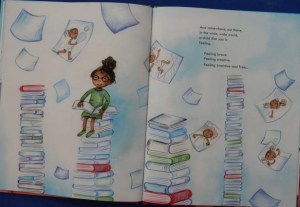
In 2019 Neil Gaiman author and UNHCR Goodwill Ambassador, asked his Twitter followers, ‘What reminds you of warmth?’ He received thousands of replies and from these he composed a freeform poem in aid of UNHCR’s 2019 winter appeal.

The images Gaiman gathered signifying warmth range from clutching a baked potato

to ‘The tink tink tink of / iron radiators /waking in an old house. / To surface from dreams in a bed , / burrowed beneath blankets / and comforters,’ …to ‘the wood burning / in the stove’ .
There is hope though for the poem concludes thus, ‘You have the right / to be here.’
Thirteen artists: Yuliya Gwilym, Nadine Kaadan, Pam Smy, Daniel Egnéus, Beth Suzanna, Marie-Alice Harel, Petr Horáček, Chris Riddell, Bagram Ibatoulline, Benji Davies, Majid Adin,

and Richard Jones each provided an original illustration. Twelve illustrators offered comments printed at the back of the book. Oliver Jeffers created the stirring cover art and this important, compelling book is the result.

A wonderfully warm glow emanates from his cover images: would that such warmth be offered to all refugees and other people displaced of necessity around the world. With both the on-going conflict in Ukraine and now that in Israel and Gaza, its humanitarian message is even more urgent today than it was four years back when the tweet went out.

A donation of £1.55 from each sale of the book in the UK and at least 40p from sales in other territories will be donated to the UN Refugee Agency.

A Child Like You / People Power: Peaceful Protests that Changed the World

A Child Like You
Na’ima B. Robert and Nadine Kaadan
Otter-Barry Books

Beautifully illustrated and presented, speaking directly in a sensitive, heartfelt manner to young readers, author Na’ima and illustrator Nadine celebrate the four children featured, whose actions will surely act as a rallying cry for all children, showing that no matter what, there is always hope.

Inspired by young campaigners and activists, Greta Thunberg, Yusra Maardini, Marley Dias 

and Iqbal Masih, the book highlights the issues of climate change, the refugee crisis, the under representation of black girls in children’s stories, child labour and enforced slavery. 

These four youngsters show the way that other children too – children like them – can also be the change, make the change happen and inspire others to make changes, to speak out strongly on behalf of the dispossessed and the oppressed – to stand up for human rights and make our world a better place for everyone.

A book for all KS1 classrooms.

People Power: Peaceful Protests that Changed the World
Rebecca June, illustrated by Ximo Abadia
Prestel

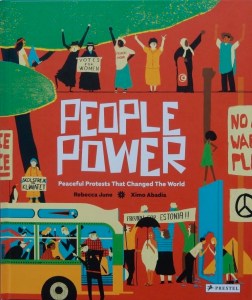
Rebecca June and Ximo Abadia provide readers with a close up look at thirteen revolutionary movements that protested peacefully in various parts of the world, allocating two spreads to each one.

It’s amazing to think that in the UK women have had the vote for less than a century; ‘Votes for Women’ was the battle cry of the women’s suffrage movement on a march through the streets of London one rainy, wintry day in 1907 in what became known as the Mud March; but it took more than twenty years of protesting to achieve their goal.

It was women too, who campaigned peacefully by surrounding the US airbase in the English countryside where nuclear cruise missiles were stored. Their actions were an inspiration to anti-nuclear movements throughout the world.

There are examples of people power from other continents such as the Montgomery Bus Boycott where in 1955, Rosa Parks refused to give up her seat to a white woman and the boycott, which lasted a year, forced the city to change its rules on racial segregation on its buses. Sadly racial discrimination is still with us, both in the USA and throughout the world; hence the necessity for the Black Lives Matter demonstrations prompted by the unlawful killing of the African American, George Floyd by a police officer.

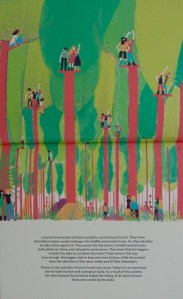
Environmental activists too have a place in this book with Greta Thunberg and her Fridays For Future movement involving young people; but new to me are the ‘Defenders of Pureora Forest’ whose protests against deforestation of this New Zealand tropical rainforest, an important site in Maori culture, saved the forest and led to the ending of felling by the New Zealand Government of all native forests owned by the state.

These and the other movements featured are described in Rebecca June’s straightforward, engaging but never preachy text, and Ximo Abadia’s stylised, often arresting illustrations, both of which convey the message that peaceful protest can effect change, every single voice matters and nobody is too young to start getting involved to make the future better for all of us; what’s needed is optimism, determination and a strong sense of hope.

An important book for primary classrooms everywhere.

Tomorrow

Tomorrow
Nadine Kaadan
Lantana Publishing

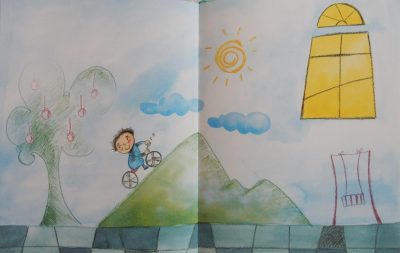
Over the past couple of years there have been several excellent picture books featuring families or individuals fleeing a war-torn home country and seeking refuge in another, often far distant land. But what of those who remain in such a place, a country such as Syria say, where war is all around?

This is the way of life for Yazan and his mother and father.

Yazan no longer sees his next door neighbour and friend, nor does he go to the park. In addition, school has stopped and surprisingly, Yazan misses it.

Artistically inclined, Yazan’s mother used to spend a considerable time painting, sometimes with her son watching, sometimes painting alonlgside.

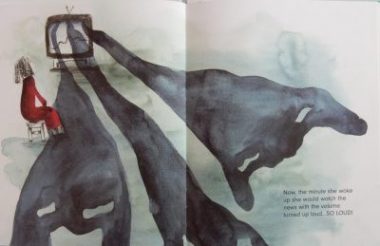
It’s the news on TV that occupies much of her time and attention nowadays though, and his father is also preoccupied.

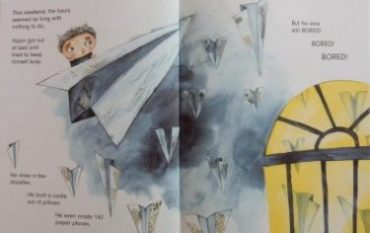
Yazan meanwhile does his best to keep busy himself; but how much doodling, pillow building and paper aeroplane making can you do before boredom sets in?

Going stir crazy he yells his ”I want to go to the park NOWWWWWWWW!!” request to his parents.
Then, ignoring his mum’s “Not today,” response, the boy ponders and then the temptation of his shiny bike is just too much.

Once outside however, nothing looks the same: no stall holder, no playmates, only alarming explosions all around. What should he do: continue his journey or return home?

Suddenly, catching sight of another person, his mind is made up. Then Yazan and his dad walk back quietly hand in hand.
Once home, what his mother does after giving him a huge hug and a warning about going out alone again, makes his heart soar. If he can’t go to the park, then at least she can bring one to him …

And that, for the foreseeable future, will have to suffice.

Over the years I have taught a good many young children who, with their parent(s), have fled conflict in various countries including Sierra Leone, Somalia, Sudan, Sri Lanka, Afghanistan and more recently, Syria; and although one never questioned them about their experiences, in time some did open up, often through their art, about what they had been through.

At that time there were no picture books such as this one for me to draw upon and it’s impossible to imagine what life for a young child must have been like.

Originally published in Arabic in 2012, Nadine Kaadan’s spare, matter of fact telling, in combination with her sometimes sombre, colour palette, create a powerful portrayal of the stark reality that expresses something of what she has witnessed. Towards the end, her watercolour and pencil scenes bring the light into the darkness of a child’s initial confusion, and one family’s near imprisonment within their loving own home.

I close by quoting the author’s final sentence in her letter to readers at the back of this moving book: ‘Today, we wait for a time when “tomorrow” can be a better day for all Syrian children.’ This is surely something we all hope for.
In the meantime, let’s share Nadine’s story as widely as possible.