Aisha’s Colours

Aisha and her parents live in Jakarta. It’s the summer holidays so they are going to spend the time at Grandma’s in a countryside village as they always do. However, Aisha’s not happy: she longs to go somewhere different like her friends.

Once in the car, Aisha talks of her friend Jennie; she’s off to a snowy place: what does snow taste like? Recounting Jennie’s description to her parents gives Mum an idea and they stop for a while and savour a special sweet crispy, crunchy treat – es campur.

As they continue Aisha talks of the blue sky another friend sees when in his holiday home swimming pool, prompting Dad to point out the stunning blues visible through the car window.
The car engine overheats and they have to pause their journey. At her mum’s behest Aisha and Dad go and lie down in a grassy field where the little girl describes the wonderful hues of tropical fish in an aquarium, another of her friends saw on his holiday. Suddenly the sky is filled with multi-coloured kites soaring above.

When they resume their drive, Aisha contemplates the beauty of the colours she’s seen on the way until they finally reach their destination. There Grandma stands;

Aisha is so excited to see her, but she’s even more excited when Grandma serves up her favourite meal. Could its predominantly yellowy colour be Aisha’s favourite? She’s not sure but of one thing she is certain: henceforward she is going to savour the amazing colours in her own life rather than compare her experiences with those of others.

Appreciating what you have is an important theme of this book wherein Nabila Adani’s illustrations engulf readers in a kaleidoscope of colours as they join Aisha on her journey of discovery.

Find Peace in a poem

Twenty poets and four illustrators have contributed to the latest Little Tiger collection, this one being a celebration of mindfulness. Mindfulness I see as the state of being wholly in the present, completely awake and aware of each moment, fully engaged in one’s surroundings and accepting that experience without judgement.

The range of poets here is contemporary and interesting, and included are new poems and some previously published ones. such as Michael Rosen’s The Rhythm of Life and, Zero Weil’s Hide and Seek. Therein she describes looking for quiet and after going to the woods and the sea, concludes ‘I found quiet / it must have been hiding / the whole time / inside my words / inside of me’.

I’ve loved that one since discovering it in Cherry Moon.

Each poet in their own way takes an everyday object or occurrence and transforms it into something memorable and in so doing is asking the reader to look anew at the world. Two poets call on readers to put pen to paper, to preserve (Carter) or let go of (Wakeling) their thoughts. In James Carter’s How Easily, he reminds us how special ’moments disappear like sand.’ Moments such as the sight of raindrops sparkling on a lake and ‘The night / you tried to count the stars.’

Kate Wakeling suggests if you’re feeling down or troubled by your thoughts, settling wherever you are, taking a pen and without stopping or thinking, allowing it to explore, in words or pictures, squiggles even. In so doing you may well find ‘some bright new / thoughts begin to / grow.’ It’s certainly worth trying The Ink Cure next time you feel your brain knotting up.

So too is Nikita Gill’s A Lesson from the Trees. Offering not words or thoughts but a reassurance ‘they will listen to you too, / and show you that the answer / to all life’s storms / is to be patient / and stand strong.’

Each double spread is beautifully presented and the four illustrators have been mindful of not overwhelming the words with their images.

Add to your poetry collection be that at home or in the classroom.

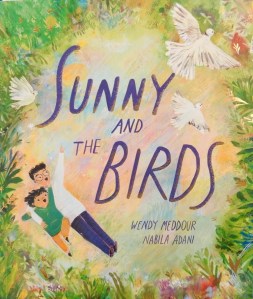
Sunny and the Birds

This image has an empty alt attribute; its file name is dscn9572-2.jpg


Sunny and his family have only recently moved to a new country. Almost inevitably there are things his dad misses. Every evening when they watch the birds through the window and Danny’s father asks him if he can name them, Dad’s response refers to similar ones “back home”. His son’s reply is “But this is our home!”

This image has an empty alt attribute; its file name is dscn9573-2.jpg

It’s evident that Dad doesn’t yet feel at home where he now is. In the middle of the night both Sunny and his Dad are wide awake and the boy acknowledges his father’s sad feelings.


This image has an empty alt attribute; its file name is dscn9574-2.jpg

After school the following day, Sunny’s Nanna meets him and the boy asks if they can go and buy Dad a present – a surprise. Can his bird-related plan help his father begin to feel at home in this new country?


As always Wendy Meddour’s story is written with great sensitivity. Presenting what for many immigrant families is a challenging time, she shows how with love, support, kindness and nature’s healing power, the process of adjustment to a different life can begin.


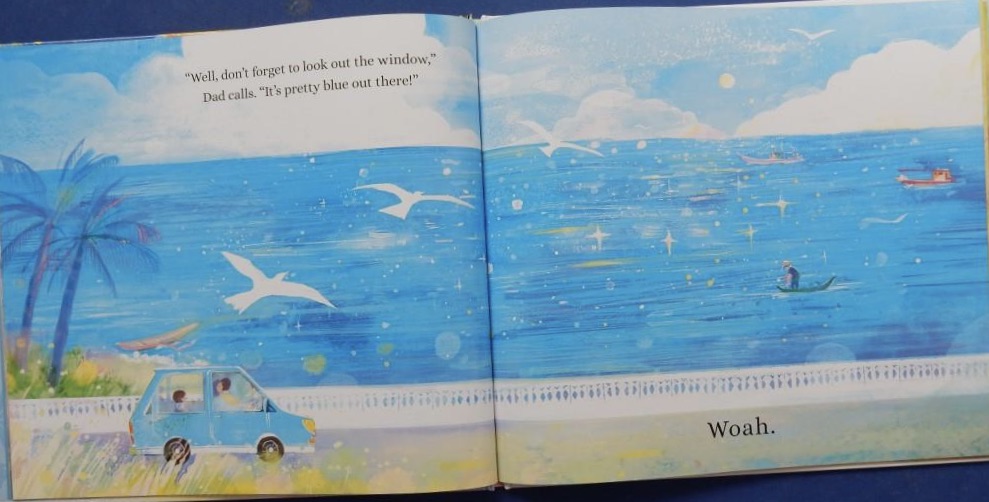
The richness and beauty of the natural world – real and remembered – is elegantly captured in Nabila Adani’s misty illustrations and you can read the changing emotions in her portrayal of the two main characters.


With more and more schools having immigrants as part of their community, this book would help children understand how newcomers might be feeling. Share at home, share in the classroom and invite listeners to participate in discussion, whatever the setting.