Amazing Treasures

Amazing Treasures
David Long and Muti
What on Earth Books

In this the second in the Our Amazing World series David Long presents a veritable wealth of amazing things in his mind boggling assortment of 100+ objects and places.

Some are naturally occurring, others are not and the author’s definition of treasure is sufficiently broad to encompass personal items such as a photograph and a favourite book; the tulip fields of Holland, the Lascaux cave paintings, the Amazon Rainforest, moon rocks (some of which have gone missing) and Bugatti cars from the Schlumpf collection.

Items such as the cars, and the abandoned city of Machu Picchu in the Andes are given just a paragraph, whereas Tikal the ancient Mayan site,
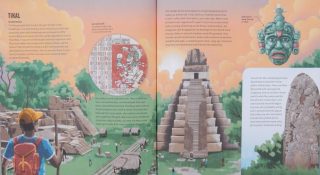
and China’s Forbidden City each have an entire double spread devoted to them. There’s also a world map gatefold as the centre spread that when open shows a list of all the 105 items included.

No matter whether your interest is in architecture, fossils, rocks and gems or the natural world, readers will likely find something new to wonder over here.

The Muti team has used a relatively subdued colour palette for their illustrations most of which are relatively close up depictions; others including Windsor Castle,

Machu Picchu and Masada are shown in aerial views of different sizes.

With topics both ancient and modern (ownership for instance), this fascinating book is one to include in KS2 class collections particularly.
What Do Animals Do All Day? / Rainforest

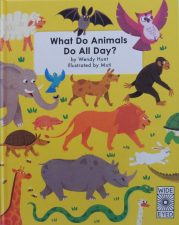
What Do Animals Do All Day?
Wendy Hunt and Muti
Wide Eyed Editions

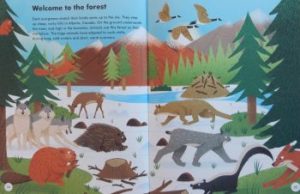
This is a follow-up and in some ways, a companion volume to What Do Grown-ups Do All Day? The author and illustrator take us to fourteen different habitats – every spread has lots to look at – and for each, on the following spread, introduces us to eight residents, every one of which briefs us on its role in that particular ecosystem.

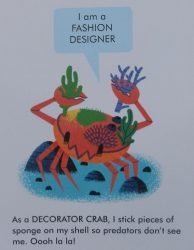
Some of the job descriptions will make young children laugh. The Decorator Crab that resides on coral reefs and sticks pieces of sponge onto its shell as camouflage describes itself as a ‘fashion designer’ …

while the Large-eared Horseshoe Bat calls itself a ‘sound engineer’ since it makes use of sound waves and echoes to locate moths in the dark.

I certainly have no desire to encounter the Striped Skunk, a forest resident that sprays stinky ‘perfume’ lasting several days. and describes its role as ‘perfumier’.
Another forest dweller the North American Porcupine tells readers its an ‘acupuncturist’.

I particularly liked the Death Stalker Scorpion’s description of itself s ‘brain surgeon’s assistant’. (Researchers are using its venom in a cure for brain tumours.)

If you were to visit the wetland reed beds in Somerset you might come across animals who describe themselves as ‘sleigh-rider, ‘aerobatic flyer’, ‘camper’, ‘trapeze artist’, ‘sun-seeker’, ‘submariner’, ‘opera singer’ and ‘synchronised swimmer’. Can you think what their common names might be?

An attractive, somewhat quirky book that provides plenty for children to talk about.

Rainforest
Julia Groves
Child’s Play

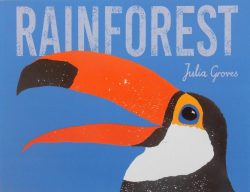
The focus here is on the visual, with fifteen animals being featured in Julia Groves’ first picture book. (Sixteen if you count the butterfly on the title page) None is named until the final spread where detailed information about each of them is given in tiny print.

A single line of text accompanies each illustration that evokes the nature of the particular creature, so for instance, ‘Fleeting ripples trace the runner’ accompanies the picture of the Plumed Basilisk Lizard; ‘Slowly stalking, majestic and silent.’ is the Jaguar and …

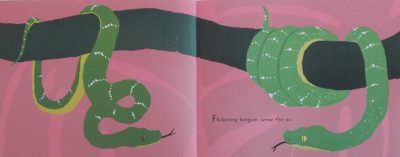
‘ Flickering tongues sense the air’

The rainforest is, as the book’s blurb tells us, a ‘precious and endangered habitat’; Julia Groves imaginative presentation of some of its inhabitants offers young readers an opportunity to enjoy what most of us will never see in the wild.