Cows Are Pink! / How It Works: Fire Engine

These are both Little Tiger board books: thanks to the publishers for sending them for review.
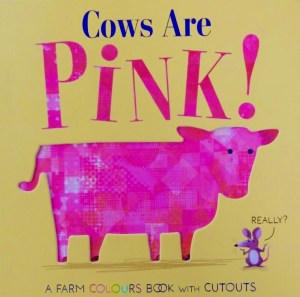
Down on the farm, the animals have all got their colours muddled up. Small children will enjoy predicting what is behind each cut out section before the page is turned to reveal in turn which animal is pink, yellow and red. What about cats though? They’re a bit more problematic and they certainly aren’t green, one of the colours visible through a cat diecut. So what is orange, black and green?
The final spread shows eight different farm animals and each is appropriately coloured, to the satisfaction no doubt of the little mouse character.
With bright, textured illustrations by Gareth Lucas this is a playful book for the very youngest.
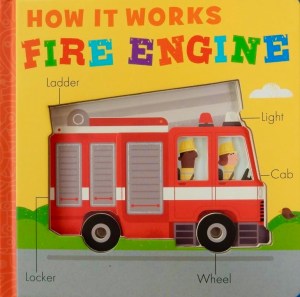
Curious learners, especially those with an interest in vehicles will enjoy this addition to the How It Works series. Nee-naw! Nee-naw! goes this emergency vehicle but first come explanations for little ones about where fire engines are kept; what firefighters do at the fire station when not out on call,, as well as what their uniform comprises. When the crew receives an alarm call it’s a case of off as fast as they can go, sirens and flashing lights warning other vehicles to give way as they approach.
Once the scene is reached it’s masks on and out with the hoses.Sometimes though fire engine crews have to perform acts of rescue for such things as cats stranded high in trees, or they might pay a visit to a nursery or primary school to teach the children the importance of fire safety. Perhaps some of them will be so enthused they go on to join the fire service themselves.

With cutaways, ‘did you know?’ questions, labels and a simple narrative there’s plenty to engage small children.
Bear’s Wash Day / Hide and Seek with the Baby Animals

These board books are Little Tiger Books – thanks to the publisher for sending them for review

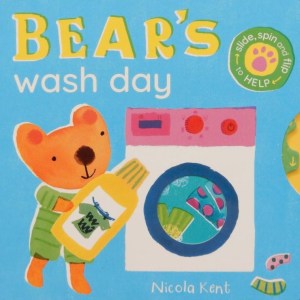
As a result of Bear and Croc’s smoothie making, Bear’s clothes are covered in spatters of juice so the two decide to do some washing. They collect all the dirty clothes, load up the washing machine, add the washing liquid and press the on button. Round and round go the clothes and once the machine has done its cycle, it’s tine to go out into the garden and hang everything on the line to dry in the sun. As soon as Bear’s dungarees are ready to wear once more, he puts them back on and the friends finally drink their smoothies.
With a spinner and flaps to help develop their fine motor skills, little ones can enjoy this simple domestic episode and have fun making the various sounds that accompany the action.

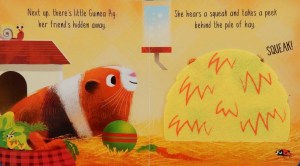
A game of hide and seek offers an opportunity to meet the baby animals that are playing the game on the five spreads herein. Each one has a different shaped felt flap behind which lurks a noisy little creature. Toddlers can join in the play and try to guess the baby animal that went WOOF!, the chirping bird in the birdcage, the squeaker behind the heap of hay,

and meet the bubble blower that’s giving his location away before finally meeting the winner of the game.
Touchy feely fun with dayglo bright scenes by Gareth Lucas in which various minibeasts appear on every spread, adding to the playful experience.

How It Works: Shark / Don’t Ever Laugh at a Ladybird

These are two new novelty board books from Little Tiger: thanks to the publisher for sending them for review.

Cleverly designed with strategically placed peep through parts of every page, this serves well as an introduction to sharks for preschoolers. They will be fascinated to learn that these powerful predators have super-strong tails that enable them to swim faster than a motorboat can move. They may well be surprised to hear that sharks were around before dinosaurs existed. I’m sure humans young and not so young are pleased not to have 300 teeth to clean, the number some sharks possess and having learned that, in contrast to humans, sharks very seldom sleep, young children might try that as an excuse not to go to bed at the proper time.
Playful, fun learning in bite-sized portions, with clearly labelled body parts and “Did you know? interjections from a deep-sea diving mouse that swims up on every spread.

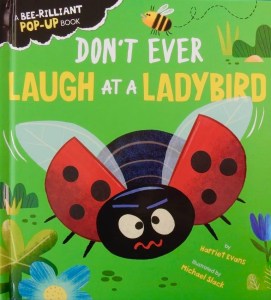
You will probably decide to heed the titular warning of the furious faced ladybird, as well as the rhyming ones concerning the other four irate minibeast kinds that fly, spin forth, leap or slither from the pop-ups on Michael Slack’s wacky brightly coloured spreads. If not, you might easily end up in a honey covered mess after baking with a bee, dizzy from trying to out dance a disco crazy spider, lose your voice while endeavouring to emulate a ribbiting frog, or smothered in slime should you hug a shell-loving snail.
Minibeast madness to read aloud with the very young

Little Chick / Little Bunny / One Little Tadpole

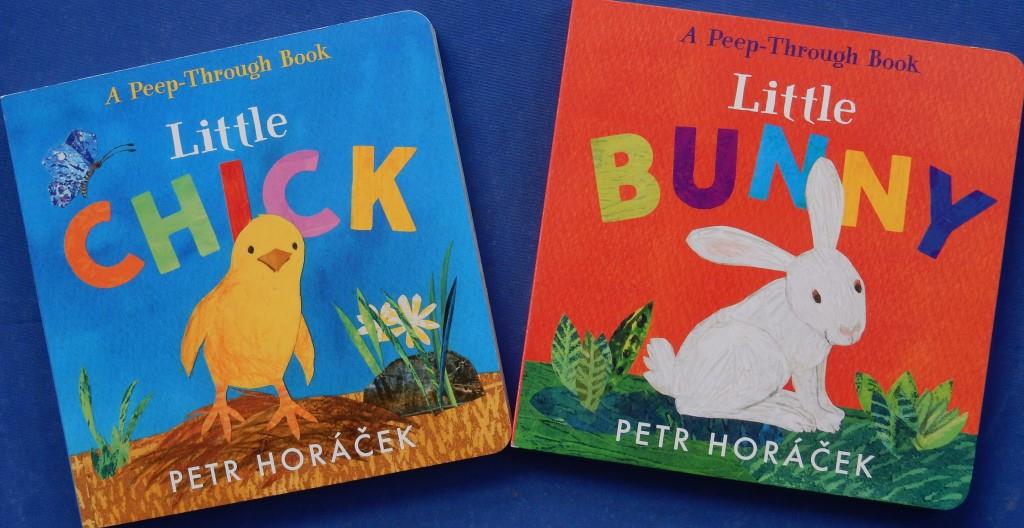
Vibrant artwork with cutaway pages and cleverly placed die-cuts, together with simple question and answer texts, will captivate little humans as they follow the titular animals through their simple stories.
The setting for Little Chick is the farm where she encounters in turn, a pig, a smily cat, a large cow and a tiny mouse, before suddenly emerging onto unfamiliar ground where a friendly horse assists the feathered infant in finding its mother, a mother that is also looking for her little one.


Little Bunny’s adventure takes place in the woods. There are lots of birds to spot as well as a friendly brown bear, but in the bushes lurks a red fox that scares the little leporine. Happily though a kindly owl leads the way to the safety of Mummy rabbit’s outstretched paws.

With his trademark glowing colours, Petr Horáček’s interactive ‘peep-through’ books will be enjoyed by adult sharers and the very youngest listeners. No child is too young for books such as these.

For an older audience is

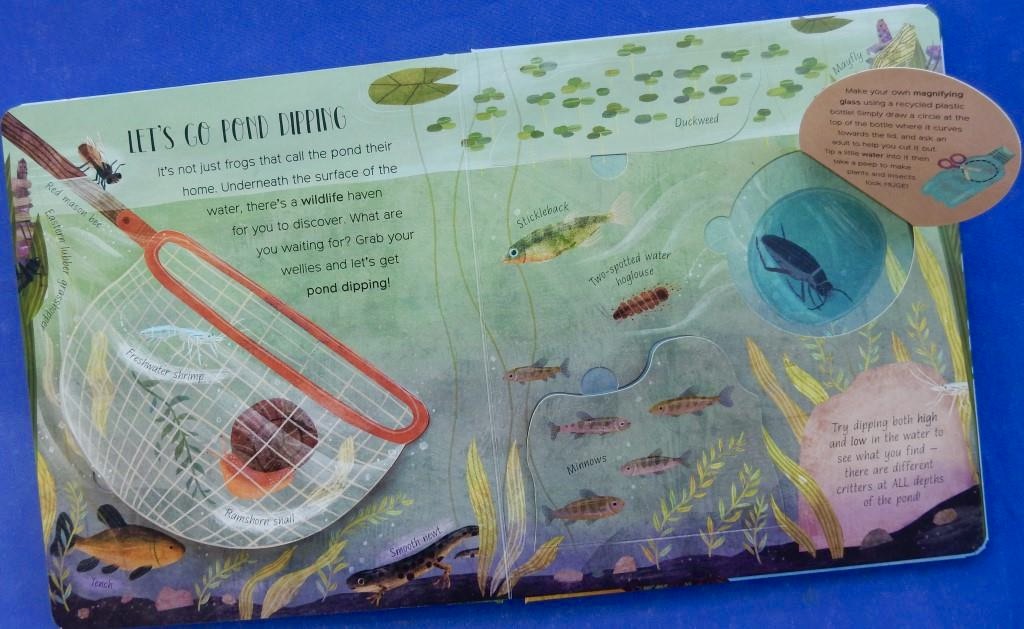
With more than thirty flaps there is plenty of exploring to be done between the covers of this large board book. Besides the life cycle of the frog there is information about the birds, insects, fish, mammals and the flora likely to be encountered in or around a pond. However, not all the creatures – for instance the two frog species illustrated on ‘The Circle of Life’ spread’ – are ones that UK readers would come across. Nonetheless this is a book that encourages children to use all their senses when exploring in the real world and to this end includes a spread on pond dipping.

It’s also good to see, on the final spread, the suggestion that readers create a miniature pond of their own as a way of helping nature to thrive.

Some of the illustrations give only an impression of the animal rather than an accurate means of identification so, having sparked a child’s interest, one would need to refer to a field guide rather than rely on this book’s visuals.

One Little Leaf / All the Things a Tree Can Be / The Odd One Out

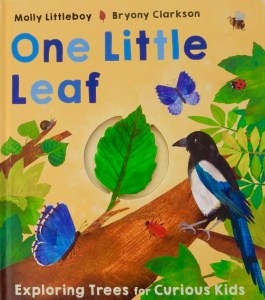
Trees are my favourite thing in nature and I think it’s never too early to introduce young children to their delights. This chunky, large format board book does just that, starting with a spread showing fifteen named leaves from different trees.Four are depicted on flaps, which when lifted reveal a brief paragraph of information about the respective trees on which they grow

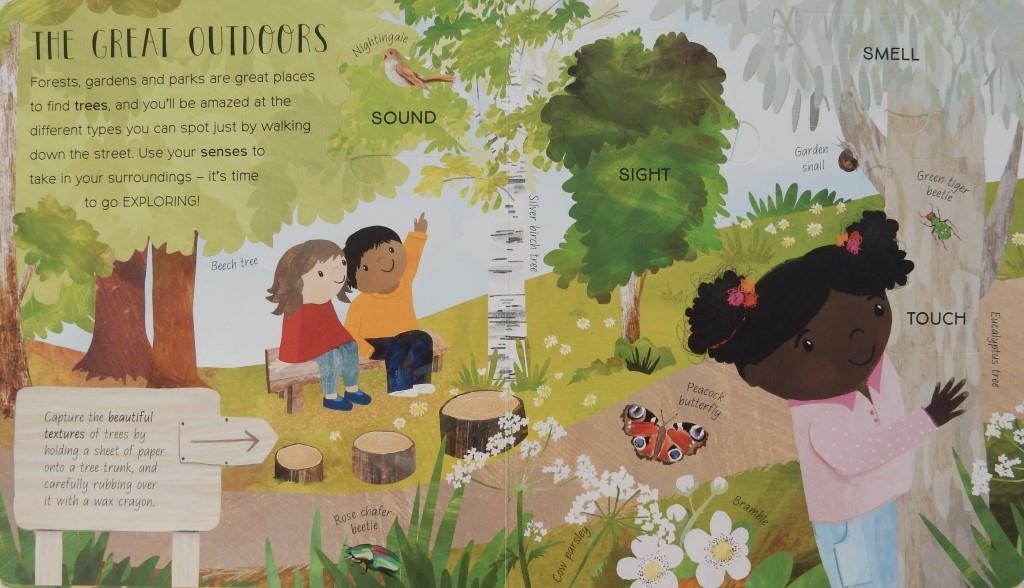
Other spreads are devoted to in turn, sensory exploration of the surroundings, 

the growth of a tree, the tree as habitat for other wildlife, some of the uses of tree parts, seasonal changes of a tree and finally, on ‘Happily Ever After’ readers are encouraged to plant a new tree and to explore the themes included further.

A chatty, engaging narrative runs through the whole book, comprising on each page an introductory paragraph and a suggestion encouraging children to become actively involved with the natural world.
With clear, naturalistic illustrations this is a good starting point on things arboreal, to share with children in their early years.

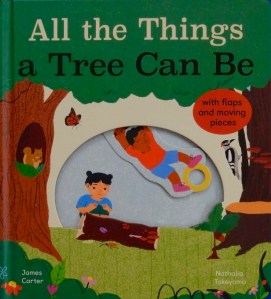
Presenting the wonderful things about trees is difficult in just six double spreads, but author James Carter includes the essentials in this little book. I love the description on the opening page, ‘Trees are ground-hugging / sky-nudging wonders!’ Indeed they are ,be they of the deciduous or evergreen kind, both of which are depicted in Nathalia Takeyama’s first illustration that also includes some woodland birds and animals, and humans.
Deciduous trees change with the seasons and this is the theme of the next spread, which has two flaps for little hands to lift and reveal simple sentences and a different visual.
The third spread takes us to visit a tropical rainforest, rich in both flora and fauna.

‘They are like nature’s tallest hotels!’ so we read on the spread depicting some of the animals that make their homes in trees, some of which benefit the trees in return. Continuing this idea, the final pages present some ways trees are vital to all manner of Earth’s life forms in that they provide food, shelter, warmth, wood, shade and most importantly, they clean the air that we all breathe.
With its integral moving parts, this is a simple introduction to a vast subject for adults and little ones to share.

This book offers a great opportunity for young children to develop their observation skills as they peruse the pages of this ‘spotting book’. The first fourteen spreads present all kinds of interesting animals, a different kind on each, including camels, bats, seals, tortoises, ostriches, pandas, monkeys, rhinos, flamingos, fish, lemurs, penguins and butterflies. In addition a pair of rhyming verses invite the reader to spot the difference on each spread, for example among the camel train, one of their number has a single hump, whereas all the others have two. Another spread asks, ‘Who gets the first fish? Can you spot the winner?’ and depicts a pod of hungry seals, ‘calling out for their dinner’, one of which depicted in the print-like pattern already has a fish in its mouth. 

Some of the puzzles are much harder to spot than others; this reviewer found herself going cross-eyed trying to find the cross-eyed lemur looking at its own nose. Young children will certainly be challenged and entertained by most of the spreads.

On the final spread, a new animal is hidden among the melee comprising several representatives from each of the previous spreads.

Bees & Beetles / Not Just Another Book about Farm Animals / Not Just Another Book about Things That Mooove

Bees & Beetles
Nia Gould and Molly Littleboy
Little Tiger

A surprising amount of information about bugs, in easily digestible portions, is found on the pages of this sturdy, split page ‘flip-flap’ book, the second in a series for the very young.

Children will enjoy being able to change the scenes by flipping the cut portions of the alternate pages to create a different but related scene for first ants, the second showing the inside of a nest; 

then spiders – the start and finish of a web. Following this, youngsters will encounter several different creepy crawlies – dragonflies, grasshoppers, beetles, fireflies and ladybirds on and among flowers in a meadow; transforming the habitat they’ll discover snails and slugs, earwigs, centipedes and below ground level, wriggling earthworms. Bees come next and finally various caterpillars and butterflies.

A useful book to support a minibeasts theme; one that is frequently explored by foundation stage learners.

Presenting information to young children in an entirely different, but equally effective way are

Not Just Another Book about Farm Animals
Not Just Another Book about Things That Mooove

Noodle Juice, illustrated by Jake McDonald
Noodle Juice

In the first the author offers facts in mouth- watering morsels about farms, and their livestock in a humorous style, with contributions from the animal residents along the way. There are spreads featuring hens, pigs, horses, sheep, cows, turkeys, ducks, geese, goats and even llamas. Did you know that you can tell whether a turkey is male or female by examining its poo?

Jokes abound – these are as likely to appeal to adults as the intended young audience and Jake McDonald’s illustrations are suitably comical.

The same is true in the second book that begins by giving a simple definition of transport and goes on to present spreads on myriad modes of moving from place to place. The information is presented by a cow narrator that seems to have a penchant for puns. Here’s an example. 

Readers will encounter feet (as in walking), boats, cycles, trains, cars, buses, trucks, planes, helicopters and rockets all of which have bovine drivers or pilots.

The busy final spread of both books asks ‘Can you find …’ In the farm book, readers have to try and spot the farmer; in the transport book there’s an elephant to locate.

Wacky fun for fact fanatics.