An Animal A Day

Following A Dinosaur a Day, author Miranda Smith turns her attention to wild creatures of all shapes and sizes.

My first port of call was the date this book arrived in the post – 27th October – where the featured creature was the Eastern Water-Holding Frog found in eastern Australia. This small carnivorous amphibian, I discovered, ‘aestivates’ when it becomes too hot and dry … burrowing underground and making itself a water-conserving cocoon from mucus, only breaking out when it rains, which could be several years later. This frog shares a double spread with five other animals, each of which exhibits a form of hibernation, another type of dormancy.

A number of double spreads are thematic, whereas others are devoted to a single animal. One such is Red Deer (16th November). This date is during the two month rutting season and the sound of stags bellowing and clashing antlers with rival males is one I frequently hear in Bushy Park.


I was surprised to meet one of the world’s biggest tortoises, Española giant tortoise, a resident of Española island off the coast of Ecuador. This herbivorous shelled reptile can be as much as a metre long and weigh 70kg, and may spend as much as two thirds of each day at rest. Sadly this tortoise is among the critically endangered animals.

No matter where you open the book (one suggestion given is that you start on your birthday), you will find something of interest as you visit our planet’s amazing ecosystems and habitats and discover how the native animals are able to thrive, or at least survive. Each one is strikingly illustrated by one of the named artists.
Readers concerned especially with conservation of the threatened species, will find information about how we can all contribute to their survival. Back matter includes a quiz, glossary and index.

A Dinosaur A Day

A Dinosaur A Day
Miranda Smith, illustrated by Jenny Wren, Juan Calle, Xuan Le, Max Rambaldi and Olga Baumert
Red Shed

Imagine being able to encounter a different dinosaur, or other prehistoric animal, every day for a whole year. That’s what you can do if you plunge into this prehistoric extravaganza. Herein, after a general introductory spread, you will meet all your favourites such as the fearsome Tyrannosaurus, the club-tailed Ankylosaurus and the plant-eating Triceratops and Diplodocus. You’ll also encounter a great many unfamiliar creatures, some of which have only recently been discovered: I have to admit the majority were new names to me.

One such is Aquilops, one of the beaked dinosaurs. It was a herbivore about the size of a cat with a skull smaller than the hand of a human. Another small herbivore was the Nqwebasaurus (found in what is now Southern Africa) Amazingly so we read, ‘fossils have been found with gastroliths in the stomach – stones it swallowed to help grind up tough plant food,’

As well as dividing the contents by months, the author also uses dinosaur groups – examples are: ‘some of the smallest’, ‘duck-billed dinosaurs’, ‘horn-faced dinosaurs’ and ‘largest of them all’. Surprising to me was that all those included here were herbivorous. One such Antarctosaurus never chewed its food, rather it swallowed plants whole.

Key facts for each dinosaur featured include the period it lived, the family it belonged to, diet, length, weight anywhere remains have been found; and there is also a brief paragraph giving key information ; and helpfully, the backmatter includes a pronunciation guide.

If you have a dinosaur fanatic or a budding palaeontologist in your family then you should definitely get a copy of this book. It’s also one to add to school collections: I envisage it being in much demand especially with KS2 readers.

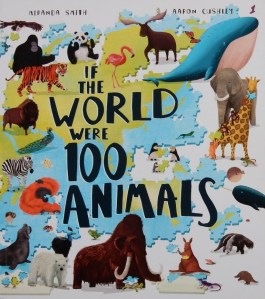
If the World were 100 Animals

If the World were 100 Animals
Miranda Smith and Aaron Cushley
Red Shed

The total number of individual animals on Earth is around 20 billion billion. So says Miranda Smith, author of this book; but it’s exceedingly difficult to visualise such a number, so instead let’s use just one hundred: how does that look? Well, there are many ways of looking at that number; for instance how many are vertebrates and how many invertebrates; how do they differ?

What about mammals? It appears that of the 100, 94 are placental ( I was fascinated to learnt that baby dolphins are born with a moustache), 5 are marsupial and just one is a monotreme -an egg laying mammal) with all five species living in Australia and New Guinea. We’re also shown – by means of a pictorial map – the distribution of wild mammals across the continents.

I was astonished that when considering 100 marine animal species, a mere 9 are already known, the rest have yet to be discovered. I guess that’s not really surprising as we also read that 95% of our oceans haven’t been explored.

Flighted animals, mammals living in the wild,

pets, the animals most deadly to humans, extinct animals and those endangered are the remaining explorations based on that one hundred supposition, and this hugely thought-provoking exploration of biodiversity concludes with some key questions relating to human actions and how these endanger the world of animals, to consider, discuss and one hopes, act upon to ensure the survival of the creatures threatened.

With Aaron Cushley’s bright, eye-catching illustrations on each of the eleven double-page spreads, what is quite a difficult overall concept (that of percentage), with a fair number of biological terms used in Miranda Smith’s text, becomes much more approachable. However, parents of children under seven (the publishers state 5+ in their PR) who haven’t studied biology beyond the basics may well find it tricky to help youngsters grasp some of the content..