Thank Goodness for Bob / The Healthy Coping Colouring Book & Journal

dscn9789

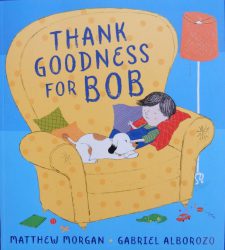
Thank Goodness for Bob
Matthew Morgan and Gabriel Alborozo
Egmont Publishing
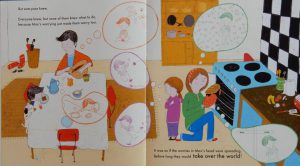
‘A problem shared is a problem halved’ goes the well-known adage. The trouble is, Max an inveterate worrier doesn’t share any of his with family or friends for fear of troubling already busy people or looking foolish: he just stores them all up inside and it leaves him feeling overwhelmed …

dscn9790

Despite this, everyone knows about this and seemingly, his worries are infectious.
dscn9791

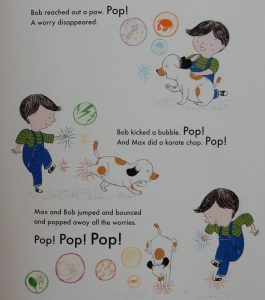
Thank goodness then for Bob. Bob the dog offers a listening ear and Max talks and talks; gradually his worries come bubbling out and drift around the room and then the two of them find the perfect way of dealing with them.
%0a

Gabriel Alborozo’s gently humorous illustrations are perfect for this sensitively told, empowering story that will help children deal with their anxieties.

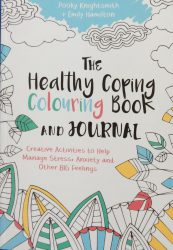
Also aimed at helping children – albeit slightly older ones than the previous book – and subtitledCreative Activities to Help Manage Stress, Anxiety and Other Big Feelings’ is
dscn9803

The Healthy Coping Colouring Book and Journal
Pooky Knightsmith and Emily Hamilton
Jessica Kingsley Publishers
Mental health ambassador, Pooky Knightsmith, has joined forces with illustrator, Emily Hamilton, to produce a book full of activities to help develop and enhance the well-being of children between eight and fourteen. It might well be equally used by adults. The aim is not only to help in reduction of stress but is also a tool for managing feelings and could be used at any time, whether one is feeling bad or good.
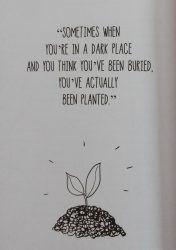
There are plenty of pages to colour, spaces for reflection and writing as well as a plethora of wise words to guide, inspire and motivate.
%0a

There are lots of diary format pages for recording ones personal experiences, preoccupations and feelings.
Buy to use or buy to give.

bookgivingdayblogbadge-1 localbookshops_nameimage-2

Wonderful Wildlife

dscn9092

It Starts With a Seed
Laura Knowles and Jennie Webber
Words & Pictures
Sometimes I open a parcel and just know I’m going to love a book before I’ve even got inside the cover. Such a one is this and as the title says It Starts With a Seed – a sycamore seed.
In this gorgeous book Laura Knowles’ rhyming narrative takes us on a journey – a journey through days, weeks, months, seasons and years as we follow the growth of that seed from the time it falls to earth right through until it’s a mature tree – fully formed with its own ecosystem. Jenny Webber’s delicate, detailed illustrations show every stage of the tree’s development from seedling …

dscn9095

to sapling to the ‘leaf-laden, bark-bound arboreal home’ to the plethora of insects, birds and mammals that live therein.

%0a

What I love so much about this book though is the sense of awe and wonder it’s likely to engender in those who read or listen to its lyrical words and pore over its painterly portrayals of the natural world. Such a superb way to embody a fair amount of information and the whole narrative is presented again on the front of a gatefold finale that opens to show seasonal changes to the leaf and flower and provide additional information such as ‘A sycamore’s small flowers grown in clusters known as racemes’ and ‘A sycamore can grow 35 metres tall’ – wow! And all from one tiny seed.
A book to buy and to keep, a book to share and a book to give: it’s perfect for autumnal reading but equally, it’s one to be returned to often, at home or in the classroom.
Laura Knowles has also has co-written

%0a

British Wildlife
Matthew Morgan & Laura Knowles
QED
Essentially this is a visual introduction to some of the riches of the natural world to be found in the British Isles from frogs to fruits …

%0a

and fishes to fungi.

%0a

Illuminature
Rachel Williams and Carnovsky
Wide Eyed Editions
This is an awesome look at over 180 animals and the plethora of plants that inhabit ten of the world’s very different environments from the Congo Rainforest to Loch Lomond and from the Californian Redwood Forest to the Ganges River Basin.

%0a

Awesome because, thanks to the three-coloured lens (included in a pocket at the front of the book) readers are able to get three different views. Look through the red lens and you see the diurnal animals, the blue lens will show nocturnal and crepuscular creatures and the green lens reveals each habitat’s plant life.
Each habitat is allocated six pages – two ‘viewing’ spreads, one giving key facts about the place and a textless “observation deck’ …

dscn9090

followed by a black and white one –

dscn9091

a ‘species guide’ that provides more detailed information on the particular animals featured in the coloured scenes. I foresee squabbles arising over this one.