Atlas of Amazing Birds

Atlas of Amazing Birds
Matt Sewell
Pavilion Books

Well-known wildlife author/artist Matt Sewell has selected some incredible birds – more than 120 – from all over the world for his latest book.

In his introduction he talks of ‘my personal selection of the most amazing birds in the world—the most beautiful, strange, scary, speedy, and enchanting.’ He also points out that his illustrations – full colour stylised watercolours labelled with both the bird’s common and scientific names – are not to scale (although dimensions of each are provided).

Using the continents as the organisational device, he begins in Europe with 22 birds, which are listed together with a map that labels the countries and an introductory couple of paragraphs. This same format is provided for each of the other six continents.

The accompanying text certainly doesn’t talk down to readers; its conversational style is engaging, humorous on occasion and he’s chosen his words for maximum impact. For example of the European roller he says, ‘impressive flight displays as it twists and turns in the air’; and of the chicks “they can vomit a foul-smelling liquid over themselves to keep predators at bay.’
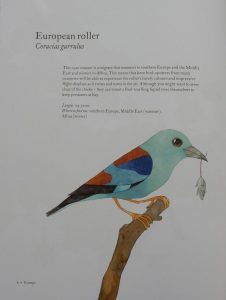
Also included is information about whether the bird is migratory.

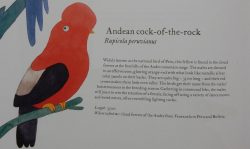
I particularly liked this description of the Andean cock-of-the-rock, ‘The males are dressed in an effervescent, glowing orange-red with what looks like metallic silver solar panels on their backs.’
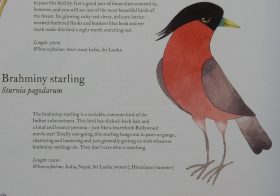
And this one really made me smile: “brahiminy starling … has slicked-back hair and a loud and bouncy persona – just like a heartthrob Bollywood movie star.’ That bird is one I recognise from frequent visits to India as are several of the other beauties from the Asia section.
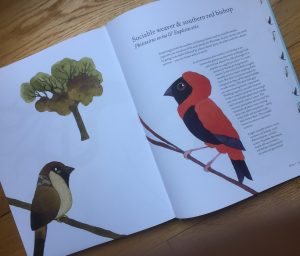
It’s hard to believe but these two African birds come from the same family for as we read ‘one could be going to the ballet, followed by a fancy dinner-party, the other could be a desert sparrow.’
All in all an alluring volume for a wide age range, show-casing some of the avian wonders of the world.

Forgotten Beasts / Dictionary of Dinosaurs / Dinosaur Bingo

Forgotten Beasts
Matt Sewell
Pavilion Children’s Books

If you’ve ever wondered about the strange animals that were concurrent with, or followed in the footsteps of, the dinosaurs, then Matt Sewell’s sumptuous new book is the place to go. ‘Welcome to the amazing world of forgotten beasts!’ announces the introductory line of the book’s blurb. Of the over forty astonishing creatures large and small, most are completely new to this reviewer. Matt supplies readers with a note on his illustrations and there’s a double spread with a time line and other introductory matter before the animals are showcased.

First, we’re introduced to some of the very earliest ones that made their homes in the water: there’s the Ordovician marine dwelling Cameroceras with its 9-metre-long conical shell and the Dunkleosteus from the late Devonian period with its razor sharp teeth that it used to crack open shells of the creatures it fed on.

Two of my favourites though come much later, from the late Pliocene – late Pleistocene era.: meet the herbivorous rhino-like Elasmotherium that weighed between 3,500 and 4,500 kg.

Despite being only around a metre tall, the horn of the male sometimes grew to a length of 1.8 metres.
Another, the enormous owl Ornimegalonyx, is also from the late Pleistocene era. Over a metre tall, it weighed nine kilos.

Awesome!

Written in consultation with vertebrate palaeontologist, Dr Stephen Brusatte from Edinburgh University, this fascinating book will broaden he horizons of dinosaur enthusiasts. Every one of Matt’s magnificent paintings is a stunner.

Dictionary of Dinosaurs
illustrated by Dieter Braun, edited by Dr. Matthew G.Baron
Wide Eyed Editions

Wow! Every dinosaur that has ever been discovered is featured in this pictorial dictionary and who better to grace its pages with his awesome illustrations than Dieter Braun.

After a short introduction explaining the what, when, the demise and evidence of dinosaurs, comes a timeline and a page explaining how the book might be used.
Then we meet each one from Aardonyx and Abelisaurus to Zhuchengtyrannus and Zuniceratops, none of which I’d previously heard of.
There’s a brief informative description that includes  how to pronounce the name, length, diet, when it lived and where found – just sufficient to whet the appetite and perhaps send eager readers off searching for additional information about some of particular interest.

For dinosaur addicts and school libraries or topic boxes I suggest.

For those who can’t get enough of things prehistoric, is a game for the dino-mad:

Dinosaur Bingo
illustrated by Caroline Selmes
Magma for Laurence King Publishing

In the sturdy box are a folded caller’s game board, eight double-sided players’ game boards, 48 dinosaur tokens, 150 circular counters and a dinosaur head box to contain the tokens.
Between three and eight people can participate in what is likely to be a popular take on the classic game. Players might even learn some new dinosaur names such as Maiasaura or Therizinosaurus along the way. I certainly did.

Great for families or a group of friends, and it would make a good present for a dinosaur-loving child.

Dinosaurs and Other Prehistoric Creatures / Atlas of Dinosaur Adventures

Dinosaurs and Other Prehistoric Creatures
Matt Sewell
Pavilion Books

Of the 1,000 dinosaur species that have already been identified, (so we’re told in the introduction) some fifty grace the pages of this beautifully illustrated book by wildlife author and artist Matt Sewell.
In a note about his illustrations Sewell reminds readers that rather than imagining them as big lizards with muddy-brown or dull green scales, palaeontologists now think that many dinosaurs may have been colourful creatures, some even feathered,. This is reflected in his illustrations herein. Did you know for instance that Yutyrannus, a relation of Tyrannosaurus rex, discovered in 2012 had a complete covering of feathers?

Accompanying each one is a paragraph or two of factual information into which the author injects not only occasional surprises but gentle humour too.
I was fascinated to learn that the ‘teenage’ Pachycephalosaurus, termed ‘Stygimoloch’ aka ‘the horned devil from the river of death’ lost its horns in adulthood.

Splendid to look at – I love the large images set against a plain white background – and likely to have a wide age appeal.

Atlas of Dinosaur Adventures
Emily Hawkins and Lucy Letherland
Wide Eyed Editions

This enormous volume – a veritable prehistoric journey of discovery – comes from the team behind Atlas of Adventures.
Herein, through a series of maps

and large colourful dino-inhabited scenes, readers are taken, one continent after another, on a world tour of the various different land regions over different eras, up to the late Cretaceous period when the creatures died out. This was due, it’s thought, to a massive meteorite colliding with Earth resulting in mass extinction that effectively ‘wiped out most of life on Earth.’
Thirty-one dinosaurs (or prehistoric reptiles) are featured (frequently hunter and hunted) but many others are also named and given brief descriptions in the richly coloured scenes within which they’re shown.

Various aspects of dinosaur life, including birth, learning to fly (that’s baby Pteranodons – ‘cousins of the dinosaurs’), to being killed by predators are included and each spread, in addition to the large descriptive paragraph, and the mini info-bank for each creature featured, is littered with relevant, and often memorable, facts. What child is likely to forget that ‘the ‘massive droppings of T-Rex were as long as a human arm and weighed the same as a 6-month-old baby’?
I’m less keen though on some of the visual humour. For instance the Leaellynasaurus (Australian) sporting a striped scarf and bobble hat; or the Oviraptors in what is now Mongolia, wielding what looks like a butterfly net, while perhaps appealing to dinosaur-mad children, to me seemed a tad too frivolous.
Nonetheless, this is a bumper feast of dino-info. and a novel way of presenting same. It’s likely to appeal widely: I certainly learned a fair bit from it.