Minibeasts / What Can You See? In the Garden / We Love Fruit!

There are all new board books from Little Tiger – thanks to the publishers for sending them for review.
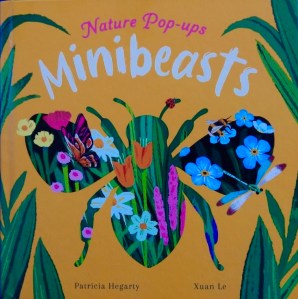
The first of a nature new series where the featured creatures almost leap out from among the plants growing in the flowerbeds. First comes a bumblebee that is busily collecting pollen from a composite flower; then there’s a ladybird that opens up its scarlet wing cases as though to take flight. Next not just one but – well maybe your little one can try counting them – the beautiful butterflies that, wings spread wide, take to the skies and flutter on the breeze. Meanwhile much closer to the ground, a shiny shelled snail climbs slowly, steadily amongst the grasses and ferns while, down by the pond darting among the lily pads, transparent wings shimmering is a dragonfly and finally, peeking from the foliage of blooming wisteria is a chirping grasshopper; but if you look very closely, there’s also one unnamed minibeast making its way along the branch.

Little ones will love watching all these small creatures as they peruse Xuan Le’s vibrant settings for Yoojin Kim’s cleverly engineered scenes.

More minibeasts appear in
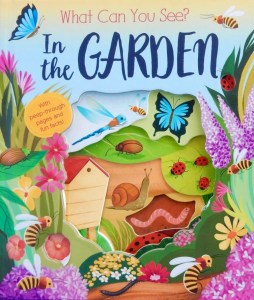
At Rosamund Lloyd’s suggestion, young children take a walk in the garden and discover minibeasts in flight, follow a butterfly through its various stages of metamorphosis, watch honey bees at work, see camouflage and other ways minibeasts keep themselves save from predators. If you take time to forage in the plant litter there are woodlice, millipedes and snails to discover whilst beneath the ground earthworms burrow and ants create colonies. Little humans will delight in such facts as “some millipedes eat their own poo’ and that unlike themselves who have a backbone, insects have a skeleton on the outside called an exoskeleton .
The cutaway pages are cleverly positioned to allow readers to peep through and see what awaits.

Spring is here so share the book and then see what awaits outside your front door.
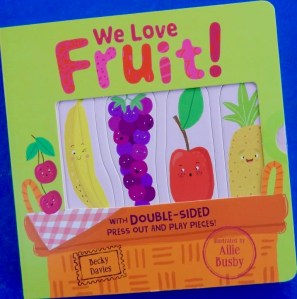
Don’t play with your tasty food. This is frequently said to little ones by parents or carers but now this book gives toddlers permission to do just that. Indeed they will love pulling out the double-sided fruit characters from the sliding tray inside the front cover and meeting the eight different fruity personalities. From these, little humans must follow the clues given on each page and choose the matching cardboard piece. Can they discover which fruit grows in bunches and when dried is called a raisin or which one might take as long as three years to grow?

A clever interactive guessing game, playfully illustrated by Ailie Busby with words by Becky Davies that offers opportunities for adult sharers of the book to talk about the importance of fruit in a healthy diet. I suspect several helpings will be desired by toddlers.

What Can You See? At the Zoo / Word Museum / Where’s Mr Train?

What Can You See? At the Zoo
Katie Ware and Maria Pereira
Little Tiger

Maria Pereira’s cutaway scenes of a zoo park present an absolute wealth of animals, large and small. Reptiles and insects share the first spread, along with several frogs. Turn over to see lots of brightly coloured birds and a pair of slumbering owls; then it’s off to a more arid part of the park where meerkats await. On the last three spreads there are tigers and monkeys; a watery area with penguins, seals and sharks and finally, hippos keeping cool, rhinos, elephants, zebras and giraffes – two of each creature as well as a couple of wading water birds.
At each location there’s a ‘can you spot … ?’ question and some snippets of information. Plenty to engage little human visitors to this particular zoo.

Word Museum
Sophie Ledesma and Isabel Otter
Little Tiger

Along with Oriel ostrich and her students, little human learners can explore the word museum in this interactive book that introduces them to learning topics – museums and words. The tour starts in the ancient pottery arcade, proceeds to the animal gallery and thence, the furniture hall, after which it’s time for a quick snack break at the rooftop cafe. Next comes an exploration of gadget corridor with lots of different devices on view and the tour concludes outside in the fashion courtyard.
Sophie Ledesma’s lively, patterned illustrations and Isabel Otter’s engaging text will set young children on the road to becoming culture vultures as they explore the exhibits, peek through die-cuts, lift the gatefold on each spread and answer the questions posed, while learning lots of new words along the way. Fun learning, quality board book style that’s just right to share with toddlers

Where’s Mr Train?
Ingela P Arrhenius
Nosy Crow

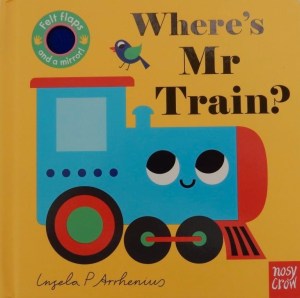
The latest in this felt-flap hide-and-seek series introduces toddlers to four different means of travelling: a tram, a ferry boat, a bus and a train. Each except the completely hidden bus has a small part slightly visible before the flap is opened and the final spread shows all four in their entirety and there’s a mirror behind the flap.
With simple bright illustrations and a simple question and answer text, this is ideal for the very youngest children.

On a Building Site / How it Works: Rocket / Dinosaur Snap! The Spinosaurus

What Can You See? On a Building Site
Kate Ware and Maria Perera
Little Tiger

The building site herein is destined to become a brand new primary school. Youngsters (hard hats donned) can follow the action from the demolition of an old building to the school’s near completion. There are lots of vehicles visiting and working on site including lorries, a digger, a bulldozer, a crane and a cement mixer. It’s good to see both men and women hard at work carrying out their various roles, building, operating machinery (including a woman in a scissor lift, bricklaying, trench digging, tiling, fitting windows and solar panels and more.

In addition to the narrative describing the entire process there are questions to encourage little ones to hone their observation skills by searching for a little mouse, a white cat and other items. With die-cuts and lots of details in the illustrations this will keep your little one’s ears and eyes engaged as you share the book.

The same is true of

How It Works: Rocket
Amelia Hepworth and David Semple
Little Tiger

Get ready to zoom off into space as you read this with your toddler. It starts by explaining briefly what a rocket is and how astronauts use a service tower to get inside. David Semple’s spreads show the release of some of the rocket parts no longer required; an astronaut floating in space beside a command module; the same astronaut walking on the moon’s surface and another flying the rocket. Then come preparations for the return to earth including the ejection of everything no longer needed and finally, splashdown and the collection of the rocket and astronauts by a ship.

Simple language and illustrations to which a touch of playfulness courtesy of a tiny mouse passenger are added, provide a first introduction to the popular topic of space.

Dinosaur Snap! The Spinosaurus
Macmillan Children’s Books

A spinosaurus takes centres stage in this rhyming story inspired by the Strickland’s hugely popular Dinosaur Roar book. Said to be the scariest beast ever it lies in wait for other dinos. such as the young stegosaurus that accidentally gives it a whack with its tail. Its next encounter is with a wily oviraptor that induces an attack of dizziness in Snap before making a dash for it.
Now pretty peckish, Snap sets its sights on the compsognathus aka Dinosaur Squeak luring the little creature down to the water’s edge where a very big surprise awaits …

Created in association with the Natural History Museum this amusing sequence of events ends with a spread giving some basic information about Spinosaurus’s features and also sends young listeners back to the start of the book in a game of seek and find. Look out for further stories in the World of Dinosaur Roar.

A Trio of Little Tiger Board Books

Kindness makes us Strong
Sophie Beer

What is kindness? Sophie Beer provides some examples in this little book beginning each double-page spread with “Kindness is …’ following it with illustrations of children who show care and consideration towards their peers, grown-ups and animals.

It might be something as simple as saying hello, or cheering on participants in a race, giving a warm hug or taking turns.

The bright, enormously attractive illustrations show how much difference acts of kindness make in creating  a happier world.

With its brief, simple repetitive but empowering text, this little book can be shared with the very youngest but equally slightly older children might enjoy reading it for themselves.

A lovely introduction to kindness.

Owl Always Love You
Patricia Hegarty and Bryony Clarkson
Caterpillar Books (Little Tiger)

It’s bedtime for the little forest animals: time that baby rabbit snuggled down in the burrow, time for tiny dormouse and hedgehog to curl up; and up in the tree, for baby squirrel to close its eyes.

The tree is also the place where new chicks in their nest await their mother songbird’s return before they too can sleep.

With die-cut holes to peep through, raised images to feel and adorable little creatures to enjoy in Bryony Clarkson’s nocturnal scenes, sleepy little humans can listen to Patricia Hegarty’s gentle reassuring rhyming narrative before they too succumb to the call of sleep.

Also with a night-time theme is

What Can You See? At Night
illustrated by Maria Perera

With the emphasis on facts, little ones are introduced to a host of nocturnal feeders such as squirrels, owls and foxes in the town.

Moving on to a more rural setting we meet creatures around a pond including singing frogs, bats on the hunt for insects, while in the field rabbits, mice and foxes forage and fireflies flit above them.

It’s not only wild creatures that are out and about at night: postal workers, delivery drivers and sometimes farmers, are at work when most of us are fast asleep.

There’s plenty to interest toddlers on every spread including some humorous items and die cuts.

Board Books Matter

Board books form the bedrock of children’s reading – or rather one hopes they do; but not all new parents appreciate their potential and their importance. Thanks to Little Tiger, here are some new titles. The first is already published the others will be early in February.

Where’s My Unicorn?
Kate McLelland and Becky Davies
Little Tiger
Right from a very young age, there seems to be a magnetic attraction between young children, (girls mostly) and unicorns, so I’m sure this textured book will please.

Its first spread shows the rear end of a hoofed animal that has left a trail of footprints as clues to follow through the pages until the missing unicorn is found on the final spread hiding in plain sight.

On the way little ones encounter a mermaid with a colourful tail, a flamingo with soft fluffy plumage and a narwhal with a magical horn.

Tactile hide-and-seek fun for tinies who can enjoy the search as well as joining in with the repeat refrain, ‘Where’s my unicorn?’ Becky Davies provides the words, giving a sentence about each creature; Kate McLelland has created the alluring visuals.

What Can You See: On the Farm?
Kate Ware and Maria Perera
Little Tiger

As well as providing an introduction to what might be seen on a farm, and something to count on each spread, this, the first of a new ‘spot and count’ series provides plenty to interest little ones in Maria Perera’s jolly scenes of farm life.

First we visit the farm shop where different kinds of delicious-looking vegetables are on sale. Lunchtime is an opportunity to watch the sheep being fed; the pigs too need feeding and fruit trees near their sty supply a wealth of apples when they’re ready for eating.

The farm also has a duck pond alongside which is a weeping willow; there are several different kinds of birds to see in that scene.

Later in the year, the combine harvester gathers the wheat from a field where lots of small creatures have made their homes; and finally it’s teatime and the farmer collects eggs from the barn where there are hens, cows while other animals scamper along the rafters.

Toddlers can by means of the die-cut visuals, acquire some facts, do some counting and develop their observation skills, using Kate Ware’s words as guidance.

I Can Do It!
Patricia Hegarty and Hilli Kushnir
Caterpillar Books

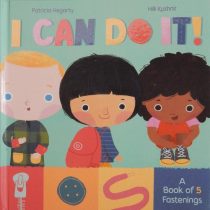
Try teaching preschool and reception age children and you’d be amazed how many 4/5 year olds start school unable to dress themselves properly. I know parents find it easier when they’re rushed in the mornings to dress their youngsters but essentially this is deskilling children. Much better to set time aside to help them learn in a playful manner to cope with zips, buttons, poppers, laces and Velcro type fastenings themselves.

This robust board book with Patricia’s text and Hilli Kushnir’s enticing illustrations will be a boon in this respect.

Using five little children as models, the narrative provides an introduction to each fastening with instructions on how to work it, and asks each time ‘Can you fasten the …? alongside a bold, bright illustration of a child wearing the item needing to be done up.

One boy fastens shirt buttons, a little girl zips up her hoodie,

another boy does up the hooks and loops fastening on his coat; a child closes the popper on a backpack and finally a little girl has lace-up shoes to tie up on her trainers.

Fun, instructive and I assure you, early years teachers will be truly thankful if your child can manage all the five fastenings.