Once Upon a Big Idea

Once Upon a Big Idea
James Carter and Margaux Carpentier
Little Tiger

What a wealth of playful language poet James Carter uses in his story of inventions large and small., all the outcomes of bright ideas generated by human brains. he tells how for example the plentiful supply of rocks and stones beneath the ground have been used to create tools, bricks and walls with which the pyramids were built.
Animals too are a rich source of materials; they provide meat for some, wool to make into clothing and much more, and their bones were also used in the fashioning of more tools.
Homes, bridges and boats often have wood in their construction but what invention has had the biggest impact on lives ever? James suggests it’s the wheel and I’d probably go along with that. I wonder how many things you can think of that include wheels in their design: if you’re a primary teacher you might try asking your class that question when you share the book.
What a wealth of creativity came as a result of sand, clay and fire … 
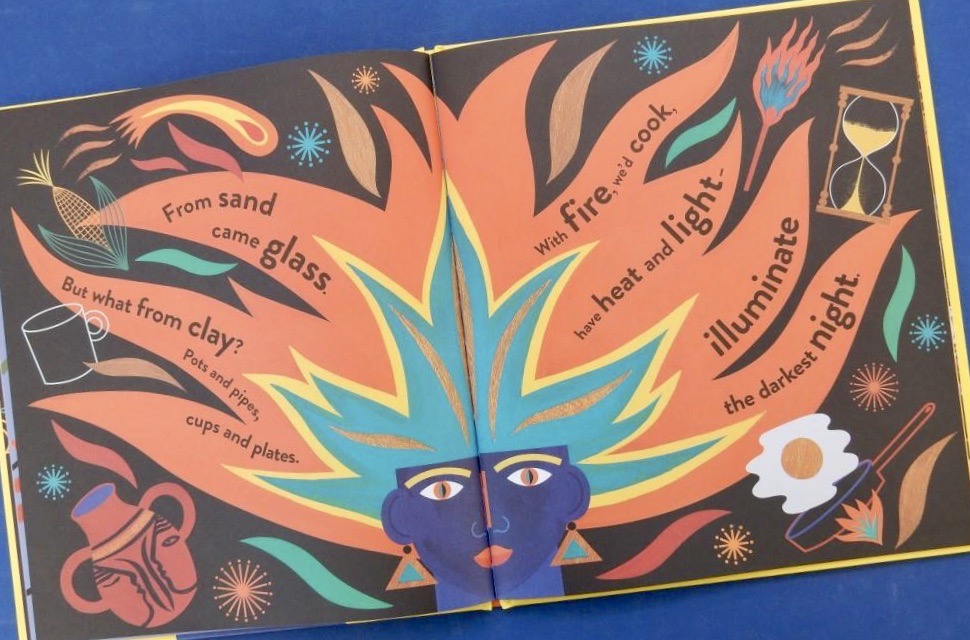
‘Fire we learnt, was elemental – / heating working, smelting metal.’ we read; while modern materials – rubber, concrete, nylon and plastic have changed our lives, not always for the better. 
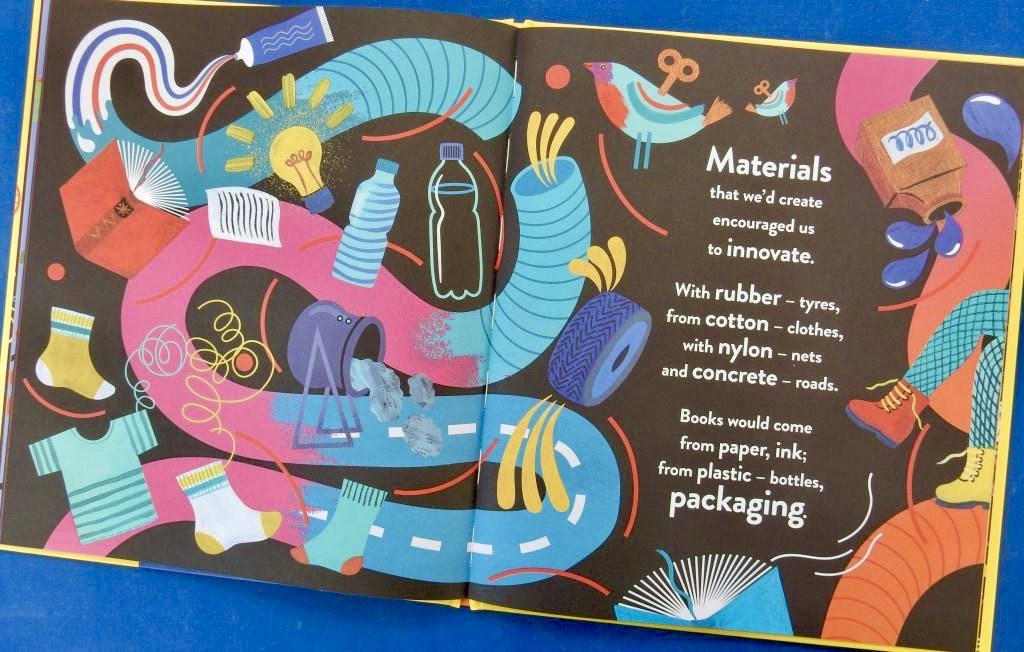
Finally, readers are reminded of the importance of recycling and reusing in James’ text as well as through Margaux Carpentier’s arresting visuals. Don’t forget to read the concluding four-letter acrostic.
Rich in STEAM classroom potential, this is a picture book to inspire young inventors of the future.

Inside Animals

Inside Animals
Barbara Taylor and Margaux Carpentier
Wide Eyed Editions

Back in the day when I was studying zoology at A-level and beyond I always felt extremely uncomfortable having to do animal dissections to get a close look at an animal’s innards. Now here’s a book containing twenty one cross-sections of a variety of animals large and small, all illustrated in vibrant colours by Margaux Carpentier. 

In the introductory section, detailed pictures show how skeleton, muscles, organs and nerves fit together inside the featured creature – a snake, a camel and a shark.

Then come several focus topics – Muscles and Moving, Skeletons, Lungs and Breathing, Brain and Senses, Heart and Blood, and Amazing Organs.

Written by one time Science Editor at London’s Natural History Museum, Barbara Taylor and set out around each internal view, are factual paragraphs and an introduction, for all the mammals, birds, reptiles, amphibians, fish, insects, spiders and other invertebrates spotlighted herein.

I was fascinated to see the honey stomach of the honeybee – a storage organ for nectar – shown and mentioned in one of the paragraphs and part of what helps this creature survive and thrive.

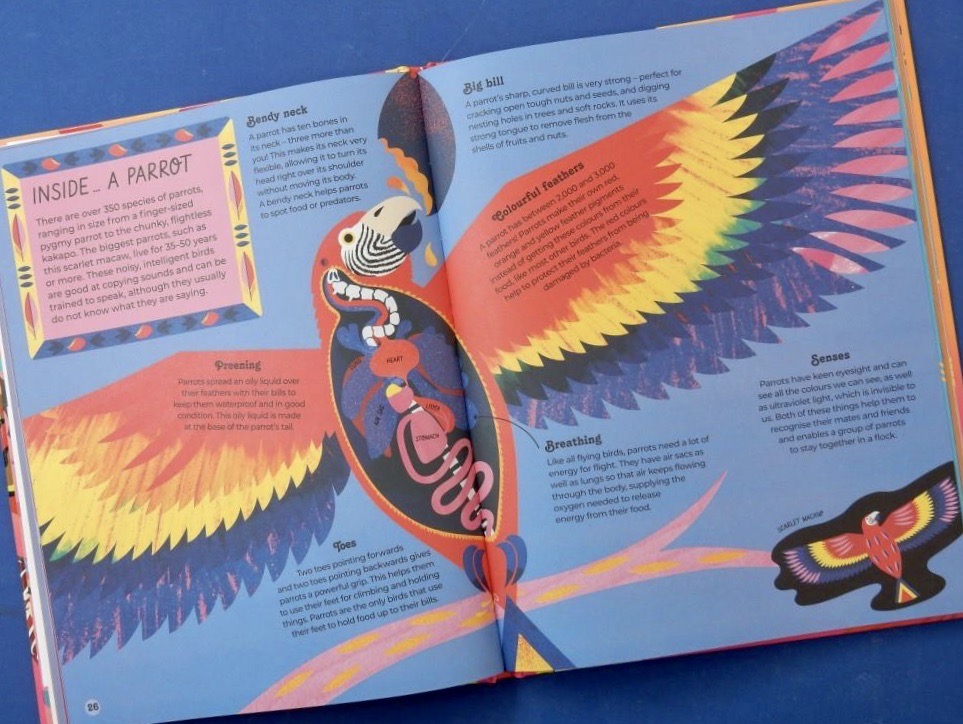
No animal would be able to survive without oxygen to breathe but not all have lungs, or gills like fish and oysters. Within a parrot we see both lungs and additional air sacs that keep oxygen-supplying air flowing throughout its body so the energy for flight is available. 

Other creatures including we read, land-living earthworms, breathe through their skin.

What about brains? It’s not every animal that has one of those although all rely on sensory information sent via electrical signals along nerves. Such information might be gathered through an animal’s sight, hearing, smell, taste and touch. Without a brain, jellyfish for instance use a simple nerve network to detect touch, light, smells and to respond to their surroundings; amazingly these graceful creatures can still sting after they’re dead.

Turning to animals having more in common with humans, a giraffe for instance possesses lungs (around eight times the size of ours), and a heart – also enormous and roughly the weight of your average two year old. I was surprised to learn that despite its very long neck, a giraffe has only seven neck bones, linked we read by ball-and-socket joints enabling that neck to be super-bendy.

I suspect that any youngster, especially those with a scientific bent, will discover some surprises in this engrossing book. It’s one I’d recommend adding to family bookshelves and KS2 classroom collections.

Wonders of the World

Wonders of the World
Isabel Otter and Margaux Carpentier
360 Degrees

The world is a truly amazing place and its wonders, some of which were formed naturally and others made by humans, are really a sight to behold. In this book author Isabel Otter and illustrator Margaux Carpentier present them for us all to see and appreciate without even moving from our seats. Better still is being able to see them with your own eyes but I as a fairly well travelled individual have visited only two of them, India’s Taj Mahal

and The Colosseum in Rome and some of them I think are no longer in existence.

In all we pay a vicarious visit to twenty one wonders thanks to the stand out bright images, descriptive text and lift-the-flap details.
We’re shown seven ancient wonders including the Temple of Artemis in Turkey, the Colossus of Rhodes and the Hanging Garden of Babylon.

Look out for the wheel feature on this page.

Those representing the modern world include the Great Wall of China, which was actually started in 221BCE and said to be the longest structure ever built by humans, having grown over 2000 years to it enormous present (21,196km) length.

Sadly of those presented on the final spread of Natural Wonders one, the Great Barrier Reef, is in great danger on account of global warming caused by we humans.

Each of these wonders could be a starting point for further exploration by interested readers and the whole book would make a great discussion topic with groups or individuals presenting their particular favourite to the rest of the class.

I personally would love to see those Hanging Gardens but there isn’t any chance of that since no trace of them has ever been found. Instead I’ll just have to do with imagining them.