The Encyclopaedia of Unbelievable Facts

The Encyclopaedia of Unbelievable Facts
Jane Wilsher and Louise Lockhart
Frances Lincoln Children’s Books

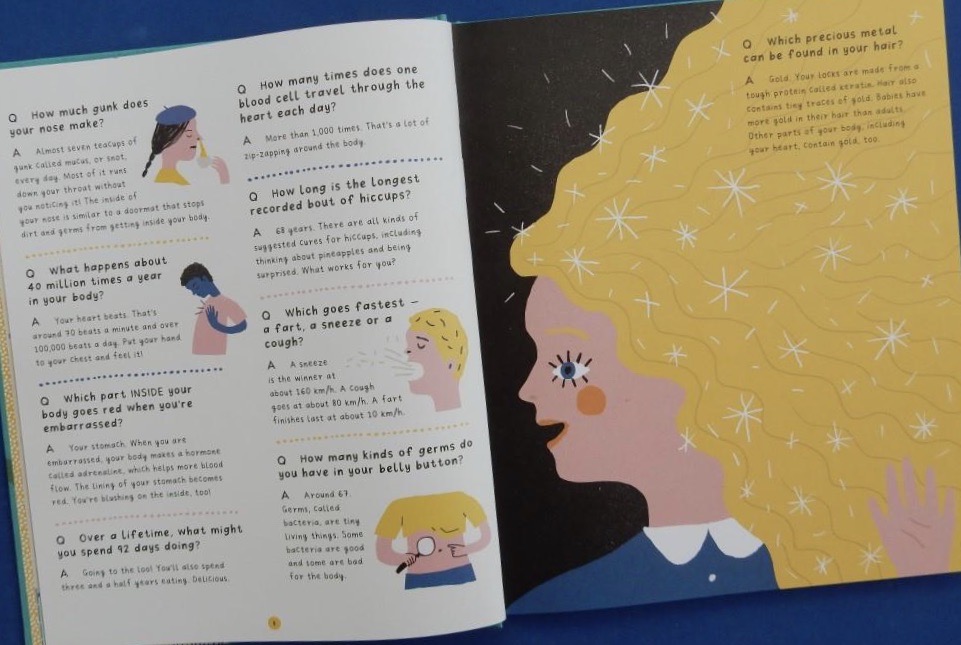
Many of us turn red in the face when feeling embarrassed but have you ever wondered about your insides? Embarrassment causes adrenaline to be produced and this helps increase blood flow, one consequence of which is that the stomach lining becomes red, so we blush both internally and externally.

Equally amazing is that our hair contains minute traces of gold, with babies having more than adults. Both are covered in the Human Body the opening part of this unusual encyclopaedia of trivia.
In case you’ve ever wondered what astronauts do with their dirty laundry, what happens to their wee, or what happens when an astronaut wants to scratch an itchy nose while wearing a space helmet, you’ll discover the answers along with those to over 45 more questions in the Space section of this book.

It’s not only STEM topics that are included herein though. There are sections entitled Customs & Culture, Our World and finally Arts & Entertainment. If you want to know Donald Duck’s middle name, you’ll find the answer there.
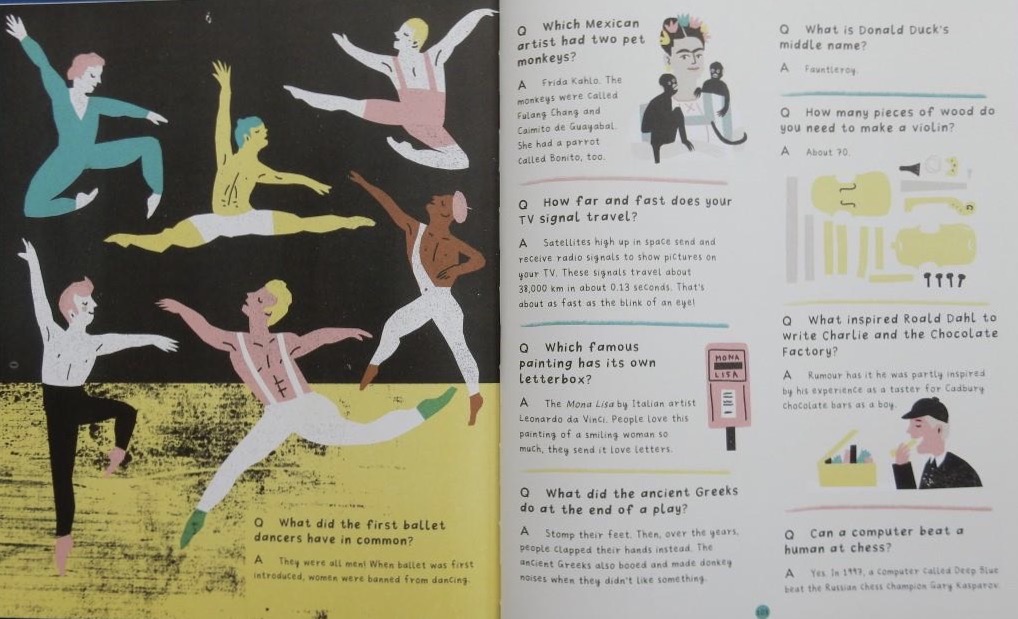
For each theme Louise Lockhart provides a wealth of offbeat, stylish illustrations, mostly small but some whole page ones too.

No matter whether you want to ask questions in a quiz with your friends or family, or just fancy dipping in to discover some new factual bits and pieces, then here’s a book for you; this reviewer certainly learned a fair bit.
The Dictionary of Difficult Words

The Dictionary of Difficult Words
Jane Solomon and Louise Lockhart
Frances Lincoln Children’s Books

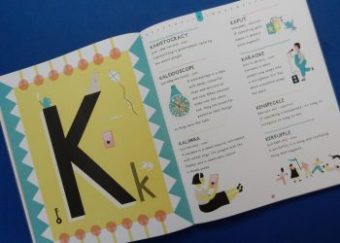
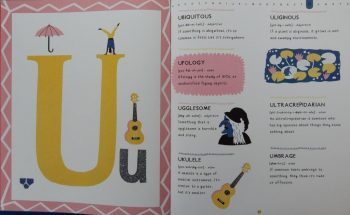
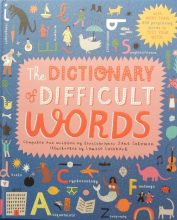
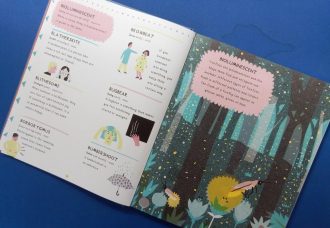
American based lexicographer, Jane Solomon, and UK illustrator Louise Lockhart have collaborated on this compilation of over 400 words, the former providing the easily comprehendible definitions and the latter, the accompanying stylish graphics.

Before the alphabetic section itself are an explanation of what a dictionary is and how to use this particular one, and a spread on parts of speech that also mentions pronunciation.

Then comes the A to Z with two spreads allocated to each letter. Some of the words included are tricky to get your tongue around so the pronunciation guide for each one could prove invaluable, especially should readers come upon a word that’s new to them. I have to say having learnt Latin many years ago did help somewhat, as it did with working out the meaning of the occasional words I hadn’t come across before – yes there were one or two – as well as several, including borborygmus – a rumbling emanating from the stomach- I was glad to be reminded of.

The same is true of kakistrocracy, for obvious reasons.

Did you know that a person (such as this reviewer) who loves solving crosswords (or a compiler of same) is called a cruciverbalist? Now there’s a lovely word to get your tongue around. As is omphaloscopy (otherwise known as navel gazing) and ultracrepidarian (somebody who has big opinions relating to things about which they know nothing). I’m sure we can all think of a few such people.

You might be forgiven for thinking that vomitorium was something to do with throwing up; not so; it’s a passageway people used in ancient Roman times to enter or leave an amphitheatre.

Not all the words are long or tricky to say though: there’s yex, which refers to the act of hiccupping or crying.

I’ll conclude with a word that I absolutely love – lollapalooza – which might be used to describe this book. If you don’t know its meaning then I suggest rather than ‘googling’ it, you get a copy for yourself, your family, or your class. As well as being a celebration of words and the English language, it has the potential for increasing the vocabulary of youngsters who will love to impress others with their word power.