Where Are You, Eddie?

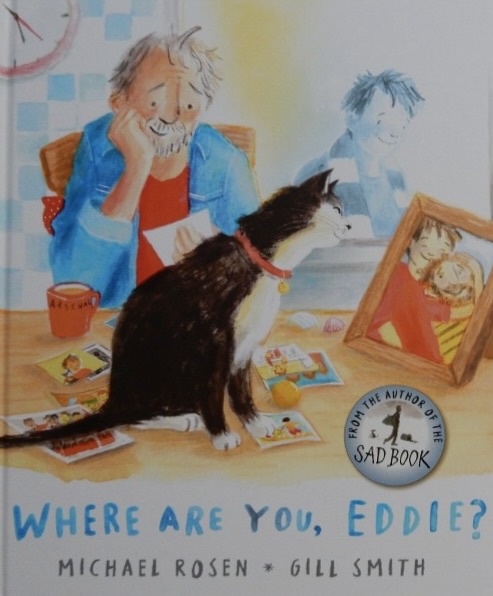
Michael Rosen has already given us the Sad Book about the loss of his son Eddie and now he’s written another picture book wherein having asked himself, “Where are you, Eddie? Are you here?” he talks to the cat, Meg, about his feelings.

To begin with the author feels that Eddie is not coming back. He’s not anywhere. “Is that the end?” he asks Meg. Meg’s response sends him out and onto a bus where he sits and thinks. He thinks about how Eddie wriggled on bus rides and played a special tickling game. “Are you there, Eddie” asks the author. He’s not there physically on the bus, nor is he tossing chips and catching them in his mouth as they walk along past the fish shop. He’s not being mischievous on school photo day, nor playing goalie in the hockey game, not building sandcastles on the beach with his siblings, nor playing a trick with the cat food.
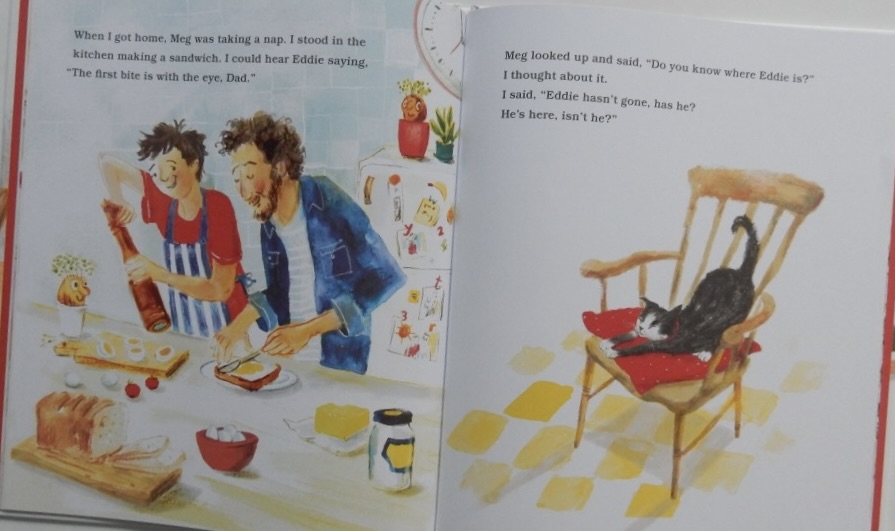
However, the boy’s father sees that because he is remembered and loved by everyone who knew him (and still is to this day), Eddie is still with him.

Essentially, then, rather than a loss or an ending, this is a special way to keep a loved one forever close. This is a deeply profound book about grieving and remembering that will likely bring tears to your eyes, so make sure you have a box of tissues to hand. Your loved one has left things in the world as a message that says, I’m no longer visibly there but I will always be there for you, in your mind and your heart. Gill Smith captures sadness and happiness both, in her touching scenes of the special memories.

This is a book to share with all children not just those who may have lost a loved one.
Penguins Don’t Wear Pink / Missing Violet

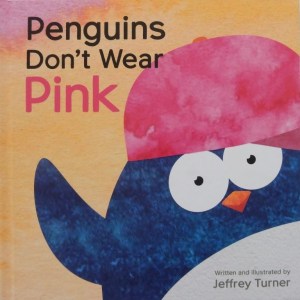
Penguins Don’t Wear Pink
Jeffrey Turner
Beaming Books

Henry the penguin has a passion for pink things but best of all is his pink peaked cap, which he wears to school every day. The other animals’ teasing causes him to do some thinking 

and he decides to wear a hat of a different colour. Nobody comments on his green hat the following day, nor the blue one or the orange one on the next two days. Henry has another think and decides that no matter what his fellow students might say, he’ll wear the pink hat again on the fourth day. Will the response be any different this time? What do you think?

Brightly illustrated this is a sweet story about having the confidence to be yourself, able to wear any colour you choose, no matter who you are or what others think.

A helpful book to start a discussion with young children.

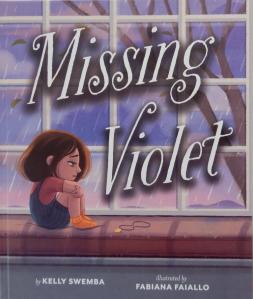
Missing Violet
Kelly Swemba and Fabian Faiallo
Beaming Books

The young narrator of this story talks of her best friend Violet, as ‘an expert at spreading sunshine. Her healing hugs made falls hurt less.’ So when Violet becomes very sick and then dies unexpectedly, the narrator experiences ‘a swirl of feelings all at once’. 

We share her emotions ‘My heart pinched. My insides ached’ first through a rainbow of swirling colours 

and then when she visits a counsellor, through separate colours: orange for bewilderment, red for anger, blue for deep sadness.

When she turns to her mum for further help, the two of them paint pictures of the two girls together and decorate a special box in which to keep them. Still the tears come so she tries talking to her classmates and discovers that they too miss Violet. They decide to say goodbye to their friend by writing notes to Violet and blowing bubbles in the school playground in a gentle farewell ritual. 

With its hopeful ending, this story of loss and grief is pitched just at the right level for young children.

The Window

The Window
Laura Gehl and Udayana Lugo
Studio Press

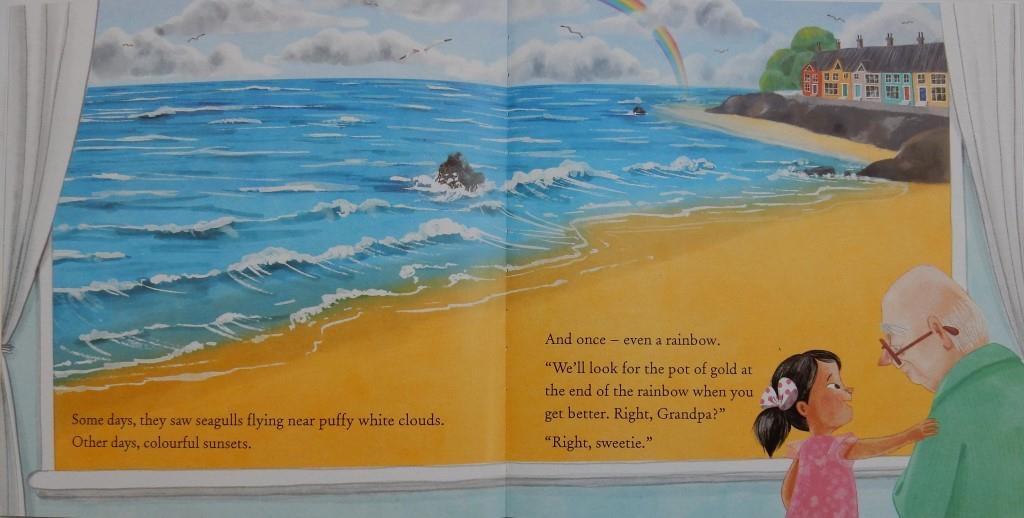
Written from the child’s viewpoint this is a beautiful, sensitively written (Laura Gehl) and illustrated ( Udayana Lugo) heartfelt story about a little girl and her relationship with her beloved grandfather in the last weeks and days of his life.

Visiting Grandpa alongside the child during his long-term illness, readers share the love that exists between the two as they look at the view from the window of her grandpa’s hospital room and talk about the things they’ll do together on the beach they see below, when as the little girl says, the old man is better.

That’s not what happens though for Grandpa gets progressively worse and eventually dies. It’s a very sad time as we see, but at the end there’s an unexpected, yet very powerful, heartening twist to this poignant tale. It’s one that serves as a reminder that although no longer physically with us, loved ones are always present.

At the end of the book are some helpful, supportive words of advice from psychotherapist Dr Sharie Coombes about how to talk with a child about the death of a much loved family member.