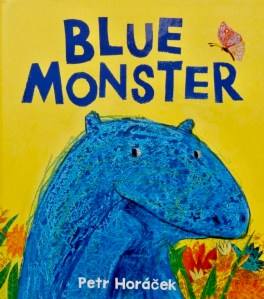
Blue Monster / Not Fair, Bear!

Bored with no-one to play with Blue Monster decides to ask Rabbit; but Rabbit is sleeping and doesn’t hear the request. Blue Monster repeats it much louder, waking Rabbit this time. Rabbit though refuses so the monster proceeds to swallow Rabbit. The trouble is he does’t merely swallow Rabbit: oh no! This crazy creature also swallows in turn Rabbit’s leporine friend, Raccoon, Fox and Wolf.
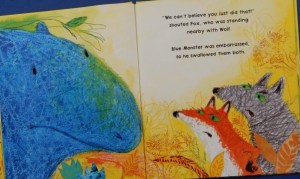
Having done so he realises his actions were not appropriate, let alone kind. Moreover with all his friends inside his tummy, who can Blue Monster play with? Overcome with guilt and sadness he sits beside a tree and yawns. You can guess what happens next but what will the outcome be? Will Blue Monster truly see and error of his ways?
Illustrated with his usual panache, Petr Horáček’s tale is a surprising mix of friendship and silliness; it’s also a tad anarchic and a terrific read aloud that will both shock and amuse young listeners as well as being a great starting point for discussion be that in the classroom or at home.

There’s further undesirable behaviour and friendship tested in
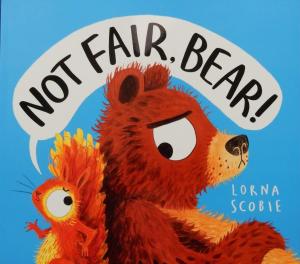
Squirrel and Bear are best friends, doing everything together. Being besties though doesn’t mean they enjoy the same things.and the huge difference in their size can sometimes cause issues regarding playing. One day Bear chooses only activities that Squirrel deems unfair. The tree climbing ends with Squirrel cascading into a bush, Squirrel isn’t a swimmer so the river fishing leaves Squirrel feeling left out and so it goes on.
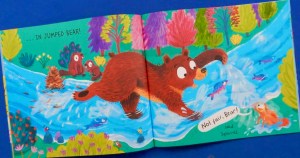
Come the evening Squirrel is feeling pretty dismal and off he goes to sleep. Not so Bear who disturbs Squirrel’s slumbers announcing that it’s playtime. An angry Squirrel tells Bear that the next day will be “DIFFERENT”.
Before long it’s evident that games played Squirrel’s way don’t work for Bear and the two have a tiff resulting in Squirrel telling Bear that he no longer wants to play with him.
Can the two find a way to enjoy each other’s games without falling out? Maybe, but will what they do please all the other creatures too? Lorna Scobie’s lively, funny story about learning to compromise is dramatically presented both in words and pictures. It’s followed by a ‘Big Feelings’ spread for children and adults to talk about together either at home or in a foundation stage setting.
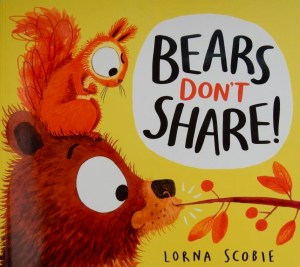
Bears Don’t Share!

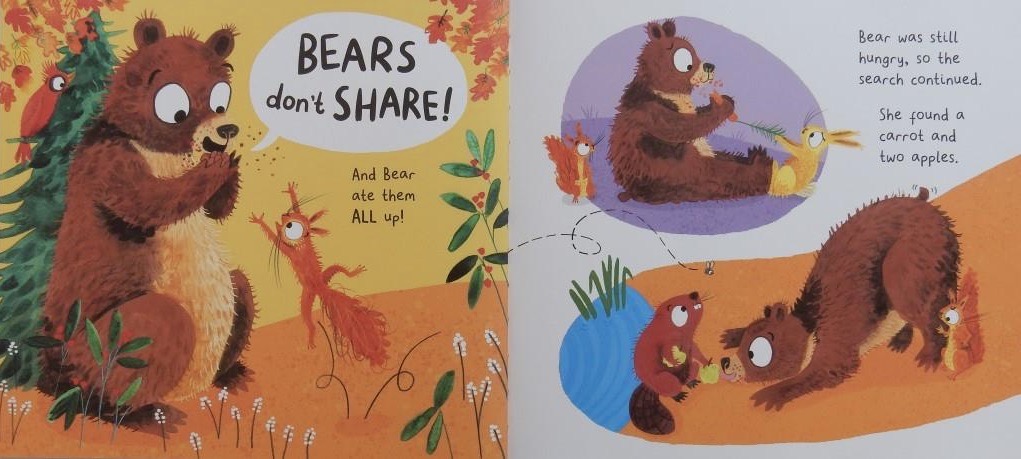
With winter fast approaching Bear and Squirrel are having a discussion about the long sleep Bear is soon to have and Squirrel suggests his friend should go with him to find some food. Off they go and soon both animals have found berries. Guess who eats them all. “Save some for me please!” begs Squirrel, “Sharing is caring, you know!” to which Bear responds, “Bears Don’t share!”. The same thing happens when they find nuts – Squirrel’s favourite food. Bear scoffs the lot. He also consumes the carrot, apples, pizza and ice cream without sharing a single morsel.

Eventually the two come upon a picnic laid out on a cloth. This, Squirrel says, is ideal for sharing. Bear however proceeds to stuff sandwiches, smoothies, jelly, cookies and veggie sausage rolls before noticing an enormous cake.

Now Squirrel is at the begging stage and Bear is just about to swallow the entire thing when she notices Squirrel. A funny feeling comes upon the ursine character: what do you think she does next?
Come the spring what will Squirrel do with his stash of berries, seeds and cake?

With a fun final twist, this is a delicious story to share especially during autumn days: I love the expressions on the faces of the two main characters. I suspect some young children will be horrified at what they consider to be Bear’s greed, but in the final spread – Winter in the Wild – the author explains that Bear isn’t really being selfish, just consuming sufficient to get him through the period of hibernation.

Collecting Cats

Collecting Cats
Lorna Scobie
Scholastic

If you love cats and wish to become a collector of same, then you’d be wise not to emulate the narrator of Lorna Scobie’s debut picture book.

To attract the objects of her desire said narrator conceives a plan: use bait of the cheesy variety.

Now cats aren’t generally attracted to this delicacy, but certain small rodents much loved by the wanted felines most certainly are,

and it doesn’t take long for the ruse to bear fruit, or should that be cats, a dozen of them to be precise – some fluffy, some spotty, some fat and the remainder, thin.

Not content with twelve, and still having some unconsumed cheese at the ready, our narrator leaves the remaining bait to do its job.

However things start to get just a little out of hand as hoards of domestic cats descend, followed by bigger, wilder kinds.

Maybe this cat collecting idea wasn’t such a great one after all.
Another plan might be more manageable, perhaps …

I first came across Lorna Scobie as the illustrator of Smriti Prasadam-Halls’ Pairs board books and Nicola Davies’ The Variety of Life, so it’s great to see her first solo picture book.
Her cat and mouse portrayal is splendid; it looks as though she really enjoyed creating so many different-looking furry creatures, every one of which including the mice, has a different personality – no mean feat. I’m anything but a lover of cats but I thoroughly enjoyed the feline frolics herein.

The Variety of Life

The Variety of Life
Nicola Davies and Lorna Scobie
Hodder Children’s Books

Here’s a large format book for young readers to dip in and out of, time and again, especially those who like animals of one kind or another and the wider biodiversity of our planet.

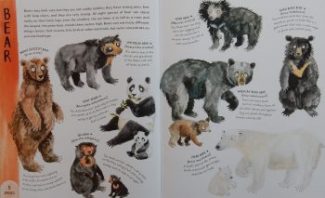
The author and zoologist, Nicola Davies explores the huge diversity of the natural world, providing information about the chosen subjects, one per double spread – a short introductory paragraph to each group and a sentence or two about those depicted (their food, their habits and their habitats) together with the common name, the scientific (Latin) name, and if they happen to number among the endangered species, a black star. It’s alarming to see for instance, that of the eight species of bear, six are threatened with extinction.

Accessibly presented are a large variety of animals big and small, and some plants – grasses and trees and finally, representing the fungi are mushrooms.

Some of the numbers of animal species are questionable though: for instance the number given on the sheep page is 6 species but 9 are illustrated on the relevant spread.

Lorna Scobie’s illustrations of the animal kingdom in particular, are impressionistic rather than strictly scientific. Nonetheless, with their googly eyes, the creatures – from butterflies to bats and sheep to slugs –

have an irresistible child appeal embodying their essential characteristics, and are recognisable if not exactly in the field guide class.

Certainly this thoroughly enjoyable book offers opportunities to take pleasure in, to compare and contrast; and should encourage young readers to respect and treasure the world’s biodiversity and do all they can to preserve and conserve it.

Board Book Shelf 1

dscn0033

Flip Flap Dogs
Nikki Dyson
Nosy Crow
There’s a newcomer to the Flip Flap series in Nikki Dyson who introduces readers to eleven breeds of dog in this split page pooch-lovers delight. In all though you can make 121 different combinations by manipulating the bissected cardboard pages..
There’s a descriptive, two verse rhyme for each breed in which, for example the Terrier, introduces itself
opposite a portrait of same, and a characteristic ‘Ruff! Ruff! Ruff! Ruff!’ or whatever. And then, that might become with a deft flick of the flaps, say, a ‘Terrihuahua’ …

dscn0031

or all manner of other crazy crossbreeds. Splendid stuff especially, if you’re canine crazy.

dscn0042

Pairs! in the garden
Pairs! underwater

Smriti Prasadam-Halls and Lorna Scobie
Frances Lincoln Children’s Books
Pairs! is a new series which provides young children with an interactive information book, a memory game (via the flaps and a straightforward instruction such as ‘Find each matching pair of snails’, and an inviting, brightly illustrated board book all between the same two covers. In the Garden penned by Smriti, introduces, with a series of jolly rhymes, including some nice alliteration ‘swirly, sparkly silver trails’, all kinds of minibeasts scattered among a plethora of flowers.
One of my preschool testers has a great time ascribing names to the various creatures Lorna Scobie has illustrated: ‘buzzy fat bee’, ‘cuddly bee’, ‘grumpy bee’ ‘but this cross skinny bee doesn’t have a friend’.

fullsizerender-16

The grasshoppers became ‘dotty’, ‘spotty’ ‘stripey’ and ‘skinny striped’ while among the caterpillars were ‘hairy, scary blue’ and ‘red spotalot’. My favourite though I think, was ‘pinky purply underpants’ beetle’.
Underwater looks at marine life both on the shore (despite the title) and under the sea …

fullsizerender-21

and is equally attractive and involving.

dscn0043

Baby Dinosaurs
Minibeasts

DK
These two larger than usual board books ask users to ‘Follow the Trail’ or trails, as there are several offered on some spreads to interact with Baby Dinosaurs or a variety of Minibeasts. The trails are glittery embossed lines that readers can trace across the pages with their fingers and at the same time find out something about the Allosaurus, Diplodocus, Styracosaurus and Tuojiangosaurus or alternatively butterflies, honeybees, ladybirds and dragonflies.
Digital illustrations of the baby dinosaurs are set against clean white backgrounds on which are digitally drawn flora to give a idea of their environments. Interactive instructions (‘Loop around’ or ‘Make an oval shape as you go round the dinosaur egg’), brief facts about the animals (‘Allosaurus walked on two legs’. ‘Mummy Allosaurus was about as tall as a giraffe‘),

dscn0039

and die-cut holes through which to peep at what dinosaur is coming next add up to a playful, multilayered reading experience.
Similarly with the minibeasts (all four are winged insects), there are glittery trails – looping or zigzagging, going straight or curving up and down, to take the insects to the flowers containing nectar, honeycombs,

dscn0038

aphids on a leaf, or a pond. All are illustrated by Charlotte Milner and the inclusion of a snail with its spiral shell to trace as the ladybird travels over a flowerpot, justifies the Minibeasts title.
One of my preschool testers seized on these and, after spending a considerable time enjoying sharing them, wanted to keep them; this had to be put on hold until I’d had a chance to reflect and write however. Beautifully done and certain to be read over and over.

localbookshops_nameimage-2