
Olive Owl
Barry Tranter and Emma Tranter
Nosy Crow
There’s something about owls in stories that endears them to very young children: most notably the classic, Owl Babies, and now here is an information picture book likely to win those far from cute creatures more friends.
Based on the Rounds apps this is one of a new series for the very young. Having read on the publisher’s press release that Olive’s creators are ‘firm believers in education through play’ it sounded as though they’re kindred spirits. There’s certainly an element of playfulness about this book. Emma and Barry Tranter’s design backgrounds are also reflected in this charming book: the owl characters and some other objects– in keeping with the Rounds series title – are made up of circles or parts of same.
Olive is a barn owl and through a mix of a narrative running across the top of the page, and factual snippets printed within circles scattered throughout each spread, readers and listeners can find out about her life cycle …

diet, shape and size as well as her mating habits and other characteristics. Young children will be interested particularly to learn that a barn owl’s wing span is wider that a 5 year old’s armspan.

There are also occasional speech bubbles that help make Olive something of a character.

All in all, a thoroughly enjoyable way to introduce an important aspect of the natural world to very young children; one to add to the early years’ book collection I’d say.
In the same series and also worth having is:
Parker Penguin
Hailing from the Antarctica, Parker is a rotund young penguin, but although he’s a bird, he cannot fly and still won’t be able to by the time he reaches adulthood after three years, which happens towards the end of the book. Instead he moves by sliding, waddling, swimming –
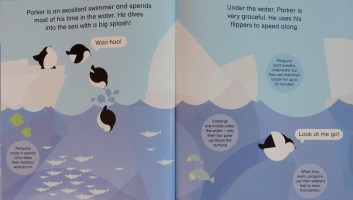
and ‘marching’. Marching is what he does, along with lots of other penguins, to the breeding ground and it’s there he finds a mate and after around seventy days out hatches a new chick, a male, Percy and …

the cycle begins again.
A different kind of cycle is explained in:

Hello, Mr Moon
Lorna Gutierrez and Laura Watkins
QED
The moon is the unlikely narrator of this rhyming story that takes the form of a response to a child’s observation, “Hello, Mr Moon … You’re up. You’re down. / Why so skinny/ and then so round?” Mr Moon then goes on to explain and is joined by a host of (mainly) nocturnal animals – a bat, a fox,

a badger, a fish an owl and a cat, each of which interjects an observation or a question for him, until the whole lunar cycle from new moon to full moon has been described and shown in Laura Watkins’ powerfully atmospheric woodland scenes.

Young children will enjoy the narrative – verbal and visual , learn some basic astronomical facts and at the same time absorb terms such as ‘gibbous’ from the context.
The teacher part of me does not like didactic directions but I appreciate that many adults may well find the “Next Steps’ suggestions on the final page helpful.


 Red Reading Hub - Jillrbennett's Reviews of Children's Books