Can I Sit in the Middle? / Can You Catch the Bunny?

This image has an empty alt attribute; its file name is dscn9949-3.jpg

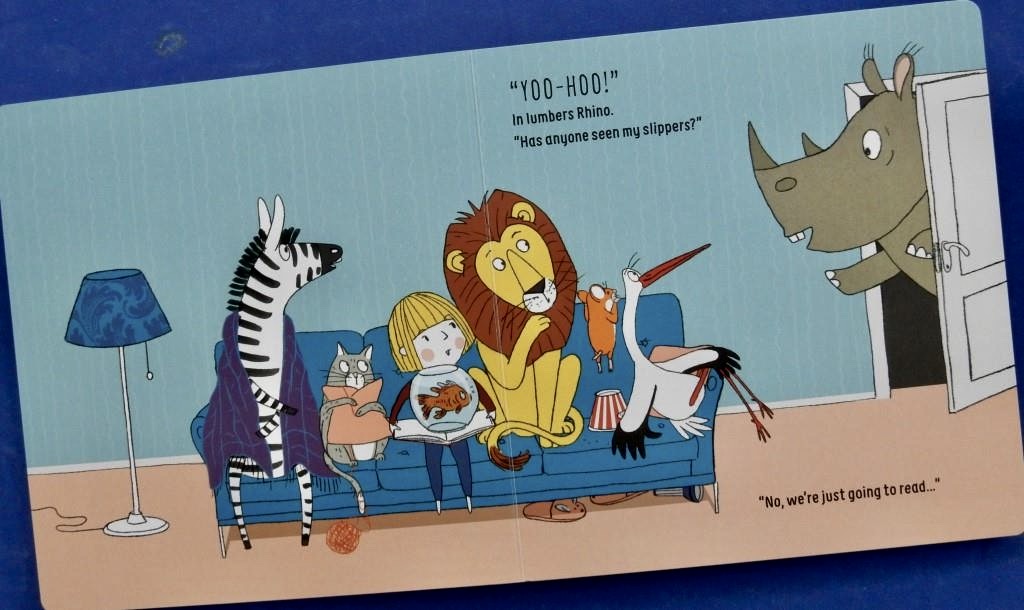
A child sits on the sofa to read with Hamster. The enthusiastic creature alerts the other animals – zebra, cat and lion – to join them. Just before the story starts Stork arrives, but then Cat decides to try and take possession of the cushion and Hamster gets up, fetches Fish and hurrah! Let the story begin. Or maybe not: some rearrangement of listeners is demanded and then the patient story reader can share the book. Oh! I spoke too soon for Rhino has mislaid a pair of slippers.
This image has an empty alt attribute; its file name is dscn9950-3.jpg

The large pachyderm upends the sofa to retrieve said slippers and OOPS! They all tumble into a heap. Does that mean no story? Happily thanks to a deft rearrangement of furniture and something else that Cat had found under the sofa, a perfect book sharing situation is created and finally, whoopee! it’s story time at long last.


As this drama unfolds small children will enjoy watching the chain of events, delighting in the details in the gently humorous illustrations and wondering who next is coming through that door to be part of the audience on the sofa.

This image has an empty alt attribute; its file name is dscn0001-1.jpg

Addressing the target audience of very young children directly, the author asks that they assist little Bunny in finding his way first through the vegetable patch and then out into the forest and from there around the garden and the orchard until finally he reaches the safety of the burrow wherein the rest of his family are waiting. With a wealth of treasures collected on his adventure, little Bunny is more than ready to share his spoils with his fellow rabbits.


Little humans will certainly hone their fine motor skills as they use a finger to touch and trace the trail on each spread as well as develop their powers of observation when with the help of an adult sharer, they look at the details – vegetables, other small creatures, fungi, flowers, mammals, and lots more besides, in each of Linda Tordoff’s scenes.
All Change! / Colour Gallery

Here are two new board books from Little Tiger – thanks to the publisher for sending them for review.

All Change!
Harriet Evans and Linda Tordoff

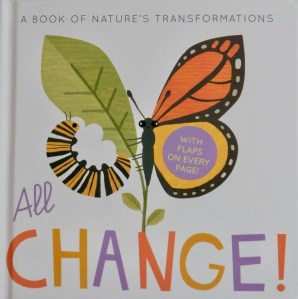
Transformations in the natural world is the theme of this board book with its clever, enticing cover picture.
By means of the flaps integral to each of Linda Tordoff’s illustrations, we see changes brought about by the seasons, through life-cycles of insects and frogs, the weather, danger, the lunar cycle, the need to catch food, for safety and more. Executed in soft, soothing colours, each scene is pleasing to the eye and the simple text offers a starting point for discussion with very young children.

Colour Gallery
Sophie Ledesma and Isabel Otter

Ready and waiting to take the animal visitors, and readers, on a learning tour around the art gallery is Gigi the giraffe. First stop is the Red Mosaic Hall, followed by the Blue Portrait Gallery, the Green Sculpture Park and the Yellow Landscape Room. This art establishment certainly makes effective use of all its space for there’s a corridor devoted to still life paintings

and the cafe displays abstract art on its walls.
As well as reinforcing the concept of colour in an unusual manner, Isabel Otter’s interactive text, the book’s design with its shaped pages and gatefolds and Sophie Ledesma’s bright illustrations (with a tiny mouse lurking on every spread), provide a fun introduction to the world of art for the very youngest children.

A Celebration of Board Books

Here’s a handful of recent Little Tiger Board Books – thanks to the publishers for sending them for review

First Nature: Ladybird
Harriet Evans and Bryony Clarkson

Following on from Caterpillar in this ‘first nature’ flap-book series is the equally playful Ladybird. Very young children will love Bryony Clarkson’s bright alluring, textured art and Harriet’s brief, sometimes alliterative rhyming text as Ladybird scuttles and scurries, hastens and hurries across the cleverly cut-away pages, slowing to feed, feel fear, fall and fly to the nest, finally ready to hibernate.

Elephant Elephant What Can You See?
Pintachan

Accompanied by a questioning chirpy bird friend, Elephant takes a wander in this lift-the-flap book, and the two play a kind of hide-and-seek game with the animals that are tucked away in turn, beneath the lily pad, in the tall grass, under water and behind a tree. Then, on the final spread, when the final flap is lifted, there’s a surprise mirror so tinies will come face to face with their own image.
With Pintachan’s simple, bright images and the repeat patterned rhyming narrative, this is likely to be a winner with little ones.

Beep Beep! Builders
Becky Davies and Gareth Lucas

Be ready for a noisy time when you share this with your little one. Set on a building site, we meet the boss Little B and his five co-workers. There’s Digger, Mixer, Crane, all of which are somewhat over-enthusiastic, as well as a roller and a tip-up truck. Having dug, mixed, built and lifted all day long, come sundown the boss praises their teamwork and suggests it’s time for play.
Tinies will love pressing the squishy bodies of the jolly diggers as they follow their actions and join in the rumbling, tooting, whirring and other sounds.

For a slightly older audience is

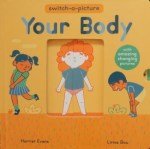
Your Body
Harriet Evans and Lirios Bou

Another of the cleverly designed ‘switch-a-picture’ books with Harriet’s rhyming presentation of in turn, the skeleton, breathing, eating, thinking and the circulatory system accompanied by Lirios Bou’s subtly coloured images of children’s bodies, first clad and then, when the central tab on each page edge is pulled, the related internal working are revealed along with additional relevant information.

A to Z: An Alphabet of Animals
illustrated by Linda Tordoff

Published under the Caterpillar Books imprint this lift-the-flap board book presents animals large and small; but where are they? They’re all hiding, just waiting to be discovered by eager fingers opening their respective initial letter flaps. Little ones can meet creatures feathered, furry, scaly and smooth all stylishly illustrated in subtle colours.