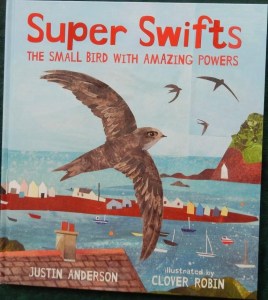
Super Swifts
Justin Anderson and Clover Robin
Walker Books
Astonishingly, swifts (champions of the bird world) are able to fly faster and higher than any other birds; even more astonishing is that they might stay airborne for as much as four years, flying up to seventy miles per hour.
Author, Justin Anderson begins this swift story in central Africa’s Congo region in early April and tells of the journey undertaken by one female in particular who with a group, flies from their place of overwintering, towards Europe and their destination in the UK.
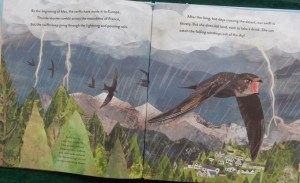
A month long journey that takes them over the world’s largest desert, across vast oceans, through thunderstorms to the place where our female will look for her mate, a bird she’s not seen for a whole year.
Clover Robin’s mixed media close ups of the pair show them making a nest in which the female lays three eggs each of which hatches into a hungry chick.
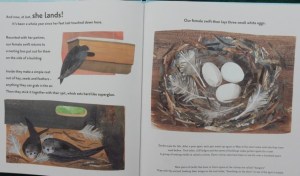
I love the author’s description of the pair sticking ‘their nest together with their spit, which sets hard like superglue.’ Come July, it’s time for the mother to make her return journey to Africa; she and the other super swifts will once more take to the skies.
On each spread, there’s a main narrative, alongside which is further information printed in smaller type. An inset box gives fascinating details of swift lice that nestle in young birds’ feathers and breed when the swifts nest again. A final author’s note contains information about some of the swift species and gives ways in which readers can help prevent swifts nesting in the UK from dying prematurely.
I’m looking forward to hearing their screeching cries as they fly over our house this summer.
Also on the subject of birds is a book wherein fact and fiction come together.
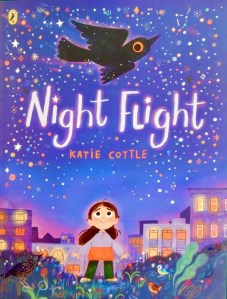
Night Flight
Katie Cottle
Puffin Books
When young Ellie moves from her country home to a big bustling city on account of her Mum’s new job, the girl notices that many of the bird varieties she loved watching aren’t there. Mum gives her a bird feeder but no birds come a-visiting, so at her mum’s suggestion, Ellie takes a walk around but all she sees are pigeons, no blackbirds, sparrows or moorhens; and empty skies as she makes her way to school each morning. Then one night there’s a tapping at her window; it’s a glossy-feathered starling, a very large one that asks for her help and Ellie agrees.
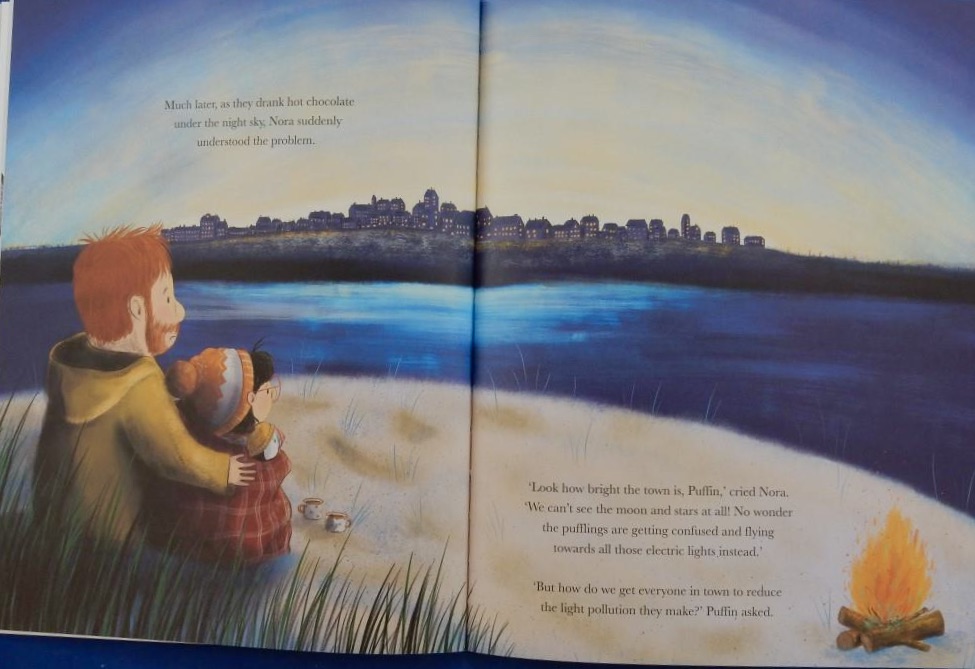
Off they soar with the child sitting on the starling’s back until they come to a hill whereon they land. When Ellie comments on the glow emanating from the city, the bird tells her that it’s light pollution. As she looks skyward, in this spot far from the city, there are hundreds and hundreds of glittering stars, stars being something else that Ellie has barely seen since the move to the city. On account of not being able to see the stars because they’re dimmed by the light pollution, the birds are unsure where they should fly: can Ellie find a way to help them find the way back home?
She sets to work with the help of her Mum, but she needs to find the confidence to speak out about the birds’ plight. Will she be successful in saving the birds? Happily yes and before long, the city has become much more like home to both Ellie and the avians.
Author/illustrator Katie Cottle’s timely story has an important message about not allowing unnecessary artificial lighting to interfere with the natural world, especially birds. It’s one that needs to be shared and its message heeded by humans especially those who live and work in cities.

 Red Reading Hub - Jillrbennett's Reviews of Children's Books