The Monster in the Lake / The Kerfuffle

These are both recent Gecko Press titles – thanks to the publisher and Nicky Potter for sending them for review
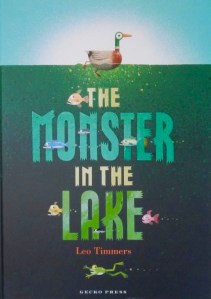
Following one duck’s suggestion, four ducks contemplate some fun in the lake. Another however, has concerns about the monster said to be in there, but the others insist there’s no need to worry. Off they go into the water, with three ducks urging the fourth, “Trust us!”. Eric trails reluctantly behind and perhaps this gives him a clearer idea of what is going on beneath the surface.

At each turn of the page readers and Eric see more of the subaquatic reality while his companions remain oblivious despite his loud, “MONSTER!”warning, even insisting that they are the only ones around other than frogs and small fish. It takes Eric’s disappearance to ruffle his friends’ feathers,
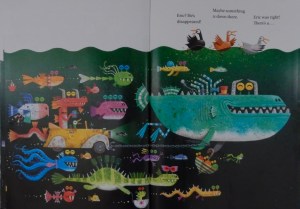
though his reappearance soon puts them at their ease again. For Eric, this whole swim has been a truly memorable adventure; as for the others, they certainly won’t know that the monster is far from threatening, rather it’s a playful beastie.

Young audiences will love sharing in Eric’s subterfuge. They’ll love too, Leo Timmers’ bold, bright, whimsical images of the marine characters and the their underwater accoutrements: why though did Eric keep all the fun part to himself?
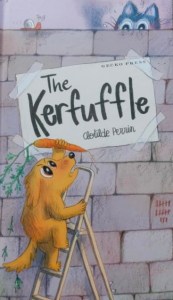
Kitty and Pup are neighbours and the best of friends but suddenly everything changes. Kitty eats Pup’s fish, so in return Pup takes Kitty’s slipper. Now the two besties have become enemies and they decide not to see one another any more – ever. To that end they build a wall separating their abodes (the book’s flaps let readers see what is happening on either side.
With the wall complete, peace reigns but then a bunny rabbit appears on top of it. Dog and Kitty both want to make friends with the rabbit and they start fighting over the newcomer.
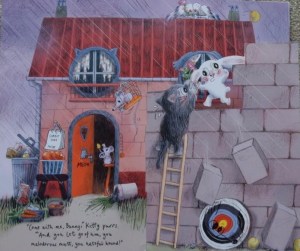
Now none of them is happy and Rabbit runs off. Eventually however Kitty decides it time to make peace with Dog and a lot of crashing and banging ensues that results in a solution that makes everyone happy.
Demonstrating the pointlessness of building walls, Clotilde Perrin’s clever amalgam of narrative and illustrations with those strategically placed flaps works really well. The illustrations deserve careful perusal as there is a lot going on between bit part players such as a pair of birds that start nesting, as well as a couple of mice.

Bear’s Lost Glasses

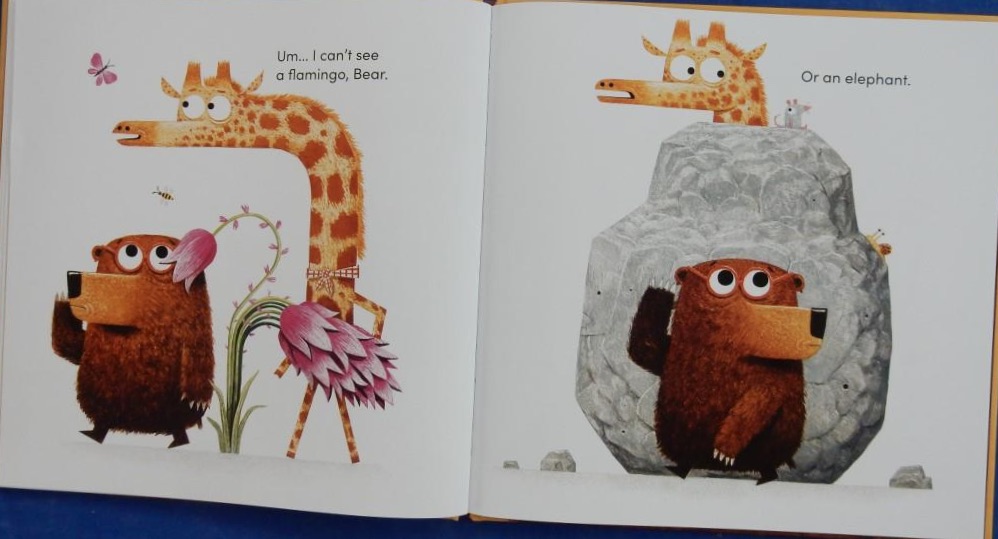
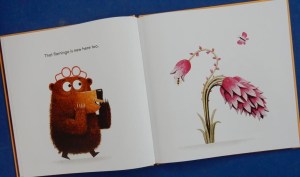
Right from the cover illustration, young children will love being in the know as to the whereabouts of Bear’s glasses but the ursine character decides that he’s left them at Giraffe’s house so off he trots. Now sans specs, as he tells us, he ‘can’t see a thing’ but nevertheless he comments on various objects he passes en route to his friend’s, misidentifying them in turn as a deer, a crocodile, an elephant, a flamingo, each of which astonishes him.

He even fails to recognise Giraffe who is taking it easy on his lounger, calling him instead a snake. Bear apologies and explains his plight; Giraffe then ‘returns’ the glasses to their owner, which allows Bear to uphold his original notion.

Bear goes on to tell his pal of the unusual sights he’s seen en route and eager to see them for himself, Giraffe accompanies the now bespectacled Bear as he makes his way back the same way he came. Of course, neither spots the flamingo nor the elephant,

the crocodile or the deer though a confused Bear blames his glasses. These he then removes and goes on to point out to Giraffe, three lions nearby.

A terrific, tongue-in-cheek comical delight that puts forward the possibility that seeing with one’s imagination is preferable to viewing reality. Little ones will relish Timmers’ tale of discovering – albeit accidentally – new ways of seeing the world and loudly correcting him with regard to the misidentifies flora and fauna.

Kind Crocodile / Who’s Hiding? On The Farm

Kind Crocodile
Leo Timmers
Gecko Press

Little does Crocodile know when he decides to leave his watery abode and go for a stroll that he’ll end up as an animal rescue service. First comes a mouse fleeing from a scary snake, closely followed by a warthog hotly pursued by a hyena; next is an impala chased by a cheetah and then a rhinoceros with a lion in pursuit. Crocodile sees off the chasers with some strategic and menacing GRRRRs and offers a safe haven to what becomes, with the addition of the heaviest animal, a surprised heap comprising rhino, impala, warthog and mouse each precariously balanced in a tower upon the kind croc’s back. This makes him let’s say, somewhat flattened, physically at least, as well as voiceless.

How will they see off that hungry lion now?

Happily teamwork comes to their rescue; but the last word (make that almost the last) is definitely that of Crocodile, which creates a moment of suspense before his final utterance. Then off they all go, the animal tower somewhat differently arranged.

With Timmers’ humorously expressive mixed media illustrations, simple patterned text and that fun plot twist, this a funny large-format board book to share with little ones.

Who’s Hiding? On The Farm
Pintachan
Little Tiger

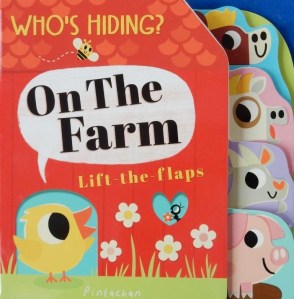
When a little chick loses his mummy, he asks Pig to help him find her but they can’t do so without little readers’ assistance. Following Pig’s instructions, they can explore what’s hidden behind the flap on each spread. They will also discover several other little chicks that have tucked themselves away cheeping, and once located those too can help in the search.

With bright jolly art by Pintachan and cutaway pages of farm scenes with minibeasts too, a simple text that includes animal speech bubbles to join in with and a happy ending, there’s plenty to entertain little humans in this fun board book.

Elephant Island

Elephant Island
Leo Timmers
Gecko Press

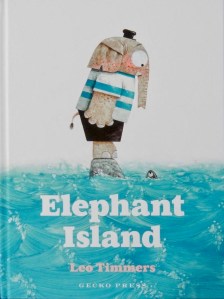
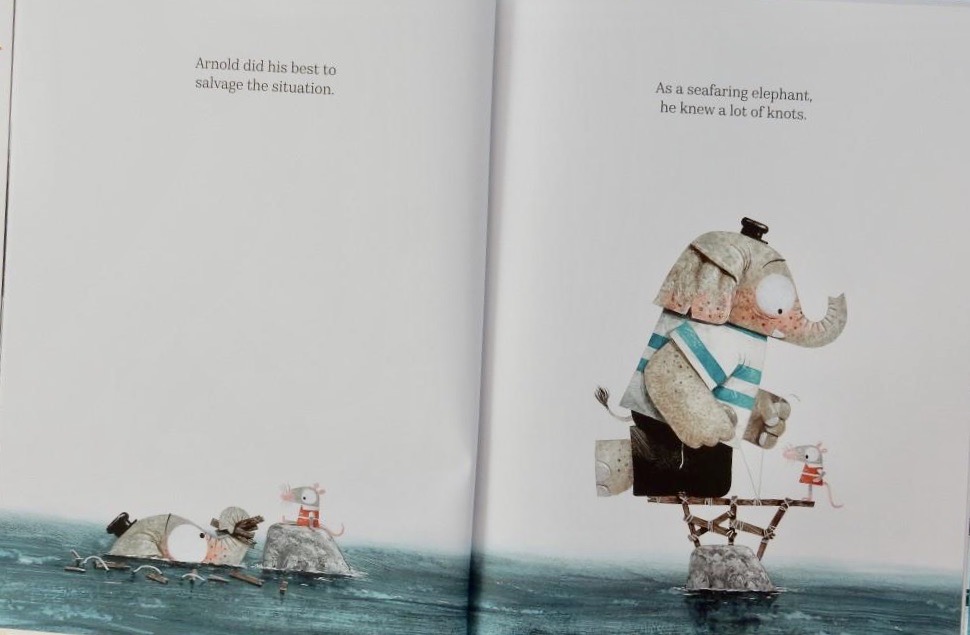
As the result of a boisterous wave, seafarer Arnold elephant’s boat is destroyed. Hours later he reaches a tiny island upon which he lands and calls for help. There’s no response although his captain’s hat does float by, and with it back on his head, Arnold is able to spy a small ship in the distance. Said ship belongs to a mouse. Rescued at last – hurrah! But then …

Fortunately Arnold is familiar with a fair few knots, some of which he uses to effect, only to sabotage things when he steps aboard the next craft of a would-be rescuer. Once again it’s operation salvage as the pachyderm fashions an ever more unlikely intricate structure from the fragments, sufficiently large to accommodate everyone whose boat he’s inadvertently incapacitated.

It’s not long before Elephant Island (complete with waffle maker) becomes a ‘go to’ destination and thanks to Arnold’s welcoming attitude an ever expanding one.

Where will all this end?

Then another storm blows up; should everyone now go home, or not …

With a deliciously un-self aware, but hugely adept constructor as its main character and a splendidly silly story to star in, Leo Timmers’ illustrations steal the show. Every one is a testament to creative play and collaborative construction, increasingly full of wacky detail to pore over and giggle at. I can see Arnold’s tale becoming a storytime favourite.

Who’s Driving? / What a Ship Sees

Who’s Driving?
Leo Timmers
Gecko Press

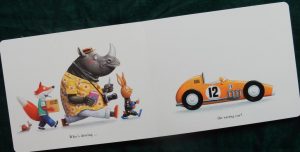
Toddlers and pre-schoolers will absolutely love playing this matching /prediction game wherein Leo Timmers invites them to guess ‘Who’s driving …’ – in the first instance the fire-engine – from the animal character line up on the verso each clutching a key and hastening towards the vehicle shown on the recto. Turn the page ‘wheeooh wheeooh wheeooh’ and the answer is revealed along with the vehicle’s destination. (Sharp-eyed youngsters will likely have spotted some of the clues as to the driver on the first spread.)

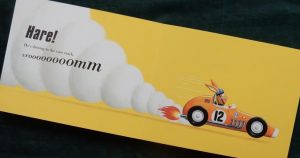
A different four animals appear as possible drivers for each of the new vehicles depicted – the limousine, the racing car,

the tractor, the convertible, the jeep and finally, the aeroplane.

There’s an element of the Hare and the Tortoise fable here too, though probably only appreciated by adults. Little ones will love the explosive onomatopoeic, sound-making opportunities that seemingly make the vehicles whizz right off the pages; and the unlikely drivers depicted in Timmers’ acrylic illustrations. Both visual skills and observation skills will certainly have been stretched too after sharing this.

What a wealth of learning potential there is in this fun little book: it’s a must for nursery/preschool settings and enormous fun for home too.

What A Ship Sees
Laura Knowles and Vivian Mineker
Welbeck Publishing

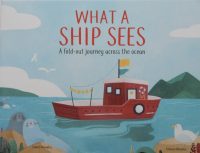
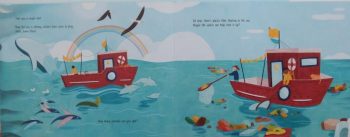
In this cleverly designed concertina book, we follow the journey of a little red ship as it sets out from the jetty on a voyage across the sea. This is no smooth journey though as a storm blows up shortly after the boat has passed a desert island, but all is well and the sailors pause for a while to help remove some of the floating plastic litter before continuing to move north to chilly waters and finally reaching home shores once more.

During the unfolding trip guided by Laura Knowles chatty style narrative, youngsters can enjoy spotting in Vivian Mineker’s illustrations, various sea craft – fishing vessels, a tanker and an enormous cruise ship, as well as dancing dolphins, a shoal of flying fish,

and the changing weather.

There’s a wealth of talk and story-telling potential in the 2.5 metre long unfolding drama, on the reverse side of which is a cutaway of the little red boat, as well as individual elements of the journey along with further information about each one be that ocean fauna, nautical communication,

safety, or ships and boats.

Monkey On the Run

Monkey on the Run
Leo Timmers
Gecko Press

This wordless picture book starts with a father monkey collecting his little one from school and right away their funky motorbike is in a nose-to-tail traffic jam.

Rather than sit frustratedly in the side car, Little Monkey gets out and starts wending his own way home.

Every spread offers potential stories aplenty so this definitely is not a book to hurry through. Rather one needs to slow the pace and relish the on-the-move fire fighting scenario; Little Monkey’s cake-lifting episode from the royal ‘feastmobile’…

cake he subsequently consumes in the crow’s nest of a wheeled boat.

There follow a confrontation with a rooster; a circus-like dangling act from a very bendy drinking straw

and later on Dad monkey gets an ice-cream surprise from above.

Then our inventive traveller secures a wonderful gift box

that he presents to his mum when father and son finally reach home.

Timmers’ vehicles are veritable inventive wonders, every one; and the way in which the interaction on each spread occurs is sheer comic genius. I’m sure readers will discover new things to relish on every re-reading, of which I’m sure there will be many.

BANG

bang 1

BANG
Leo Timmers
Gecko Press
I love quirky picture books and this near wordless one is certainly that. I also love that the leader of the pack (an executive deer sporting a bowler hat) is a writer and reader. The problem is, said deer is driving along in his BANG-mobile loaded with copies of his latest publication (this book) while reading one of the books, seemingly unaware of the fact that the vehicle in front has just shed part of its load right in front of him. BANG! – books in dustbin.

bang 2

The subsequent pages reveal the knock on effect as each following, tailgating vehicle runs into the back of the one in front:

bang 3

pig with his chickens, giraffe with her clothes shopping, crocodile with tyres, cat with his catch, goat with his fruit and vegetables and rabbit with her sextuplets. More observant chameleon with his load of paint, manages with an ‘eeeeeeeeeeeeee’ to stop just in time, only for penguin in his ice-cream van to plough into the back of him and shunt him into the multi-vehicle pile-up. Fortunately not a single animal is hurt.
The panoramic pull-out page reveals the whole shebang and the resulting, amazing interaction of drivers, passengers and loads.

bang 5

Ice-cream anyone?
Surprisingly everyone is happy save a single baby rabbit whose sibling has stolen his ice-cream.

bang 4

The sheer absurdity of the whole thing is irresistible.
Timmers’ wonderfully comic illustrations allow readers to fill in their own words. The amount of detail in every single vehicle, animal and load means that each double spread offers much to talk about – from the exaggerated animal features of the drivers and their snazzy attire, to the funky vehicles with their various loads and much more.

Use your local bookshop:localbookshops_NameImage-2