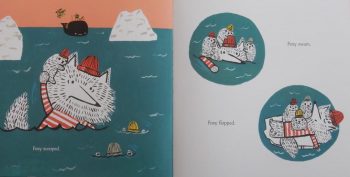
I Do Not Like Books Any More!

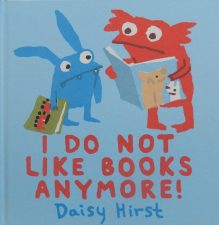
I Do Not Like Books Any More!
Daisy Hurst
Walker Books

How insightful is Daisy Hurst: her account of young book loving monster Natalie’s disillusionment with the whole reading thing when she starts school is absolutely superb and a sad reflection of the sorry state of beginning reading teaching in pretty much every primary school I’ve spent any time in during the last few years.

That’s getting ahead of things though, so let’s go back to the start where we find Natalie and her younger brother Alphonse, thanks to their parents and relations, relishing every book encounter. Not only that, they remember stories they’ve heard and love to invent their own too.

Natalie eagerly anticipates being able to read for herself: “When I can read, I’ll have all the stories in the world, whenever I want them,” she says.

When she gets her first ‘reading book’ though it’s not quite as exciting as she’d hoped. Her teacher tells her to ‘sound out the words’.

Natalie’s frank response hits the nail firmly on the head:

and she goes on to add while trying to read at home … “I can’t … And nothing even happens to the cat!” Alphonse is marginally impressed …
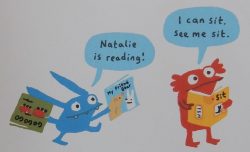
but totally agrees about the nature of the reading material, politely requesting something more exciting …


Despite her best efforts the marks on the page of the interesting books continue to ‘look like scuttling insects with too many eyes and legs’: Natalie has had enough …

She storms off to tend her poorly toy elephant with the best medicine she can think of – a story from her own imagination (aided and abetted by Alphonse).
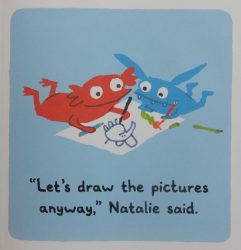
Impressed with their efforts, Alphonse suggests turning the story into a picture book. Out come the pens and when the illustrations are ready, Dad acts as scribe and they staple the pages to make a book and surprise, surprise, Natalie finds that she can pretty much read the entire thing – HURRAH!
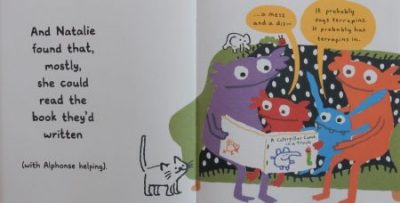
As someone who has always advocated and for many years, taught using real books as the medium (alongside child made ones) for helping children learn to read, Daisy Hurst’s book made me both laugh and cry.

Yes, the monster children here have supportive parents who model, encourage and support, but sadly not all children are so fortunate: for many Natalie’s experience of reading at school is ALL they get.

This a brilliant cautionary tale that ought to be read by all those involved in the teaching of reading in the foundation stage and KS1 as well as teachers in training; and, dare I say it, policy makers in the government too.

Read the Book, Lemmings!

Read the Book, Lemmings!
Ame Dyckman and Zachariah OHora
Andersen Press

Having seen it in the catalogue, I eagerly awaited the arrival of a copy of this latest comedic offering from Dyckman and OHora, creators of the wonderful Wolfie the Bunny and Horrible Bear! It more than lives up to its promise.

The book features three lemmings of the particularly impressionable kind, a whale that doubles up as a container ship, S.S.Cliff , its polar bear captain, PB by name, and first mate Foxy.
The story actually starts on the front endpaper where a sign floating on an iceberg informs, ‘ lemmings: small fuzzy, illiterate rodents who share the icy North with arctic foxes and polar bears. People used to think lemmings jumped off cliffs. Now we know they don’t.’

Close to the iceberg is a cliff and guess what: a lemming jumps proclaiming at the same time “Wonder what that says.” “Me too,” replies a second lemming. “Ditto!” says a third.
The trio lands up aboard S.S. Cliff whereon Foxy has just settled down with his book entitled ‘Everything About Lemmings’. “Huh!” he announces, “Says here, lemmings don’t jump off cliffs.” The lemmings hear just a single word: a four-lettered one beginning with j and …

Foxy requests the use of PB’s bucket and fishes the creatures out, bestowing upon them hats and names – Jumper, Me Too and Ditto, and urging them to “Read the book,” before settling down once more with said text.

A few further foolhardy leaps follow, each one increasingly reckless … “Sinking! Sinking fast!” / “Me too!” / “Glub!

until Foxy’s “WHY didn’t you read the book, lemmings?!” finally gets to the crux of the matter: the lemmings can’t read.

Time for some reading lessons …

After which, er that’s for you to discover when you ‘Read the book!’ (And, be sure to check out the final endpapers.)

Ame Dykman’s brilliantly mischievous text is an absolute treat for readers aloud and listeners alike; and the deadpan humour of OHora’s illustrations with their fun details and supremely expressive faces and body language, is the perfect counterpart for this madcap romp. I love the colour palette.

If this isn’t a superb demonstration of the importance and delights of reading, then one reviewer at least will jump off the nearest cliff.

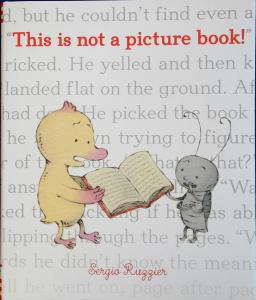
This is not a picture book

DSCN7589

This Is Not a Picture Book
Sergio Ruzzier
Chronicle Books
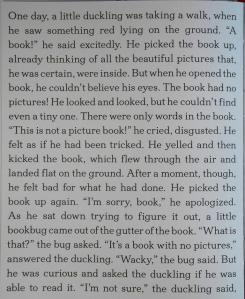
Essentially this delicious work of metafiction is about learning to read, or rather, becoming a reader. It begins with a duckling coming upon a book. No actually it begins with the front endpapers which, for a competent reader, present no problem, but might well be how a not yet reader views a printed text – as an intimidating jumble of letters and seemingly senseless words. Here are the first few lines: ‘One day, a itellet ldgicukn was anigtk a wkla, nhwe he wsa itegmohsn erd nyigl on the gonrdu. “A book!” he etyclxied. He kiecpd the book pu, eladyra ikgnntih fo all the faileutbu eispcutr hatt, he was eicnrta, eerw snedii.
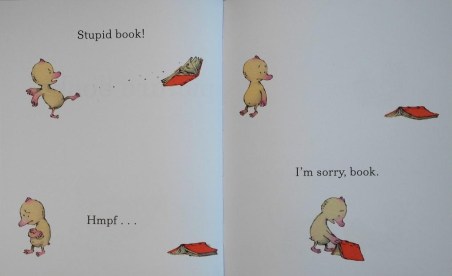
Back to our duckling and his book, a fat looking volume, which, he discovers on opening it, is completely lacking in pictures. This is what happens next …

%0A

Along comes a bug, eager to know what duckling has and whether he can read it. There follow an ingenious couple of spreads symbolising the beginning of duckling’s transition from someone that finds pictureless books a no go area, to a reader in the full sense of the word …

%0A

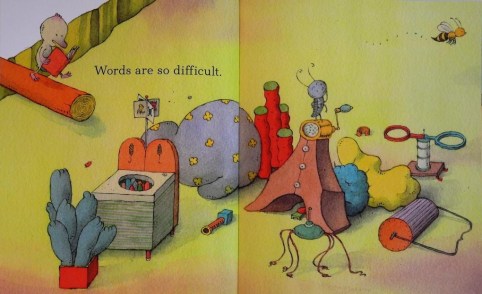
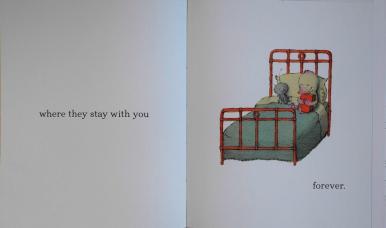
One who appreciates the worlds that open up through words be they funny, sad,

%0A

wild or peaceful, words that take you far away and also, bring you back home again, words that no matter where you are, will always be with you …

DSCN7593

What a wonderful testament to the power of reading and the way it can change individuals and, one hopes, the world.
Readers of this terrific book should turn now to the back endpapers to see the transformation to comprehendable text completed … job done for that particular duckish reader.

DSCN7594

Ruzzier’s gentle watercolour and ink illustrations speak volumes demonstrating the power of visuals too. Quite simply, brilliant.

Use your local bookshop   localbookshops_NameImage-2

WNDB_Button