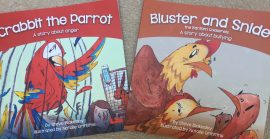
Crabbit the Parrot / Bluster and Snide

Crabbit the Parrot
Bluster and Snide

Steve Blakesley and Natalie Griffiths
LDA

Ex primary teacher, Steve Blakesley has penned two rhyming lessons showing undesirable and then desirable behaviour animal style.

Crabbit the Parrot is a self-centred bird, beautiful to look at but not to listen to. It’s always a case of ‘me’, me first’, mine’ or other self-serving words and he just can’t cope when he doesn’t get his way immediately.

He’s the last to be sold from Mrs Jollies Pet Shop but when eventually a family chooses him and he gets a new home, Crabbit  is bad tempered and demanding
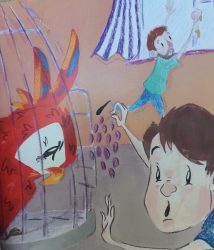
and makes a reckless break for freedom.

No amount of coaxing will bring him down from his branch in the tree but then an old raven CK happens along with a warning about a marauding moggie (ignored by Crabbit) and some wise words about the need for the parrot to alter his behaviour.

This brings about a positive change in Crabbit who heeds the lesson and returns inside, a reformed character.

Bluster and Snide are a pair of bantam cockerels that bully the other farmyard birds especially the smaller, weaker ones
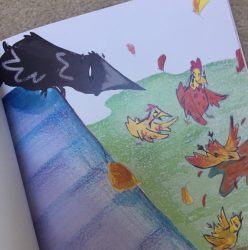
until one day they issue a challenge to CK (Carrion King), calling him cowardly and bragging about their gang.

Their over confidence leads to Snide daring his brother to do something reckless, the outcome of which is a badly injured, friendless and increasingly hungry Bluster.

Time to change his ways perhaps? CK certainly thinks so, advocating ‘You need to be a friend.’ But, in the face of the farmyard fox, is it too late? …

Lively ‘Story Therapy’ tales such as these two with Natalie Griffiths’ expressive illustrations, can open up individual or class discussions on their inherent themes of anger management and bullying and will prove a useful PSHE tool for primary schools.

Voyage to Arghan / Ernest and I

Voyage to Arghan
Ernest and I

Joanna Grace and Helen Lanzrein
LDA

In her book Sensory Stories, Joanna Grace wrote of two key elements of sensory story sessions: – the importance of sensory stimulation, which is central to cognitive development and the power of narrative, and the storytelling space it can create for those who share a story.
Sensory stories (that include in the telling not only words but also pictures, tastes, smells, sights, sounds and touches) in general are inclusive and can be used for people of all ages.

These two titles are part of a new picture book series by Joanna.

Each begins with an explanatory preface that outlines the sensory story concept, explains how best to share the book with one or more children and provides a resource list of items that need to be to hand before you start.
The introductory notes suggest you share the story hearing first the words, then focusing on the pictures and finally, the sensory element. This pattern lends a natural rhythm to the whole process.

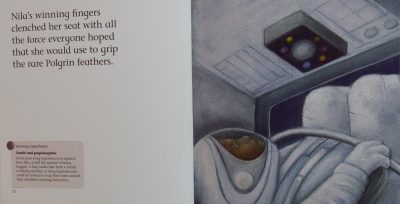
Voyage to Arghan , created particularly for ‘supporting children with their mental wellbeing’, tells of a little girl who as winner of the “First Child in Space” competition, blasts off into space,

destination the distant planet Arghan, in the hope of finding rare Polgrin feathers.

Both her story telling and the suggestions for the sensory elements are a reflection of the author’s creativity while her inclusion of technical terminology demonstrates her academic knowledge of her subject.

Some of the experiences suggested in this story need no extra resources. These include a hug, a lunge, a breathing techinque; and rolling back and raising the feet in the air (you might with their permission, tip backwards the chair of a wheelchair user) to simulate the rocket launching. Other elements need a little preparation but nothing more exacting than the adornment of a shoe-box to create an entire Arghanian world.

Beautiful textured pastel illustrations by Helen Lanzrein provide the visual element of the story and there’s a final ‘voyage log’ offering ideas for discussion.

Parents and educators alike will welcome this book, as they will Ernest and I, created particularly for ‘supporting children to identify with their attachments’.

Its rhyming narrative, essentially a soothing reflective story of childhood memories of a boy and his much loved soft toy penguin, is also beautifully illustrated by Helen Lanzrein.

With more multi-sensory storybooks to follow I as an educator, look forward to seeing them.