Number Garden / Noisy Construction / All the Things a River Can Be

These are all new Little Tiger interactive board books: thank you to the publishers for sending them for review.

A group of animal friends are shown around the number garden by Marigold the tortoise. With a fold-out to explore on every spread, small children will enjoy accompanying them and in so doing they can practise their counting skills to ten and respond to the other questions too.
First stop is the orchard, followed in turn by a hot-house and a rockery, then it’s off to the pond, a vegetable patch and the tour finishes in the meadow with a picnic.
Vibrant art work with just the right amount of detail for the very young (including minibeasts to spot), together with the interactive nature of the words make for a fun book to share with tinies. There’s a final spread whereon Marigold gives some extra facts about the six locations visited.

A rather unlikely subject for a board book but when shared with young children, this one, with its moving pieces and flaps, will likely lead to lots of learning.
In its half dozen spreads little ones can find out what makes a river special. People sometimes think of a river as a road, an inland waterway whereon they can travel in various kinds of boat. It also provides a watery habitat for lots of animals including many kinds of birds, fish, mammals and amphibians as well as plants, some aquatic, others that grow along the river banks. Some humans too make their home on rivers, choosing to live in houseboats. On its journey from source to mouth a river moves at different speeds, sometimes a slow trickle, at other times fast flowing and fierce. People who explore river beds can find all manner of interesting things such as coins, jewels and possibly even ancient remains.
The final spread brings together many of the activities people might do on a river visit, things that give them pleasure including boating, swimming and watching wildlife.
1 2 3 Sleepy Me / I Can Count

Here are two playful counting books from Little Tiger – thanks to the publisher for sending them for review.

1 2 3 Sleepy Me
Sophie Aggett and Gareth Lucas

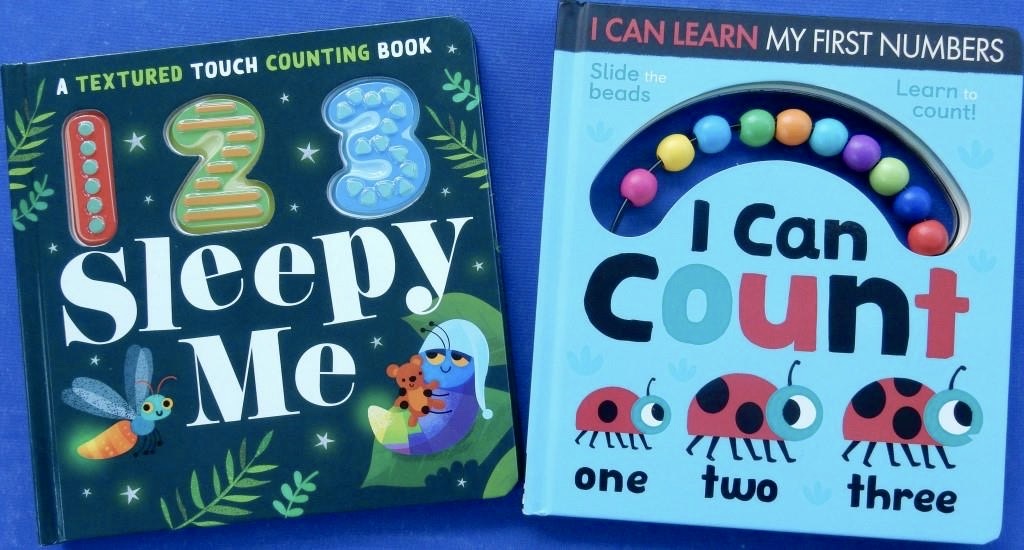
This die-cut counting book has a nocturnal theme and moulded textured numerals 1-5 offer a variety of tactile experiences. Strangely Gareth Lucas sets his illustrations of stars to count and talking minibeasts – a ladybird, a firefly, a butterfly, a baby bee and a glow-worm against brightly coloured rather than dark backgrounds, although the final one is rather more subdued as the glow-worm decides it’s time for sleep. The rhyming text begins thus, ‘One little night star shining over you. “Goodnight!” says a ladybird as she spots …’ and continues adding a star 

until in addition to the five twinkly stars there’s a full moon in the sky and all five minibeasts assemble to bid, ‘Goodnight, everyone!’
Simple, interactive pre bedtime counting fun for tinies.

I Can Count
Lauren Crisp and Thomas Elliott

This cleverly designed board book is intended to help little ones with both counting and number recognition. A die-cut shape through both the covers and the pages contains an arched shape plastic rod through which are threaded ten beads. The rhyming text alternates giving an instruction like ‘Horses gallop in the sun. Can you count them as they run? or asking a question such as ‘How many arms do starfish grow?’ Additionally on each page is the relevant numeral and on each spread the sentence, “Slide the beads to help you count!’

On the 10 page stands a rocket and rather than counting up from 1, the instruction is ‘Join the countdown to see it fly.’ encouraging children to count backwards 10 9 8 etc … LIFT OFF! 

Thomas Elliott provides the brightly coloured illustrations on every page with cute googly-eyed characters and in addition to maths skills little ones will develop their fine motor skills.

Little Tiger Board Books for Little Humans

Day and Night
Harriet Evans and Lirios Bou

There are five different locations – a temperate forest, a desert (wherein I encountered a hyrax for the first time), marshes, a savannah and a steamy tropical jungle – to visit in this ’switch-a-picture’ book, both during the daytime and then, by means of a series of tabs on each recto, at night. Thus for example in the marshes rather than the seeing “Bright dragonflies swarm through blue sunny skies,’ if the tab is pulled, these disappear from the window and are replaced by a much darker sky wherein fireflies make looping patterns. While in the jungle instead of the monkeys climbing trees that are visible in daytime, a pull of the tab reveals bats.
Innovative, and engaging, with attractive illustrations by Lirios Bou and Harriet Evans’ brief rhyming text and additional facts hidden until the tabs are tugged, this is a fun book for day or evening sharing with the very young.

I Can Learn: Dinosaurs
Lauren Crisp and Thomas Elliott

New in the publisher’s I Can Learn series, Dinosaurs has both cutaway pages and flaps. Starting at the Triassic period, then moving to the Jurassic and finally the Cretaceous period, little ones can meet a host of dinosaurs both large and small. Lauren Crisp provides the brief rhyming text and questions that accompany Elliott’s enticing illustrations of the prehistoric animals set against different colour backgrounds.
There are lots of new names to learn (pronunciation provided) and the occasional surprise such as the erupting volcano, the lava of which is only revealed when you lift the flap.

Also illustrated by Thomas Elliott is

How Many Beads?
written by Nicola Edwards

Here’s a book that offers both measuring and counting fun with the aid of the string of ten beads inserted in the back cover.
Collections of items at home, in the sea, in a garden, around town,

‘my things’ and ‘at night’ are each allocated a double spread that contains guiding questions and a wealth of labelled objects. So, little ones can try counting oysters, clownfish, rocks and starfish beneath the sea as well as finding out which of the underwater creatures is the longest. (Once they get used to using the beads for measuring, an adult might introduce the idea of estimating first.)

Plenty to engage little hands, eyes and minds here.

Play and Learn with Board Books

The Touch Book
written by Nicola Edwards
Little Tiger

Here’s a book that invites young children to “Get Hands-on! and explore texture and who could resist those paint-covered fingers of the little girl on the opening page?

In all, ten different textures are presented: fluffy, crinkly, smooth, bumpy, sticky, spongy, furry, rough, scratchy and soft, and each double spread offers three possible synonyms for the one presented. For instance, crinkly alternatives are wrinkly, ridged and ragged.

However it’s not only the sense of touch that’s being developed: ‘run your finger along something crinkly, what kind of noise does it make?’ asks the narrator; while the ‘sticky’ spread talks of sticky things being either tasty or ‘icky’ which might lead into a tasting session. Your fingertips really do stick to the tiny hexagons beneath the dripping honey so ‘tacky’ might be a good alternative though you’d definitely need to taste some honey to decide if syrupy is appropriate.

I like that little ones are invited to describe the textured patch beneath the digger – would they use ‘scratchy’ or perhaps gritty, grainy or raspy?

Full of potential learning opportunities, this sturdy book can be used either in a family or in an early years setting, perhaps as part of a larger sensory theme.

Although not sensory, to add to the overall fun, I’d suggest following up a sharing of the next book with some hands-on experiences

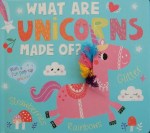
What Are Unicorns Made Of?
illustrated by Louise Anglicas
Little Tiger

A rhyming text guides the adult reader aloud, presenting possible answers to the titular question while Louise Anglicas’s candy-coloured illustrations showing unicorns cavorting across the countryside, through Sweetville, over the rainbow, among the trees and dancing to music offer plenty to explore.

The first consideration of unicorn-ness concerns what’s within: could they be filled with jellybeans, or perhaps ‘yummy pink popcorn?
What about their manes: marshmallow or possibly strawberry ice-cream – maybe but then neither would last long with hungry toddlers in the vicinity! Imagine unicorn rainbow tails all a-sparkle in the sun or horns alive with beautifully patterned butterflies, glittery musical hooves: the only way to discover if any of these might be part and parcel of a unicorn is to close your eyes and wish to see one – ta-da …

Animal World: I Can learn My First Colours
Lauren Crisp, illustrated by Thomas Elliott
Caterpillar Books (Little Tiger)

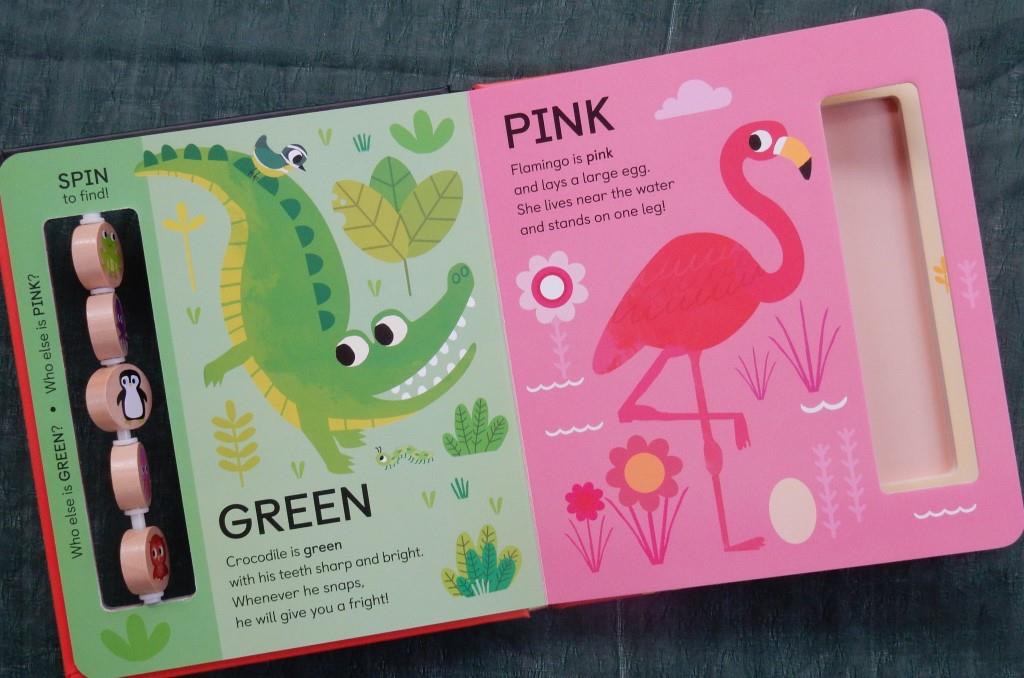
Four-line verses and images of beady-eyed animals are used to help reinforce, or perhaps introduce, the basic colours to toddlers: thus ‘Crocodile is green / with his teeth sharp and bright. / Whenever he snaps, / he will give you a fright!’ whereas ‘Giraffe is yellow / as tall as can be. / She nibbles on leaves / from high in the tree!’ In addition to the main text, along the edge of each verso asks for instance, “Who else is GREEN?’ Who else is PINK?’

The vertical rod inserted into the cover has 5 flattish cylinders, on each side of which is a small picture of an animal, so that little fingers can spin them around to discover another creature with a colour that matches the one in the main illustration.

The final spread shows a dozen butterflies each corresponding to one of the colours already featured and invites little ones to respond to two questions: “What is your favourite colour? And “What colours can you see high up in the sky?’

There’s a wealth of potential fun learning between the covers of this one.