Who’s Driving? / What a Ship Sees

Who’s Driving?
Leo Timmers
Gecko Press

Toddlers and pre-schoolers will absolutely love playing this matching /prediction game wherein Leo Timmers invites them to guess ‘Who’s driving …’ – in the first instance the fire-engine – from the animal character line up on the verso each clutching a key and hastening towards the vehicle shown on the recto. Turn the page ‘wheeooh wheeooh wheeooh’ and the answer is revealed along with the vehicle’s destination. (Sharp-eyed youngsters will likely have spotted some of the clues as to the driver on the first spread.)

A different four animals appear as possible drivers for each of the new vehicles depicted – the limousine, the racing car,
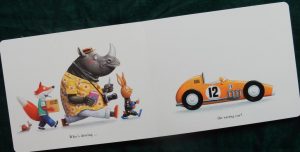
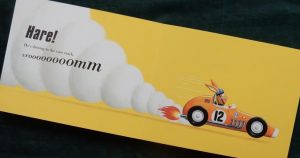
the tractor, the convertible, the jeep and finally, the aeroplane.

There’s an element of the Hare and the Tortoise fable here too, though probably only appreciated by adults. Little ones will love the explosive onomatopoeic, sound-making opportunities that seemingly make the vehicles whizz right off the pages; and the unlikely drivers depicted in Timmers’ acrylic illustrations. Both visual skills and observation skills will certainly have been stretched too after sharing this.

What a wealth of learning potential there is in this fun little book: it’s a must for nursery/preschool settings and enormous fun for home too.
What A Ship Sees
Laura Knowles and Vivian Mineker
Welbeck Publishing

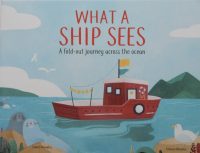
In this cleverly designed concertina book, we follow the journey of a little red ship as it sets out from the jetty on a voyage across the sea. This is no smooth journey though as a storm blows up shortly after the boat has passed a desert island, but all is well and the sailors pause for a while to help remove some of the floating plastic litter before continuing to move north to chilly waters and finally reaching home shores once more.

During the unfolding trip guided by Laura Knowles chatty style narrative, youngsters can enjoy spotting in Vivian Mineker’s illustrations, various sea craft – fishing vessels, a tanker and an enormous cruise ship, as well as dancing dolphins, a shoal of flying fish,
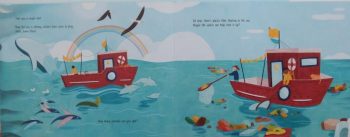
and the changing weather.

There’s a wealth of talk and story-telling potential in the 2.5 metre long unfolding drama, on the reverse side of which is a cutaway of the little red boat, as well as individual elements of the journey along with further information about each one be that ocean fauna, nautical communication,

safety, or ships and boats.

Wild World, The Coral Kingdom and Who’s Hiding on the River? / Who’s Hiding on the Farm?

Wild World
Angela McAllister, Hvass & Hannibal
Wide Eyed Editions

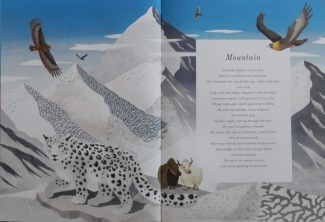
The author has chosen thirteen natural habitats – Rainforest, Arctic, Prairie, Woodland, Coral reef, Desert, Rock pool, Mountain, The Outback, Moorland, Deep sea, Mangrove and Savannah – that are under threat due to human activity, and captures the essence of each one in a series of free verses.
Here’s the opening to Mountain:
‘I am the highest mountain, / Born in a collision of continents. / All is beneath me, except the sun, moon and stars. / I am rock, / Crag, cliff and ledge, draped in veils of white. / I am snow-maker, with glaciers in my arms, / Whose meltwater swells great rivers below.’

In stark contrast is the quieter sounding Savannah, which opens like this: ‘Savannah speaks in whispering grasses, / In the chatter of cicadas across an endless plain. / Spacious homeland of swift cheetah / And gazelle, with the horizon in her eye.’

Using matte colours, the illustrators Hvass and Hannibal showcase the flora and fauna of each location in a series of eye-catching paintings that incorporate the text within them.

Human use, climate change and pollution are responsible for the damage to the environment and after her introductory poem, it’s not until the final pages that the author enlarges upon her conservation message citing the specific damage within the thumbnail sketch of each of the places portrayed. Thereafter she implores readers to use less energy, to recycle and to buy with care.

We’d all do well to keep in mind her final words about our precious planet: ‘Explore it, protect it, love it. / Our Earth is a wonderful wild world. ‘

Also with an ecological message is:

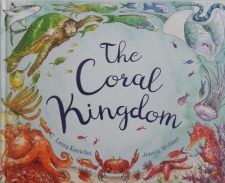
The Coral Kingdom
Laura Knowles and Jennie Webber
Words & Pictures

Our coral reefs, with their gorgeous colours: crimson, red, rose, yellow,

turquoise, emerald, jade, purple, even black, that have taken 1000s of years to grow and give home to a myriad of creatures large and small are under threat.

When the coral is bleached white due to acidity caused by climate change, and stays white for too long, then the reef dies.

Laura Knowles has written a rhyming narrative that outlines the life cycle of a reef and includes a caution that unless we humans take action these amazing ecosystems will be lost forever.

Jennie Webber’s detailed watercolour illustrations show the beauty of the undersea habitat and a final fold-out page gives additional information about coral reef conservation.

A useful addition to a primary school conservation topic box, or, for a child interested in ocean life or ecosystems.

Who’s Hiding on the River? / Who’s Hiding on the Farm?
Katharine McEwen
Nosy Crow

It’s never too early to start learning about nature and here are two board books just right for introducing animals, some wild and some domesticated, to the very young.

Both are beautifully illustrated by Katharine McEwen and there are lots of animals to find in both locations.

Toddlers can spend a day by the river, from a busy morning through to night-time as they explore the pages, manipulate the sturdy flaps in response to the ‘Who’s hiding here?’ on every right hand page to discover tadpoles, cygnets, fish, dragonflies, a stoat, a beaver and more as they swim, wriggle, wade, leap, build and paddle.
The farm book also moves through the day in similar fashion and McEwen’s text is carefully worded to introduce new vocabulary including ‘pecking,’ ‘trotting’, ‘snoozing’ ‘prowling’, munching’ and ‘diving’ along the way.

Published in collaboration with the National Trust these are fun and at the same time, gently educational.

Once Upon a Jungle

Once Upon a Jungle
Laura Knowles and James Boast
words & pictures
James Boast’s vibrant floral images of the jungle setting that provides a home for myriads of creatures, almost leap out at you  off the pages of this book that focuses on a small number of those creatures, a few of which are just visible on the opening spread …

The straightforward, patterned text then introduces ants, a preying mantis, a lizard, a monkey, a panther that ages and is eventually broken down by roaming beetles.

Thus the soil is enriched, new seedlings thrive and eventually, become part of the jungle habitat: home to …

Simply, and highly effectively, Laura Knowles has demonstrated a food chain within this jungle ecosystem; a food chain that is further elucidated on the final fold-out spread wherein information is given about the various roles played by the sun, producers, consumers and decomposers, along with a final challenge to re-read this alluring book and identify which flora and fauna are performing each role.
As well as being an eye-wateringly beautiful book in its own right, this is an excellent way to introduce the concept of food chains to young children; in addition, it’s a book that children would (once it’s been shared with them) be able to read for themselves. They can along the way, also see how many of the jungle fauna they can spot.

I’ve signed the charter  

Wonderful Wildlife

dscn9092

It Starts With a Seed
Laura Knowles and Jennie Webber
Words & Pictures
Sometimes I open a parcel and just know I’m going to love a book before I’ve even got inside the cover. Such a one is this and as the title says It Starts With a Seed – a sycamore seed.
In this gorgeous book Laura Knowles’ rhyming narrative takes us on a journey – a journey through days, weeks, months, seasons and years as we follow the growth of that seed from the time it falls to earth right through until it’s a mature tree – fully formed with its own ecosystem. Jenny Webber’s delicate, detailed illustrations show every stage of the tree’s development from seedling …

dscn9095

to sapling to the ‘leaf-laden, bark-bound arboreal home’ to the plethora of insects, birds and mammals that live therein.

%0a

What I love so much about this book though is the sense of awe and wonder it’s likely to engender in those who read or listen to its lyrical words and pore over its painterly portrayals of the natural world. Such a superb way to embody a fair amount of information and the whole narrative is presented again on the front of a gatefold finale that opens to show seasonal changes to the leaf and flower and provide additional information such as ‘A sycamore’s small flowers grown in clusters known as racemes’ and ‘A sycamore can grow 35 metres tall’ – wow! And all from one tiny seed.
A book to buy and to keep, a book to share and a book to give: it’s perfect for autumnal reading but equally, it’s one to be returned to often, at home or in the classroom.
Laura Knowles has also has co-written

%0a

British Wildlife
Matthew Morgan & Laura Knowles
QED
Essentially this is a visual introduction to some of the riches of the natural world to be found in the British Isles from frogs to fruits …

%0a

and fishes to fungi.

%0a

Illuminature
Rachel Williams and Carnovsky
Wide Eyed Editions
This is an awesome look at over 180 animals and the plethora of plants that inhabit ten of the world’s very different environments from the Congo Rainforest to Loch Lomond and from the Californian Redwood Forest to the Ganges River Basin.

%0a

Awesome because, thanks to the three-coloured lens (included in a pocket at the front of the book) readers are able to get three different views. Look through the red lens and you see the diurnal animals, the blue lens will show nocturnal and crepuscular creatures and the green lens reveals each habitat’s plant life.
Each habitat is allocated six pages – two ‘viewing’ spreads, one giving key facts about the place and a textless “observation deck’ …

dscn9090

followed by a black and white one –

dscn9091

a ‘species guide’ that provides more detailed information on the particular animals featured in the coloured scenes. I foresee squabbles arising over this one.