Big Thoughts / Some Days I’m the Wind

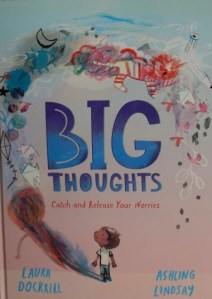
We’re all beset with worries from time to time – ‘Big Thoughts’ as the child narrator of this books calls them. Such thoughts can’t be seen by others despite them being loud inside your head. They might be Big Thoughts about the future, the past or perhaps even make-believe (not telling the truth). Moreover the more one tries to ignore such thoughts, the louder and more all embracing they become.

So what can be done to alleviate a very worried mind? One way is to share them with a an older person who has learned some coping strategies. Strategies that can be passed on and will then stay with the sufferer henceforward. Another way is to talk with a friend who has suffered similarly, so neither person feels alone.
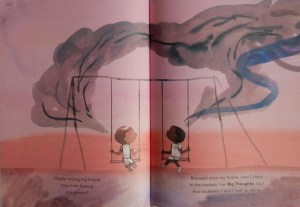
Laura Dockrill’s text is such that readers/listeners are made to feel the centre of attention – seen and heard – and together with Ashling Lindsay’s sensitive illustrations and the final spread entitled Tips and Techniques’ make this a very reassuring and helpful book.
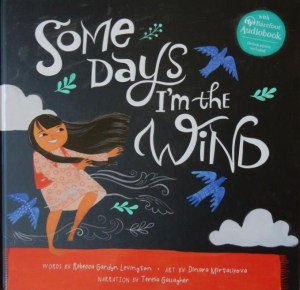
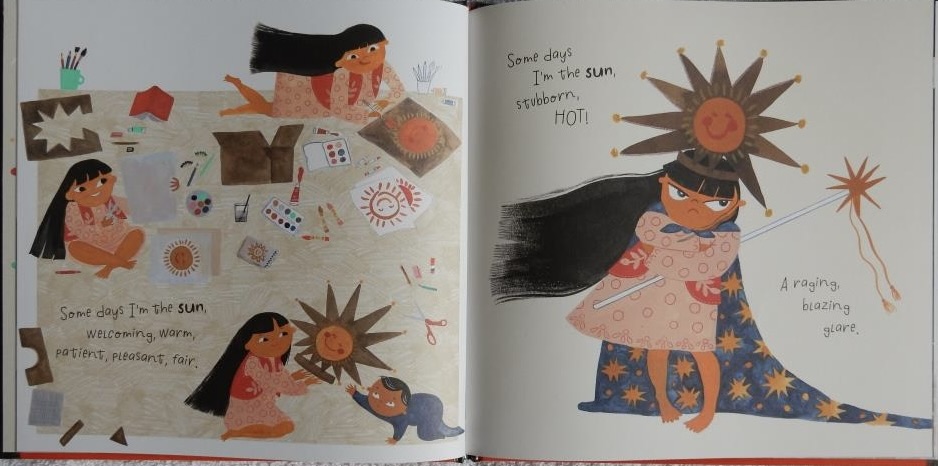
Using metaphors relating to the weather and the natural world, the young narrator of this book tells us how her feelings and emotions can change from day to day or perhaps several times in a single day. “Some days I’m the sun, welcoming, warm /patient, pleasant, fair. // Some days I’m the sun, / stubborn, HOT! / A raging, blazing glare.’
Or, ‘Some days I’m a tree, / flourishing, strong, reaching for the sky/ // Some days I’m a tree / trembling, bare, / bidding leaves goodbye.’

The well chosen, child friendly metaphors combined with the repeat ‘Some days’ of the gently rhythmic text and the vibrant, boldly coloured illustrations, keep readers turning the pages as they, like the narrator come to understand that there are a whole multitude of ways to feel, to act and to be. This is reaffirmed in the final proclamation, “And just like the wind, / or the sun, / or the sea / on some days / I’m some ways, / but all days // I’m me.”

After the child’s narration is a spread entitled “Exploring Our Emotions’ written by a child development specialist. A book to share and talk about at home, or with an EYFS or KS1 class.
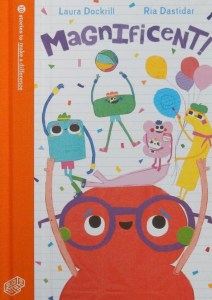
Magnificent! / In Her Element

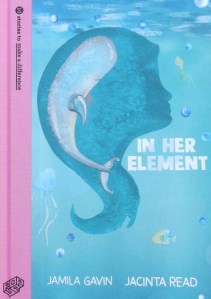
These are two of the titles in the Pop Up Projects CIC 10 Stories To Make a Difference collection, each one inspired by the theme of difference.

Magnificent!
Laura Dockrill and Ria Dastidar

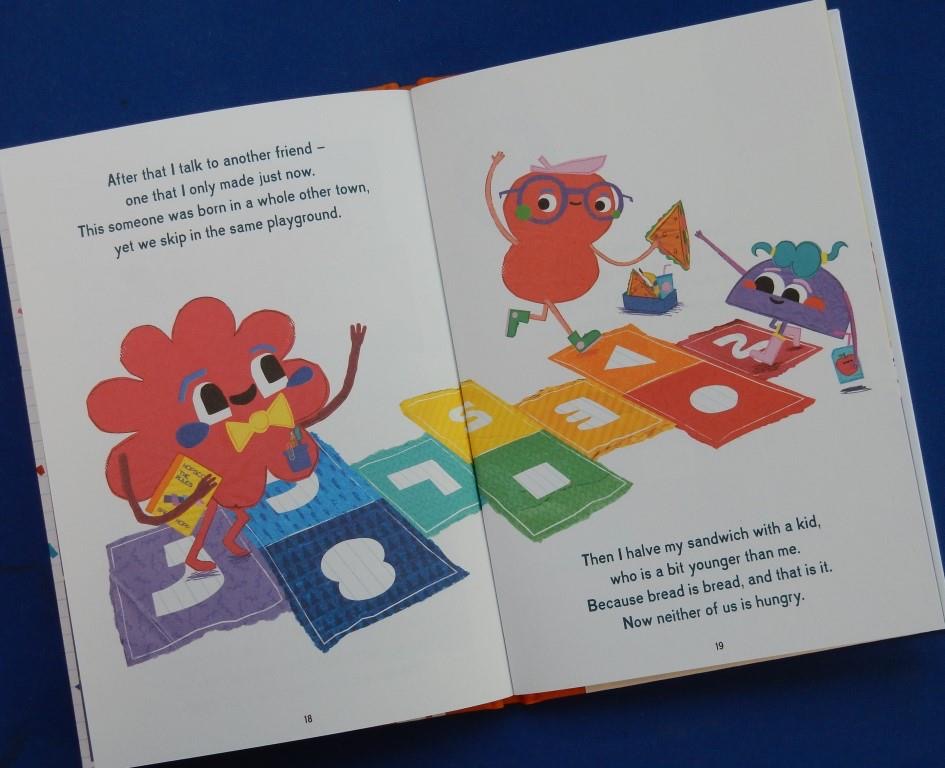
At the start of Laura’s poem, Magnificent! the chief protagonist is trying to cover up individuality, acting like others and trying like mad to blend in – a familiar scenario I suggest. In graphic detail Roa Dastidar shows the trials and tribulations this causes, covering up one’s true feelings and trying to fit in. Social inadequacy, as we see in the playground scenes certainly brings no comfort: overthinking and overcompensating are unrewarding.

Later though, we see a difference – ‘a flip of the coin today’ – it’s time to toss aside boring, cheating sameness and start celebrating differences, no matter what they might be. Quirks are part of what makes us who we are, we’re all different – be that where we come from, how we communicate or how we look.

So long as we remember to reach out to others, especially those who might be struggling, our world can be one of joy where uniqueness rocks.
A smashing book to share and discuss, especially as part of a PSED session.

In Her Element
Jamila Gavin and Jacinta Read

That Jamila Gavin is a superb crafter of tales is evident from the very start of this moving sharing of events in young Sophie’s life, In Her Element. Sophie has cerebral palsy, communicates through her beautiful expressive eyes and a screen, and has a carer, Martin with whom she has a special bond. She loves to be taken swimming , has a special connection with the ocean and dreams of swimming with whales: “Water is my element” she tells Martin, imagining herself as an aquatic creature. Indeed the watery world acts as a metaphor for all the thoughts Sophie cannot give voice to.

Now there’s to be a change in her life: Sophie’s parents tell her that a special residential school they’d previously visited has offered her a place to start the next term. Tears stream down her face as she informs Martin what’s to happen, although she remains calm showing no anger. He in turn is hugely reassuring, reminding her of her ambitions and the importance of becoming as independent as possible.

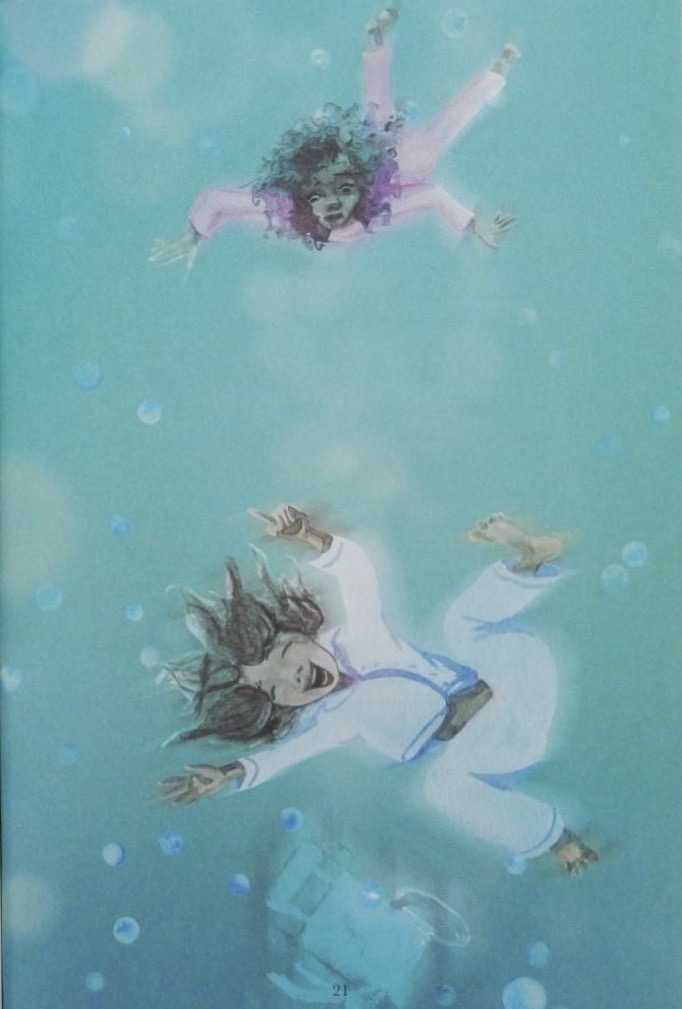
Almost inevitably, life at school is challenging, especially as Sophie has to share a room with the far from welcoming Amber, an ace swimmer who has been severely injured and now wants nothing to do with the sport or water. So she says, but then one night, Sophie’s actions cause Amber to show what her element truly is. Jacinta Read’s final two watercolour illustrations portray this brilliantly.

What a powerful story with such an uplifting ending. Jamila Gavin paints a picture of an enormously positive main character whose imagination is a key part of her life.

If the rest of the series is as good as these two I’d strongly recommend primary schools get all ten.

Butterfly Brain

Butterfly Brain
Laura Dockrill and Gwen Millward
Piccadilly Press

Gwen Millward’s cover for this book is absolutely delightful; don’t be beguiled by this however. What’s inside is a story about a boy dealing with his grief. There’s even a warning on the first page informing readers that what follows is ‘rather strange and gory.’

Time and time again, Gus gets into trouble; he breaks the rules at school, is rude to his teachers, angry towards others and is always leaning back on his chair, taking not one scrap of notice of warnings about injury from those in school or at home whose anger he’s aroused.

Then one day, the inevitable happens …

CRACK! and that crack becomes a large gap through which Gus’s brains with his dreams, understandings, feelings and memories are exposed for all to see.

A butterfly appears – his very own brain butterfly – a guardian guiding light, it says, but that too flies away. There’s only one thing to do.

Out of the window and up into the night sky goes the pyjama clad boy in pursuit.

During their journey Gus learns how important memories are, be they good or bad, including those buried deep within. He revisits long gone, alarming dreams, learning of one that should not be left behind, and discovers the vital importance of the imagination.

Is he ready finally to own the secret and the painful fear of loss?

Enormously moving, forthright, and written in rhyme, this is a truly heart-rendingly incredible book that can speak to everyone, child and adult, through its words (Laura’s) and its powerful pictures (Gwen’s) rendered in mood-invoking hues.

A definite keeper this.

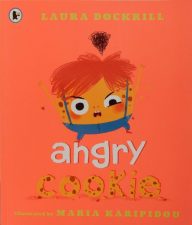
Angry Cookie

Angry Cookie
Laura Dockrill and Maria Karipidou
Walker Books

Who can resist the words of the chief protagonist on the back cover: “Don’t even think about opening this book, you nosy noodle. I’m warning you. I am very angry.”
Of course, like me you will immediately open the book and discover that Cookie IS angry, very angry and causing him to have daylight flooding into the book and thus his bedroom, is quite simply, intolerable.

However since we’ve already committed that outrageous act and are apparently not going anywhere, the biccy feels bound to share the reasons why he’s so aggrieved.

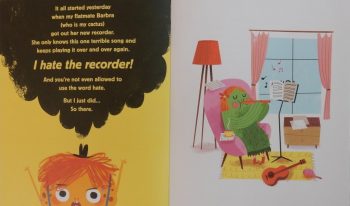
It’s on account of the previous day – a terrible one by all accounts – that began when flat mate Barbra insisted on playing the same tune on her new recorder over and over. (Cookie has my sympathies there.)

Next came running out of his favourite sweet toothpaste and having to use an unpleasant spicy one instead.

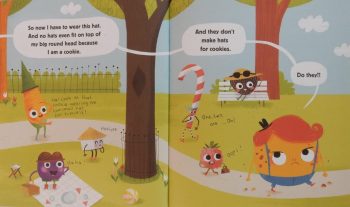
Even worse though was the bad haircut that forced our cookie narrator to wear an ill-fitting hat; unsurprisingly nobody makes hats for cookies, hence the bad fit that makes him a source of amusement to others.

If you can believe it though, the day has to throw in an even bigger disaster. Angry Cookie heads to the ice cream parlour, his heart set on his favourite vanilla sundae topped with all manner of yummy sprinkles and served in a tall glass. But – I’m sure you’ve already guessed – they’ve run out. Can you blame the poor thing for his anger?

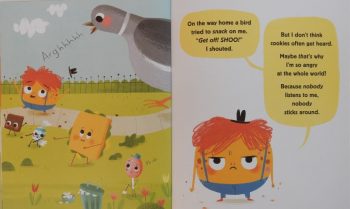
Then on the way home along comes a bird that almost makes a meal of Angry Cookie himself;

but perhaps there is one consolation. Could our devotion and friendship be the key to a happier Cookie? After all we have stuck around despite all that the self-confessed ‘grumpy lump, horrid humph’ has said and done, so it’s worth waiting around a little longer to see if happiness is lurking somewhere under that tiny titfer.

What a deliciously quirky, witty tale Laura Dockrill has cooked up. Young children will adore this grump of a character and likely identify with his moody moaning.

Maria Karipidou has done a terrific job portraying Angry Cookie, making him, despite all that ranting, a character one cannot help but love right from the start.

Destined to become an early years storytime favourite methinks, and a great starting point for talking about emotions.