Mama’s Special Wonton Soup

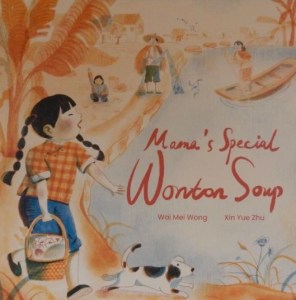
This story is set in Southern China and begins with Mama announcing to her young daughter that she’s going to make wonton soup for supper that night and asking the girl to go to the market for some meat. Eagerly the child sets off, empty basket in hand and on her way she passes villagers who are already busy at work. What kind people they are: one gives her radishes, another some shrimps, her Grandma gives some sweet persimmons and her aunt gives a hug. Each time she stops the same words are exchanged: “zǎo ān” (Mandarin for “good morning”) and “xiè xiè” (thank you), except that is, when the girl pauses to splash in puddles and later tries using a stick to turn a toad into a prince.

At the meat stall in the market, the girl purchases the special meat her Mama requested and also receives a bone for the family puppy.
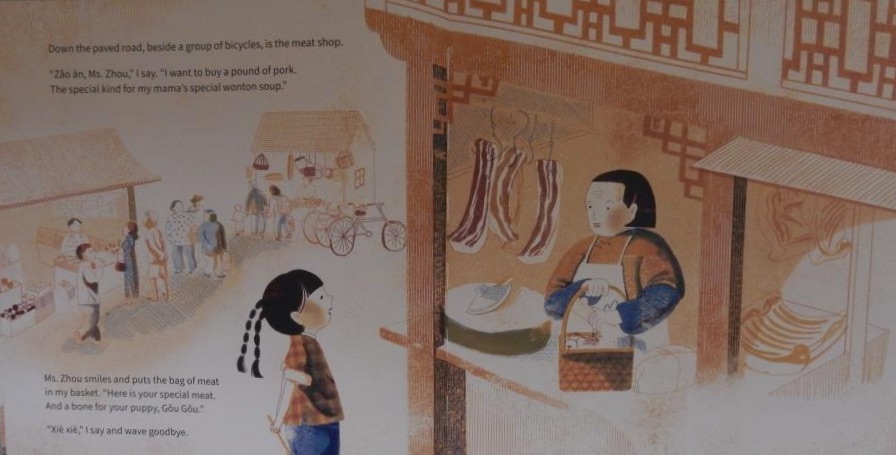
Back home once more the chid narrator gives Mama the unexpectedly heavy basket and tells her about how she came by the additional items. “I have an idea,” she then announces and dashes off back to the village to invite various villagers to come and partake of Mama’s tasty meal.
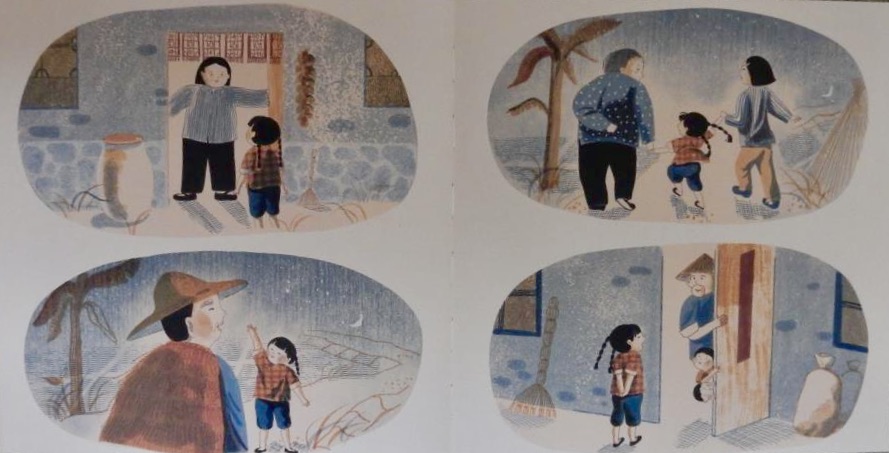
Wai Mei Wong’s charming tale of a warm-hearted village community is portrayed in earthy hues by Xin Yue Zhu whose scenes amplify the kindness of everyone.

A feel-good tale and a reminder of the importance of caring and sharing.
Soni and the Life Drinkers

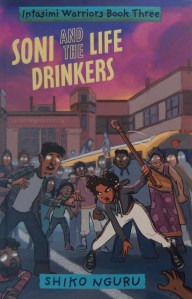
With just a few days to go, twelve year old Soni has her sights firmly fixed on winning first prize at the annual middle school dance competition, Vunja Mifupa. To that end even after her fellow members of the dance squad have left, she remains behind in the studio to continue practising. While so doing she hears a heartbeat that makes her blood run cold; it’s no ordinary one but that of a shiqq, an underworld monster.

As Soni leaves, her father greets her with devastating news. Her beloved mentor and teacher, the already ailing Mr Lemayian, has taken a turn for the worse. It must be the malevolent Life Drinker that is the cause. Mr Lemayian has helped Soni and the other Intasimi Warriors—Mwikali, Odwar, and Xirsi—come into their powers and defeat evil, so now these powers must be used to save their beloved teacher. Soni calls a meeting with her friends and tells them the awful news. During the meeting there’s an unexpected arrival – it’s a hybrid (part human, part shiqq ) claiming to be able to help them, saying her name is Thandiwe and that the Final Battle is nigh. Moreover Thandiwe hands Soni a brass bracelet saying, “ … it belongs to our family. It’s your Entasim.” But can Soni trust her to help find the Life Drinker that’s draining Mr Lemayian of his life force? Then Soni learns that her mum has a twin sister who has a dark secret – a key to finding the identity of the Life Drinkers perhaps?

With their mentor growing weaker all the time, surely they can’t refuse Thandiwe’s help, despite the Intasami Warriors already having been betrayed? Maybe it’s the only way to go so long as when working with others, Soni can manage to moderate her impulsive nature.

The book ends with the Final Battle yet to happen, leaving readers eagerly waiting for the next episode.

Freedom Braids

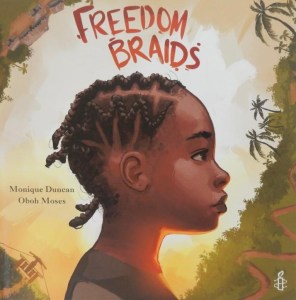
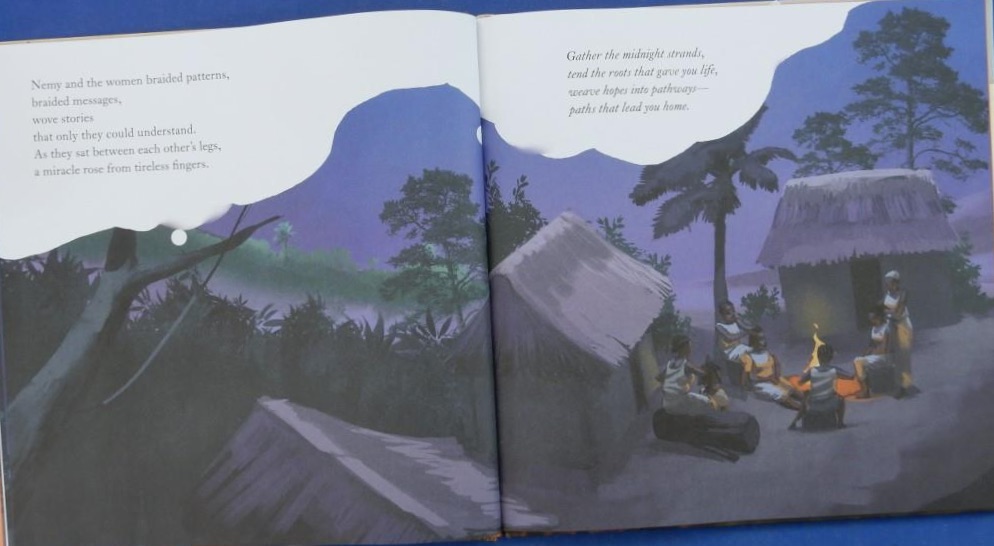
Every morning, Nemy, a child on a plantation walks through the fields scattering seeds, pulling out weeds and stripping leaves. She watches Big Mother hard at work cutting sugar cane, cooking yucca roots and in the evening she listens to her stories before bed. Then one night Nemy follows Big Mother to a shack, outside which sit a group of women braiding one another’s hair. She too has her hair braided, by Big Mother, and it makes her recall her own Nana. Nemy feels part of the community of women that night as she too forms lines of plaits just the way her Nana has taught her and in so doing she evokes the smells of the oils and herbs her Nana used.

In the midst of her protective community, the girl learns how to braid maps, messages and information concerned with freedom into another’s hair;

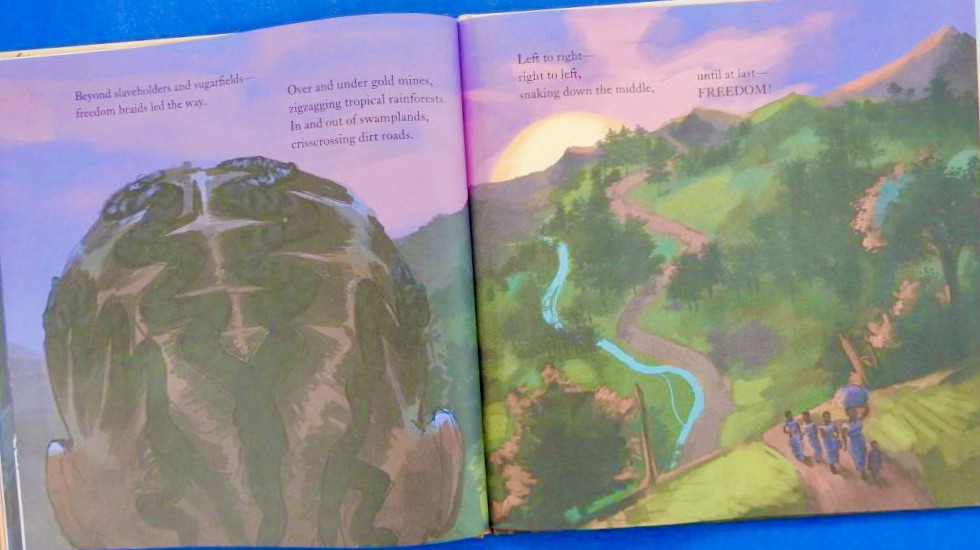
even seeds were hidden in cornrows that would be planted once the wearers were free. This entailed keeping careful watch of their captors as they crept out into the forest once night fell, staying clear of danger thanks to the dark surroundings. This is what Nemy and her fellow group members did until finally they’d left behind the sugar fields, trudged through forests and finally found a place to establish a new home – freedom at last!

In a final spread, author Monique Duncan explains how her story is based on real life experiences of the enslaved, in particular those in Columbia ,and includes some fascinating information about the meaning of the various styles of hair braiding.

Despite the terribly unjust treatment of those sold into slavery, the enslaved courageously found their own ways of resisting and this poignant story is infused with hope. Oboh Moses’ digitally rendered, almost exclusively nocturnal scenes of the women capture their beauty and serenity, and his use of colour intensifies the drama particularly in the scene where the women are on the path to freedom.
A book that deserves, indeed needs, to be shared widely as a reminder of the courage shown by the enslaved during the centuries of the Transatlantic slave trade.

The Language of Flowers

Juhi’s Appa, a florist, has taught her the language of flowers. She knows that stargazer lilies, irises and jasmine represent different kinds of love. On account of her flower knowledge she is aware of the various celebrations and special events that happen in her neighbourhood: frangipani is for those who pray on full moon days, dried henna petals are used to paint hands on a variety of occasions, daffodils announce the birth of a new baby and peonies often decorate a birthday cake. However of all the customers who visit the family’s florist shop, Mr Potter is her favourite. He is always cheerful, enjoys telling jokes and stories from long ago and every Wednesday chooses flowers of the brightest hues for his wife. Mr Potter lives life to the full, Appa tells his daughter.

Then one Wednesday it’s Mrs Potter who comes to buy flowers; she wants them for her husband who is in hospital and Juhi knows just the ones that will cheer him up. Several weeks pass and there’s no sign of either Mr or Mrs Potter and then on a Friday Juhi enters the shop and finds Appa making an enormous bouquet of white flowers. Sadly he tells her that Mr Potter has died and the bouquet is for his wife. Juhi though does not know the language of grief and remains silent.

Appa asks Judi if she’d like to accompany him to deliver the bouquet. However she doesn’t think that the white bouquet her Appa has made truly represents the way she wants to remember Mr Potter’s life of joy. Instead she makes a garland of all his favourite, brightly coloured blooms from his world travels.

This moving story of love, community, grief and self-expression is told in Shyala Smith’s elegant direct words and through Aaron Asis’s often vibrant, textured gouache and digital illustrations.

Step into my shoes

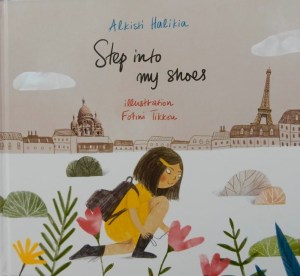
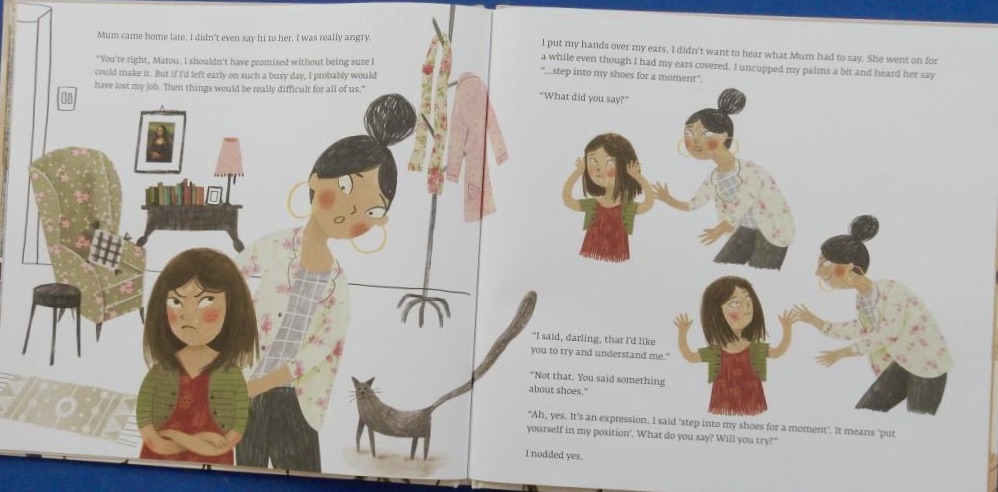
Matou, the narrator of the story, lives with her parents in a small town just outside Paris. One Friday afternoon, her school finishes early and walking home alone, Matou passes the mosque. Outside she sees what she calls ‘a sea of shoes.’ Her eye is drawn to a pair of trainers and as nobody is around, she tries them on. Then suddenly the door opens and she hurriedly removes the trainers and puts her own shoes back on. Shortly after a boy wearing the trainers passes her.

Henceforward Matou would make a habit of stopping and trying on various pairs of shoes left outside the mosque.

A few weeks later an eagerly anticipated day arrives; Mum has promised to leave work early so the two of them can visit the shops together. The perfect opportunity to show her mum those sports shoes, thinks Matou. But when she gets home, it’s Dad who greets her with the news that her mum is unable to take the time off from work. Matou is very angry, Mum apologises and asks her daughter to … “step into my shoes for a moment.” Having had this saying explained to her, Matou agrees to try.

The result is that by recalling her mosque shoe trying, the girl is able to understand her Mum’s difficult position and all is well between them.

Come the spring, Matou is much happier; not only does she have a new friend, she also has a special new pair of shoes. With themes of acceptance, positivity and optimism, this book with its French setting, and mixed media illustrations, will enable readers to step into the shoes of the girl narrator.

One Extra Sparkle: Ellie and the Marriage List


Ten-year-old Ellie Anderson (who has Down’s syndrome) anticipates having the best summer ever. She loves hanging with her big brother, 15-year-old Ben though of late he’s been paying her less attention on account of soccer and his stock-taking job. Now he’s become even more preoccupied with new neighbour, Sara, even inviting her on outings Ellie thought were special for her brother and herself – their nature hike and the Ability Centre (AC) dance, for instance. She feels like she’s losing Ben.

Things get even worse when her best friend, Ling, claims that according to her list Ben and Sara are getting married, That means they will move away forever. Ling’s list has six steps including hand-holding and kissing; Ben and Sara are working their way through these steps and when they reached step three, it’s panic stations. The two friends start operation stop Sara and Ben’s wedding at all costs, either that or Ben could end up as a Hawaii husband. It’s impossible not to be amused at what Ellie and Ling get up to as, list in hand, they track him.

They begin training to enable them to use the treehouse in Ellie’s garden to scare Sara so much she never comes near again. However Ellie finds herself carrying out the plan by herself, things go wrong, people’s feelings are hurt and Ellie herself feels terrible. Moreover she doesn’t even get to help Ben when he DJs at her AC dance, though she does help her magician Dad at the event.

But nothing else seems to work out right and Ellie ends up endangering the weeping willow tree in her garden she loves so much. With so much at stake, can she possibly find a way to rekindle her brother’s affection toward her as well as save her favourite tree from being cut down?

There is so much to love about this book: Ellie is such an endearing character with her extra sparkle: she is artistic and full of life despite having to cope with speech difficulties and ‘wobbly spaghetti’ muscles. Her family members, particularly Ben, are very supportive and her friendship with Ling is really heartwarming. Indeed the whole story, with Lucy Rogers’ superbly expressive illustrations, is one that deserves to be read widely.
At the back of the book author Tricia Seabolt gives information about Down’s syndrome and various therapies that enable people who are neurodivergent to flourish.

A Hat Full of Sea

Cora visits her Grandpa Jim during his stay in hospital; she wears the hat he’d given her every time she goes. His room there has only a small window, which Cora doesn’t feel is enough for him. She wants him to experience a variety of places and so using the hat, she sets out to help him.

First it’s the sea and with the help of her imagination, the girl catches ‘the cold-water ripples and the white foaming waves. … the softness of the sand and the seagull cries all wrapped up in the wind.’ Carefully she carries them to him and we see the water seemingly covering him like a blanket.

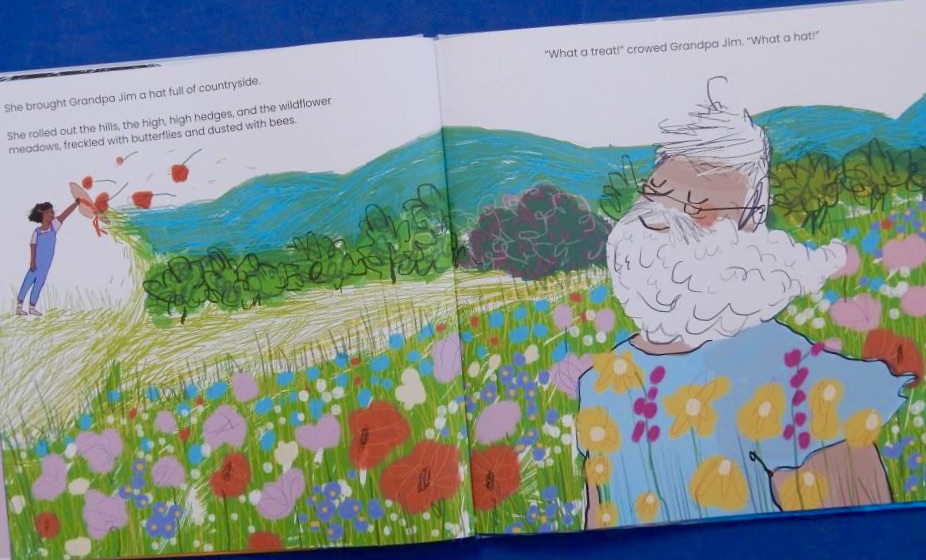
Next she takes him the countryside alive with flora and fauna,

then the thrills of a fairground and more including the beauties of a black velvet night sky.

Her best idea, Cora thinks, will be a journey but as she nears a train, she drops her hat. She’s heartbroken at not being able to find it , but when she visits the hospital again she can’t find her grandpa either; he’s not in the bed.

Happily though, he has recovered and is soon beside her telling Cora that it’s her, not the hat, that is special and cheered him up. Moreover he feels ready for a walk down to the sea.

I love the playfulness of Jen Khatun’s digitally created illustrations that are perfectly in keeping with Maudie Smith’s warm, equally playful text. A beautiful portrayal of inter-generational love that reminds us all how important it is to spend time with loved ones.

The Great Henna Party

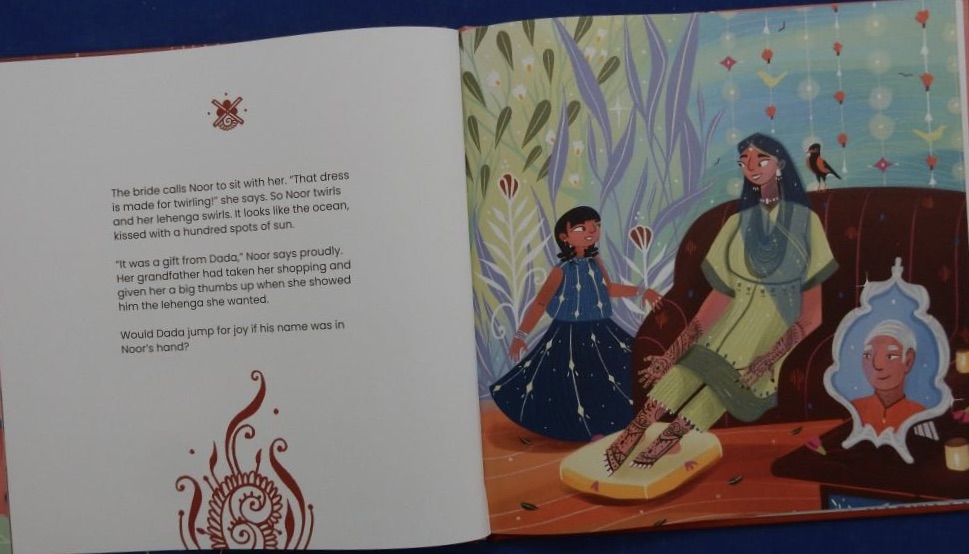
It’s the eve of Noor’s cousin’s wedding and the women of the family have gathered to sing traditional songs and have henna (also called Mehndi in Urdu and Hindi) designs applied to their hands for the big day. Meanwhile Noor’s Baba (Dad) has been busy decorating the garden with lights and string of flowers. They shimmer like treasure, Noor thinks.

At the henna party Mama tells Noor about the ‘henna name game’ in which the henna artist hides the groom’s name in the intricate patterns she applies to the bride’s hand and the groom has to try and find it. Noor likes the idea of this henna game and asks her mother if she can hide someone’s name on her hands too.  Mama agrees but her daughter can’t decide which of her treasured family members to pick.  As the party proceeds Noor wonders if it should be one of her parents, her Nana or Dada (grandfather)

or perhaps her big sister. As the party draws towards its close, Noor suddenly has an innovative idea and when she sees the result of her choice, the girl declares. “It’s perfect!”

This is a truly delightful celebration of family and of culture that thanks to the details – verbal and visual – both author Humera Malik and illustrator Sonali Zohra have included, will be accessible to all children, not just those who are familiar with South Asian cultural traditions. I love the warm colour palette and richly patterned illustrations Sonali has used. (A final author’s note giving more information about henna is included.)

A lovely book to share with KS1 children. It’s sure to result in much discussion both about this story and perhaps weddings more generally.

The Invisible Story

On a shelf, hidden away in a corner of a large library is a book that’s unlike all the rest. They would sometimes spend time arguing about which is most read, or best loved; but the ‘Invisible Story’ listening from the shadows has never been read. It longs to be colourful and popular like the others. “I’m just a ghost, nobody can see me.” it chants over and over.

Then, one day a young girl visits the library; she runs her fingertips over the spine of the ‘ghost’ book, discovers tiny raised dots. and announces … “I’m going to read.” The alarmed book begs her not to, saying that its pages are blank. However the girl’s gentle voice calms the book and it goes on to discover that it is in fact a very wonderful story indeed, a story written in braille, “the language you read with your fingertips’.

The invisible story now realises that no one story is better than any other, they are just different.
Translated from the original Spanish by Daniel Hahn, Jaime Gamboa’s inclusive tale is a reminder that not every book is intended to be read with the eyes. It also contains an important message about the power of a great story – the best books can be read over and over; they never really end.

Wen Hsu Chen’s watercolour and cut paper illustrations work in harmony with the text and are really effective, be they wholly white, predominately white with small splashes of colour or where the colour predominates.

For those readers who are blind, partially sighted (or dyslexic) the publishers have collaborated with the Royal National Institute for the Blind and accessible formats are available from RNIB Bookshare.