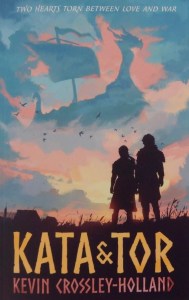
Kata & Tor

Set in 1066, the focus of this story is a failed invasion of York by the Vikings led by King Harald Hardrada of Norway and leader of the Viking fleet.. The king has sent his youngest son Tor and companion Eirik ahead as information-gathering scouts but an accident wrecks their boat and Eirik ends up dead. Unsure where he’s landed up and without a partner, Tor is at a loss to know what to do. He realises he must bury his friend but before so doing he goes wandering along the beach, discovers a hut and spends a couple of nights there before proceeding with his mission, telling those who ask that he’s come from Orkney in order to avoid suspicion.

Meanwhile Kata who knows very little about her parents, is hard at work in her village supporting herself and neighbours, yearning for something other than marriage at a young age within her Anglo-Saxon village and environs.

It’s fate that brings the two young people together and they’re immediately attracted to one another. However in such troubled times being in love with someone from so different a background and with rumours spreading about the imminent coming of Hardrada, Kata is constantly asking herself if she’s fallen for a Viking and if so, then what? Tor too has a difficult dilemma: he insists to Kata that he’s not a Viking – he certainly doesn’t want to fight – and is at odds with himself – but he has to decide where he really belongs. Can they find a way to be together?

History lovers in particular will enjoy this tale much of which, though not the titular characters, is historically accurate.
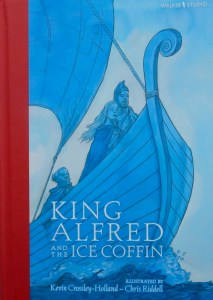
King Alfred and the Ice Coffin

Prize-winning author Kevin Crossley-Holland and artist Chris Riddell join forces again, this time in a mythic re-imagining of a story set in Anglo Saxon times. We hear at the start of this rhythmic, dramatically told prose poem, how King Alfred of Wessex met a trading traveller with ‘a tale to tell’. The trader is Wulfstan of Ravenscar and he spins a story to the King, his wife and the royal household telling of adventure, shipwreck and love.

It tells how at an early age, Wulfstan became skipper of a small trading boat. A boat that after a violent storm eventually reached a jetty where he expected a hostile reception. However the people that helped them ashore were welcoming and assisted the traders in mending their boat.
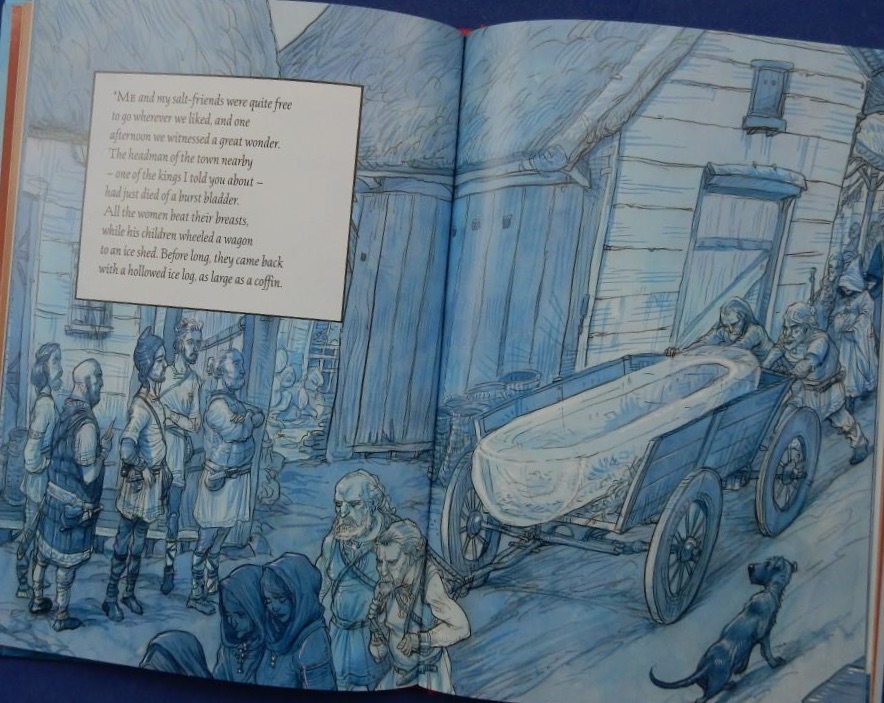
One day after the death of the nearby town’s headman, the visitors learn of some of the people’s customs including their use of a hollowed out ice log as a coffin to preserve the man’s body

and the events that happened including a horse chase hunt for the headman’s wealth, leading up to placing of the body onto the funeral pyre. As for the treasure hunt, Wulfstan himself became the winner of a real treasure, the beautiful golden haired Eliza whose heart he had won.

Riddell’s rich illustrations are at first rendered in sepia tones but once the story of the sea voyage begins, change to blue tones, returning to sepia after Wulstan concludes his account.

This would make a good read-aloud for Primary School classes looking at Anglo Saxon history as well as a solo read those interested in that period.

If Music Be the Food of Love

DSCN5509 (800x600)

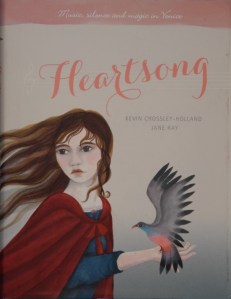
Heartsong
Kevin Crossley-Holland and Jane Ray
Orchard Books
Antonio Vivaldi and his music, and stories of orphan girls who grew up in an orphanage/music school, the Ospedale della Pietà (in Venice) were the inspiration for this powerfully told and beautifully illustrated book.
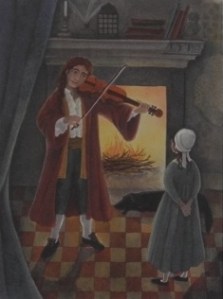
The young Vivaldi was director of music at the institution and wrote many pieces for the girls in his choir.


DSCN5505 (800x600)

One of these was the foundling child Laura whose name Jane Ray came upon on a visit to the Vivaldi Museum in a list, written in an old ledger, of the foundling babies left at the Ospedale della Pietà.
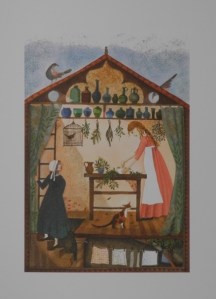
Abandoned as a baby, Laura who is mute, narrates her own story telling of her musical education, her daily duties,

DSCN5506 (800x600)

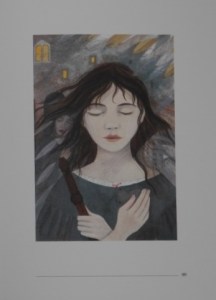
her friendships and how music, in particular her flute playing, finally becomes her redemption.

DSCN5507 (800x600)

Jane Ray’s evocative illustrations have a powerful haunting quality that resonates with the text: Crossley-Holland wastes not a single word as he gives voice to Laura – ‘In the watches of the night. Like a cradle, rocking. Sometimes I think I hear you. Do you love music too? / The drops of water falling onto my stone floor are minims and crotchets, quavers and semi-quavers. Like a song I almost think I know. Like a song you sang to me.’

DSCN5518 (800x600)

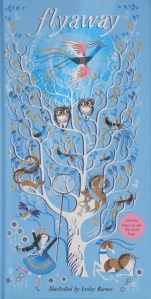
Flyaway
Lesley Barnes
Frances Lincoln Children’s Books
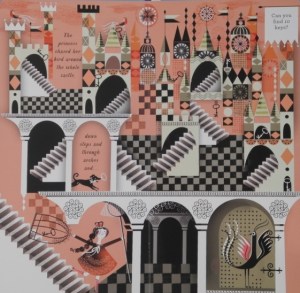
The young princess in this lift-the-flap story keeps a bird caged and every morning demands that it should sing for her. One day though, she forgets to lock the cage. The bird escapes and so begins a chase through the entire castle …

DSCN5516 (800x600)

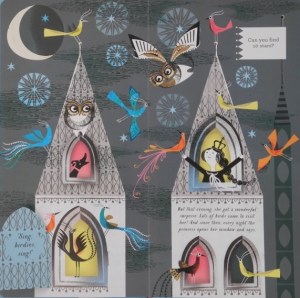
and out into the grounds. There, the princess traps the bird in a net and so is happy once more. Not for long however, for she soon notices that the bird no longer sings. Realising that it longs to be free, she releases it once more and is later delighted to discover that her kindness is rewarded by not one, but a whole host of birds that come and sing for her every night.

DSCN5517 (800x600)

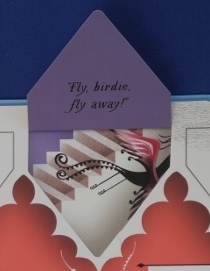
With stylish illustrations, ten things to find and a flap to lift on every spread (some revealing the encouraging “Fly, birdie, fly away!” to the escapee),

DSCN5515 (800x600)

to add to the enjoyment, this book for young readers and listeners embodies an important message about freedom.

Use your local bookshop          localbookshops_NameImage-2

 Exciting event: Children’s Book Illustration Autumn Exhibition, Piccadilly, 23rd-29th October

C090B987-9FD4-47C9-A6E5-CEEE0DD83F4E[6]