These are all books for very young children, – thanks to the publisher Oxford Children’s Books for sending them for review.

50 Words About Nature: Animals
50 Words About Nature: Bugs
Lily Holland and Debbie Powell
As an advocate for using the correct scientific terminology with young children I was excited to see this pair of books – the first two in the new series 50 Words About Nature – doing just that.
Animals takes a look at the whole of the animal kingdom – mammals, fish, reptiles, amphibians, birds, insects and molluscs giving examples of each including a tiger, alligator, dolphin, frog, beetle and octopus, in the process defining such words as carnivore, herbivore, vertebrates, invertebrates, primates, habitat, zoologists and extinct.
In similar fashion Bugs explores first insects, then arachnids and next returning to insects, focuses on several different beetles, including some like fireflies that are nocturnal. There’s a spread featuring nocturnal moths, another looking at pollinatorsand the final one introduces entomologists. Terms used include exoskeleton, antennae, proboscis, metamorphosis, arthropods,

elytra, carapace and telson. I don’t think I met those last three until I started studying biology at secondary school. However in my experience, small children love big words, will assimilate these in context herein and enjoy impressing adults by using such terms as bioluminescence and pollinators.
Integrated into the text, Debbie Powell’s illustrations are both arresting and realistic.
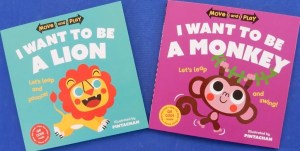
I Want To Be A Lion
I Want To Be A Monkey
Pintachan and Katie Woolley
It’s time to move with two additions to Pintachan and Katie Woolley’s Move and Play series for the very young. Get your little ones, be they at home or in an early years setting, pouncing,
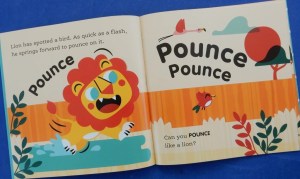
creeping, rolling, running, hiding away and yawning like a lion. If you’re at home cut out the mask, add string and your child will be even more lion-like especially if they also start with a few very loud roars.
Alternatively they might prefer to emulate a monkey; in which case the starting sound is ‘Ooo-ooo-ah! after which comes the more active scampering, rolling scratching, munching (bananas of course), climbing , swinging, leaping all of which can be combined into a lively monkey dance. What are you waiting for? …
Stuck for ideas? Scan the QR code inside the front covers. Pintachan’s bright art work and the engaging texts support the development of children’s imagination and their physical development, but above all they are fun.

 Red Reading Hub - Jillrbennett's Reviews of Children's Books