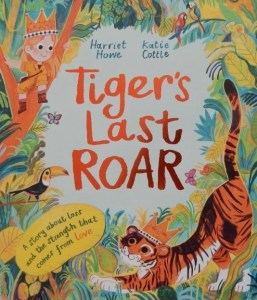
Tiger’s Last Roar Harriet Howe and Katie Cottle Templar Books
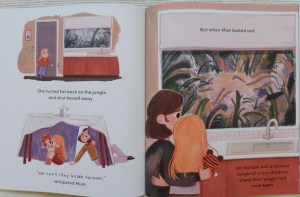
Mae and her pet cat Tiger are inseparable. When they’re together the garden becomes a vast jungle of which the two are queens, exploring and adventuring all day until the teatime call comes. Having dined together, they bath together, draw together and tell stories together. However, Tiger is getting older and as summer turns to autumn, Tiger is tired and wants to spend more time sleeping instead of exploring. Then one day when the teatime call comes, she fails to return. Tiger has died and Mae is heartbroken. Unable to speak she lets out an almighty roar, then turning her back on the jungle she shuts herself away.
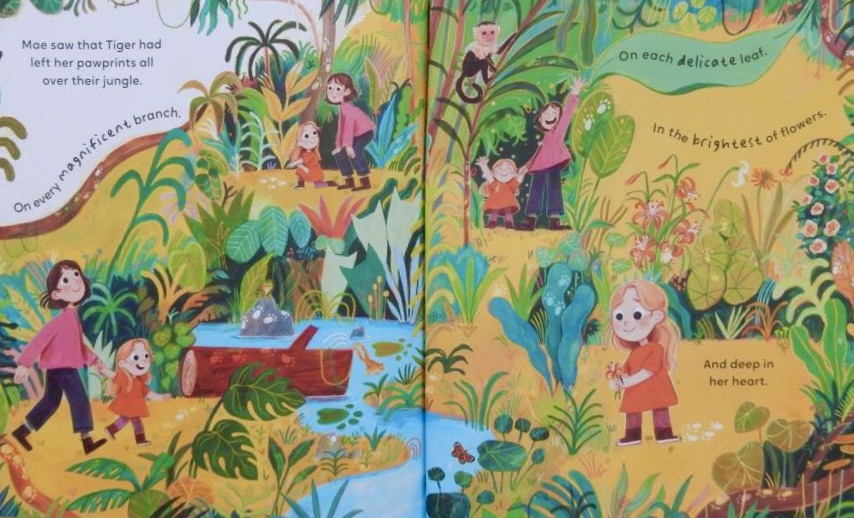
Her empathetic Mum gives her time and loving hugs, then gently suggests that talking about Tiger might help her cope. After a while, under Mum’s gentle guidance, the two of them tell stories of Tiger, Mae draws and they share memories of the beloved animal. Mae then starts to venture outside, albeit apprehensively, anxious that nothing will be the same without her pet. However, Mae discovers that Tiger has left paw-prints everywhere in the jungle and most importantly, in Mae’s own heart
and there they’ll remain for ever.
With Katie Cottle’s richly coloured illustrations, this powerfully moving story, full of warmth and tenderness shows just how big an impact the loss of a pet can have on a child, especially an only child. After the story, there’s a helpful spread that provides a space for children to use, should they too lose a much loved pet, as well as a page for adults on ‘supporting a child through the loss of a pet’.
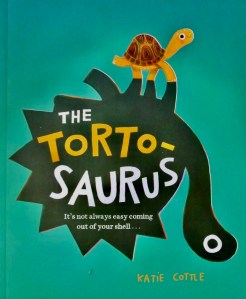
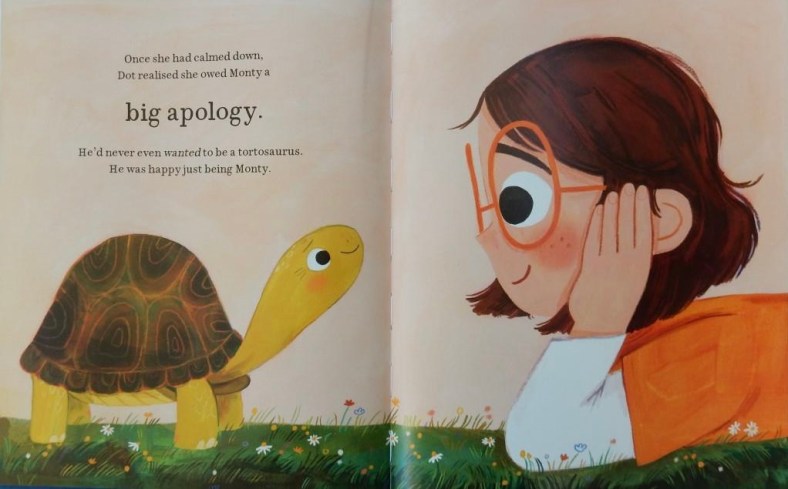
It’s Dot’s first day at her new school; she wants to fit in and make friends; but maybe she’ll start joining in tomorrow, she decides. Dot as you’ve likely realised already, is a person who likes taking things slowly, something her pet tortoise Monty truly understands.
In class during a discussion about pets, Jude tells everyone that he has a tortoise and Dot is on the point of saying something when Jess makes the disparaging comment that tortoises are old and slow. As a result Dot puts her hand down but is spotted by her teacher and so she announces that she has a Tortosaurus and will bring it for show and tell.
Fortunately Dot is a creative child and so she sets to work on Monty transforming him into an amazing creature that awes her classmates. Very quickly Monty becomes something of a ‘shell-ebrity’ which is not at all what he wants. Indeed he finds being in the limelight is really hard but he doesn’t want to let Dot down. After a while Monty is awarded a certificate of reptilian excellence and the stage lights make him feel all hot and bothered so he wriggles around until he’s removed every bit of his costume.
Initially Dot is angry; she grabs Monty and makes a dash for home but once there she calms down and on realising she’s forced the creature to be something he’s not, she apologises profusely.
Thereafter Dot decides it’s time to start being true to herself; gradually she comes out of her shell and makes friends with fellow tortoise owner, Jude.
This is a celebration of being one’s true self, allowing others to do likewise: and valuing them for what they are: that way real friendships based on honesty are formed and sustained. Katie Cottle’s illustrations speak volumes as we see Dot’s changing emotions throughout the story. Read at home and read in the classroom. I can imagine a lively circle time discussion resulting from a sharing with KS1 children.
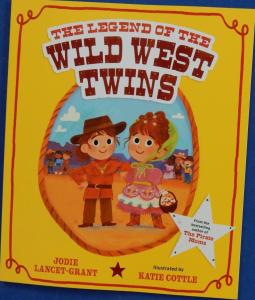
The Legend of the Wild West Twins Jodie Lancet-Grant and Katie Cottle Oxford Children’s Books
Imagine a Wild West where every one of the inhabitants is a child. That’s the setting for this cleverly written adventure starring twin sisters Buffalo Lil and Buffalo Jill. The former is said to be the hardest ridin’ … fastest knickerbocker glory-guzzlin’ gal in town; her sister, she of the sweetest smile is the sewer of the frilliest frocks and baker of the tastiest iced buns in the vicinity of Lone Ridge.
Lone Ridge’s claim to fame was its hosting of the wildest cowboy contest in the West: the Rip- Roarin’ Rumble and for the first time, Lil has decided to enter. What will happen when she comes up against Lone Town’s hero Yee-Haw Jack, he with a reputation for long distance lasso-ing feats, acrobatics in the saddle and bucking bronco saddle sitting that’s almost unbelievably long lasting?
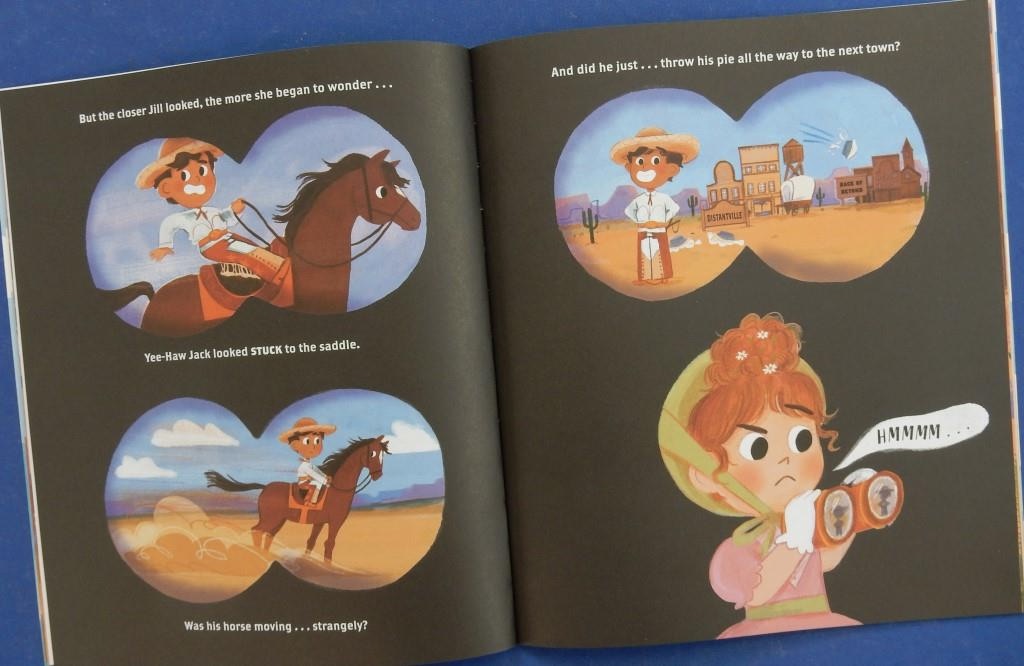
Into town rides the young guy certain he’s about to win the Rumble once again but Lil isn’t going to let him do so without giving it her all. Moreover, Jill has her back and keeps her beady eyes on Jack from the off. Pretty soon her suspicions start to arise.
Come nightfall she goes out to investigate and it’s evident that Jack is no hero, he’s a ‘low-down cheatin’ rattlsnake.’
Is it possible that by co-operating, the twins can expose Jack and his dastardly ways.
High octane humour with a plot that twists hither and thither, celebrates difference and demonstrates that honesty and being true to yourself are what matters most, whomsoever you are. Katie Cottle’s pictures have a potency all of their own and provide the perfect complement to the text.
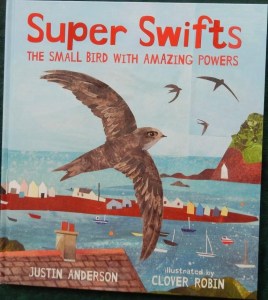
Super Swifts Justin Anderson and Clover Robin Walker Books
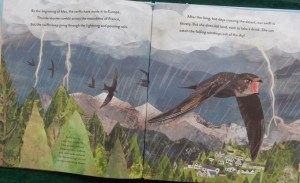
Astonishingly, swifts (champions of the bird world) are able to fly faster and higher than any other birds; even more astonishing is that they might stay airborne for as much as four years, flying up to seventy miles per hour.
Author, Justin Anderson begins this swift story in central Africa’s Congo region in early April and tells of the journey undertaken by one female in particular who with a group, flies from their place of overwintering, towards Europe and their destination in the UK.
A month long journey that takes them over the world’s largest desert, across vast oceans, through thunderstorms to the place where our female will look for her mate, a bird she’s not seen for a whole year.
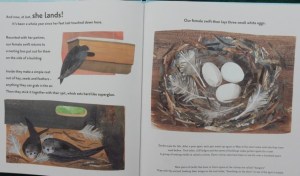
Clover Robin’s mixed media close ups of the pair show them making a nest in which the female lays three eggs each of which hatches into a hungry chick.
I love the author’s description of the pair sticking ‘their nest together with their spit, which sets hard like superglue.’ Come July, it’s time for the mother to make her return journey to Africa; she and the other super swifts will once more take to the skies.
On each spread, there’s a main narrative, alongside which is further information printed in smaller type. An inset box gives fascinating details of swift lice that nestle in young birds’ feathers and breed when the swifts nest again. A final author’s note contains information about some of the swift species and gives ways in which readers can help prevent swifts nesting in the UK from dying prematurely. I’m looking forward to hearing their screeching cries as they fly over our house this summer.
Also on the subject of birds is a book wherein fact and fiction come together.
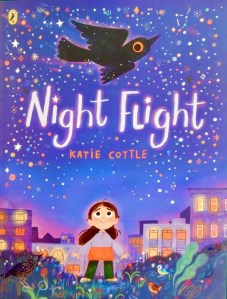
Night Flight Katie Cottle Puffin Books
When young Ellie moves from her country home to a big bustling city on account of her Mum’s new job, the girl notices that many of the bird varieties she loved watching aren’t there. Mum gives her a bird feeder but no birds come a-visiting, so at her mum’s suggestion, Ellie takes a walk around but all she sees are pigeons, no blackbirds, sparrows or moorhens; and empty skies as she makes her way to school each morning. Then one night there’s a tapping at her window; it’s a glossy-feathered starling, a very large one that asks for her help and Ellie agrees.
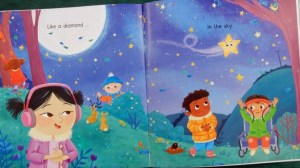
Off they soar with the child sitting on the starling’s back until they come to a hill whereon they land. When Ellie comments on the glow emanating from the city, the bird tells her that it’s light pollution. As she looks skyward, in this spot far from the city, there are hundreds and hundreds of glittering stars, stars being something else that Ellie has barely seen since the move to the city. On account of not being able to see the stars because they’re dimmed by the light pollution, the birds are unsure where they should fly: can Ellie find a way to help them find the way back home?
She sets to work with the help of her Mum, but she needs to find the confidence to speak out about the birds’ plight. Will she be successful in saving the birds? Happily yes and before long, the city has become much more like home to both Ellie and the avians. Author/illustrator Katie Cottle’s timely story has an important message about not allowing unnecessary artificial lighting to interfere with the natural world, especially birds. It’s one that needs to be shared and its message heeded by humans especially those who live and work in cities.
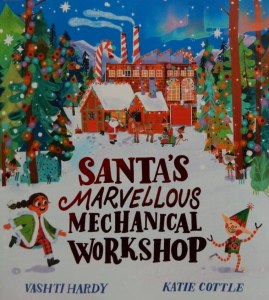
It’s Christmas Eve and Lily has just moved into a new house but it doesn’t feel like home, there’s no food in the cupboards and she hasn’t got a single friend in this neighbourhood.
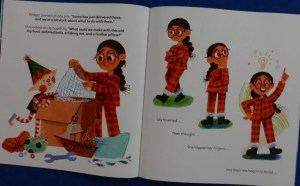
Acting on her mum’s suggestion to go upstairs and unpack her own things, Lily sets to work. She labels, sorts and organises until it’s almost time for bed. Then at the bottom of a box, she comes upon a wrapped package. Inside is a book but the cover and pages are blank. So it seems, but then a strange tiny creature waves and almost the next thing she knows, Lily is surrounded by snow and is being given warm clothes by the creature who tells her that it’s called Widget and is one of Santa’s elfbots. Moreover, she learns, Santa needs her help.
The bot leads Lily to Santa’s workshop wherein many more elfbots are busy making new toys. This isn’t however, where Lily’s assistance is required. In another section, Santa’s favourite, are all manner of old, broken toys. What’s needed Lily is told, is her imagination.
Can one little girl, one tiny bot and a lot of ingenuity transform piles of what looks like junk into wonderfully exciting toy inventions?
When asked what she would like in return for her efforts, Lily tells Widget her dearest wish before falling fast asleep on the sleigh. What will next morning bring: sadness at missing Santa’s visit or hope and the envisioning of making a new exciting family home?
I love the combination of creativity and up cycling in this magical seasonal story. It’s perfect for sharing in classrooms especially where there are children recently arrived from different parts of the world, and feeling like Lily as Christmas approaches, whether or not it’s a festival they would celebrate.
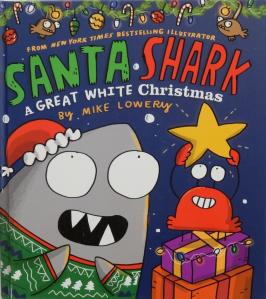
Santa Shark Mike Lowery Orchard Books (Scholastic)
Ex-sea-dingly silly, laugh out loud sea-sonal fun is to be found ‘neath the waves in the company of Edgar the shark. It’s late in December and elasmobranch, Edgar, is getting ready to receive a very special guest; it’s none other than Santa Shark. For this he enlists the help of his crab best pal, Lotta. Lotta however has never before heard of Santa Shark so she takes a bit of convincing, but before long she agrees to assist Edgar. As they work together preparing for the visitor, readers are treated to a plethora of puns such as the making of Christmas cods
and a rendition of “We fish you a Merry Christmas.” However as bedtime draws near, Edgar suddenly has a horrible realisation: there’s no snow. What’s to be done? If there’s no snow, it means no visit from Santa. Can anything cause the desired precipitation? Perhaps the lovely Lotta might have a brainwave … Dramatic illustrations and a zesty text will amuse both child and adult readers aloud.
Omar, the Bees and Me Helen Mortimer and Katie Cottle Owlet Press
One of my favourite weekend walks takes me past a goat willow or pussy willow tree that my partner and I call ‘the buzzing tree’. In spring it’s alive with bees and you can hear them busily working long before you reach the tree. You can almost hear a similar buzz emanating from the cover of this new picture book.
Said buzz is set in motion when newcomer Omar takes a slice of his mum’s special honey cake into school for show and tell. He talks of how once upon a time back in Syria his grandpa who grew apricot trees and jasmine, was a keeper of bees.
This sets teacher Mr Ellory-Jones thinking and before long the members of his class have decorated the entire corridor outside their classroom with paper jasmine flowers and the children are pretending to be buzzy bees. He also tells his pupils about the importance of bees and of growing bee-friendly flowers for them to feed on. The children’s questions prompt further explanation and during playtime, having observed the greyness of her surroundings, Maisie (the story’s narrator) comes up with a wonderful idea. “We should make a REAL bee corridor … All the way from our school to the park next to my grandad’s garden. He’s got a beehive!”
With the backing of their teacher, the class order packets of wildflower seeds. Seeds they sprinkle into envelopes with growing instructions, requesting recipients to put the pots on their windowsills.
Next day operation delivery is carried out and then the waiting starts. When spring finally arrives, there’s evidence that people have done as asked …
and by the time summer comes two good things have happened. Maisie and Omar have become best friends and there are wild flowers in abundance stretching from school to park. Grandad too is thrilled to have an abundance of bees in his garden.
A new school year starts and now it’s Maisie’s turn to talk at show and tell: her chosen object – a jar of honey from her grandad’s bees. Hurrah! Can you guess what Omar brings into school to share the following day … (There’s even a recipe included).
With themes of sustainability, the environment, intergenerational relationships, and connectedness, this is a smashing book to introduce young children to the importance of protecting and enhancing the natural world, in particular our precious bees.
Katie Cottle’s inclusive, mixed media illustrations complement the story beautifully: she captures the mood and feeling of the classroom, street and garden perfectly.
Picture book messages about helping to save the environment come in all shapes and forms.
In Katie Cottle’s second eco-story the messenger takes the form of an enormous wave that suddenly rises up out of the sea just as Meera and her mother are settling down for a relaxing day on the beach.
This blue giant urgently wants to communicate with them and its message is a vital one asking for their help.
Donning their diving suits and following in their small boat, mother and daughter pursue the wave and discover that the ocean is awash with rubbish of all kinds and that many sea creatures are in great danger.
After a day of hard work a great deal remains to be done to clear up the pollution – way too much for just two people.
The following morning Meera is back on the beach and the next, but now she has enlisted the help of some of her friends.
They in turn enlist some of theirs and so it continues …
The narrative concludes with a list of half a dozen suggested ways in which we can all help by reducing our consumption of single-use plastics.
Katie’s powerful images convey the plastic pollution problem in a manner that young children will easily relate to, particularly those of the sea creatures caught up in the debris. Stories such as this one are a great way to galvanise youngsters into action.
The Green Giant
Katie Cottle
Pavilion Children’s Books
The natural world and our part in conserving it has never been more in the media than now with children marching for the environment and against climate change; in tandem there’s been a burgeoning of conservation/environment non-fiction books recently. Less so of fictional ones, so it’s especially good to see Katie Cottle’s debut picture book.
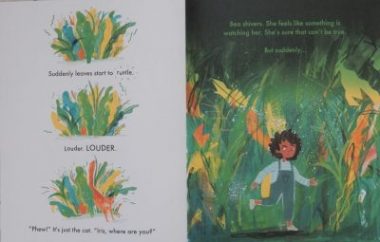
Bea is a little girl who goes to visit her garden-loving Grandad in the country; Bea when we first meet her, seems wedded to her tablet while her Dalmatian, Iris likes nothing better than chasing things.
When Iris gives chase to a ginger moggy, Bea sets aside her tablet and follows her dog, over the fence and into the garden next door.
The greenhouse she finds there is full of plants. From the rustling leaves leaps the cat but could something else be watching the girl, casting an enormous shadow over her?
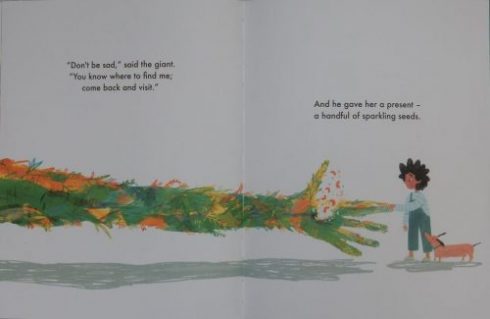
Before her stands a huge green giant, friendly seeming and with a story he wants to share. Bea learns that long ago back in the city he germinated becoming a happy seedling but then as the city air became increasingly toxic, he was forced to flee, eventually finding refuge in the roomy greenhouse wherein he now stays.
It’s a happy summer Bea spends with her green friends but all too soon, the holiday draws to an end.
The giant gives his human friend a parting gift – handful of seeds.
Back in the city once more, Bea is struck by its greyness and she knows just what to do.
Thus with the help of sunlight and water, operation transformation begins to take place … Perhaps it might one day be a place which her giant friend would be happy to visit.
The disconnect with the natural world that has come about in part due to the digital gadget obsession of many youngsters is cleverly understated, while the importance of caring for our precious natural environment comes through more urgently in Katie’s eco-story. There are definite links between them and it’s up to us as educators/parents to set a positive example to youngsters before it’s too late.
A book to share, discuss and act upon at home and in school.




 Red Reading Hub - Jillrbennett's Reviews of Children's Books