Celebrating Nosy Crow Board Books

Peekaboo Bear
Peekaboo Apple

Camilla Reid and Ingela P Arrhenius

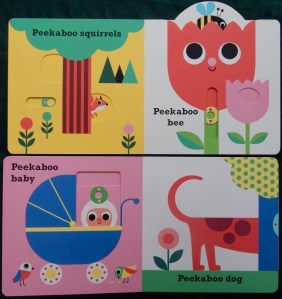
Toddlers and babies absolutely love to play peekaboo, especially when there’s a mirror involved, so these two books will be winners on both counts. Add to that Camilla Reid’s playful rhyming couplets that introduce equally playful, adorably illustrated animals, some of which are revealed by manipulating the sliders in Ingela P Arrhenius’s brightly coloured, patterned spreads, (as well as the occasional human in the Apple book)

and you have two sure fire winners for several more reasons. Exuberant language, alluring art, manipulative skill development and most importantly, sheer fun: what more can one ask of books for babies?

Listen to the Carnival of the Animals
Marion Billet

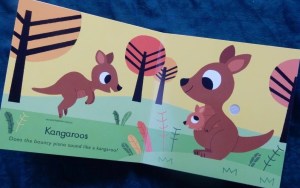
With its six sound buttons embedded in the spreads, tinies can listen to the Royal March of the Lion, The Elephant (and maybe stomp along too), bounce in time to Kangaroos, imagine floating neath the Aquarium water, enjoy the flutes emulating bird song in an Aviary and finally, glide gracefully across the lake like The Swan. Each animal (often along with minibeast bit-part players) is allocated a double spread brightly and engagingly illustrated and introduced with a sentence to maximise engagement such as “Does the bouncy piano sound like a kangaroo?’

or ‘Isn’t it magical under the water?’and there’s a final page asking “Which animal was YOUR favourite?’
A lovely introduction to Saint-Saēns’ classic The Carnival of the Animals for the very youngest listeners (with music played by two famous orchestras)

Who’s Hiding in the Snow?
Katharine McEwen

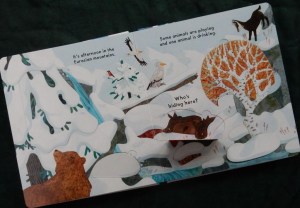
In five beautifully illustrated double spreads we visit a variety of chilly locations wherein to discover the answer to the titular question. First, we’re in the Asian tundra in the early morning to hunt for the climbing and flying animals that have hidden themselves under the snow (lift the flaps to find the amur leopard, the ermine, a Siberian squirrel, a Siberian tiger and a snowy owl.) Next stop is the icy Antarctic to search for swimming creatures, a bird that hops on one foot and a chinstrap penguin creche. Afternoon in the Eurasian mountains shows some animals while others –including an alpine marmot and sleeping wild boars are hiding.

A snowy Arctic evening depicts animals on the move and others such as the walrus, resting . It’s night-time when the final destination is reached and the northern lights shine to reveal the ears of grey wolves (the rest being hidden) as well as a moose lurking behind snow-capped rocks and some very sleepy dall sheep. Brr!

A considerable amount of information about the various animals is given on the inner side of the flaps under which the animals are hidden offering interactive learning of a fun kind for young children.

A Forest’s Seasons / Apple / Who’s Hiding on Safari? & Who’s Hiding in the Jungle?

A Forest’s Seasons
Ingela P. Arrhenius
Chronicle Books

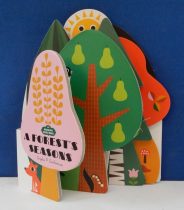
This tiny, chunky board book comprises just six pages, each differently shaped, showing the seasonal changes in a forest. ‘Spring brings babies and blooms’ we read, whereas summer is alive with different greens; in autumn we see fungi and a predominance of orange and browns while in winter the landscape is blanketed in white.

A delight for small hands and a lovely introduction to the idea that nature is cyclic.

Apple
Nikki McClure
Abrams Appleseed

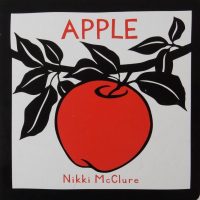
Essentially what is the life cycle of an apple but interspersed with human interaction is presented in just fourteen words, – a single one per spread – opposite one of McClure’s signature style black and white cut outs. The apple being the only red, in each composition makes it stand out.

In autumn an apple falls from the tree; it’s collected and put into a sack with others.

Back at home, a little girl watches her mother cutting the apples and seizing her chance takes one (SNEAK) and pops it into the school bag and off she goes to school. Intending to consume it later she begins playing and the apple lies forgotten.

Eventually it rots, is composted and finally in spring we see it’s sprouting into a new tree.

There’s a final explanatory page reminding readers that ‘apple seeds rarely grow into trees that make tasty apples.’ Nonetheless this book is an effective and simple lesson and one whose outstanding art offers much to enjoy and discuss with little ones.

Who’s Hiding on Safari?
Who’s Hiding in the Jungle?

Katharine McEwen
Nosy Crow

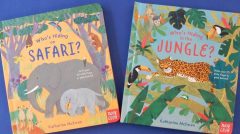
By means of her alluring colourful collage spreads, Katherine McEwen takes little ones to two locations to spend a day playing animal hide and seek either in Africa or the South American rainforest.

On Safari, from early morning the grasslands are an exciting place to watch wild animals be they nesting, napping, digging, playing, having a cooling afternoon swim in the river or basking in the warm sun. Come evening you can spot hungry giraffes grazing on the trees and perhaps spy a monkey or two nibbling; and when it’s dark it’s the turn of the bats and foxes to appear while their fellow creatures sleep.

There are also lots of lively animals around Hiding in the Jungle amidst the lush flora and in the overhead canopy.

Little ones can also search for others hiding along the steamy riverbank, beneath the surface of the river and, in the cool of the evening, look among the foliage for creeping, crawling creatures.

Night brings sleep for most, but lifting the flaps will reveal some surprises.

Both books contain simple factual snippets and every spread has several flaps to investigate, where there is information about the hidden animals.

Wild World, The Coral Kingdom and Who’s Hiding on the River? / Who’s Hiding on the Farm?

Wild World
Angela McAllister, Hvass & Hannibal
Wide Eyed Editions

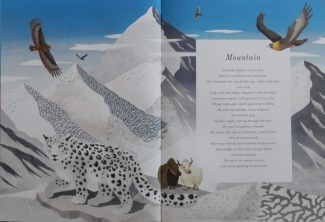
The author has chosen thirteen natural habitats – Rainforest, Arctic, Prairie, Woodland, Coral reef, Desert, Rock pool, Mountain, The Outback, Moorland, Deep sea, Mangrove and Savannah – that are under threat due to human activity, and captures the essence of each one in a series of free verses.
Here’s the opening to Mountain:
‘I am the highest mountain, / Born in a collision of continents. / All is beneath me, except the sun, moon and stars. / I am rock, / Crag, cliff and ledge, draped in veils of white. / I am snow-maker, with glaciers in my arms, / Whose meltwater swells great rivers below.’
In stark contrast is the quieter sounding Savannah, which opens like this: ‘Savannah speaks in whispering grasses, / In the chatter of cicadas across an endless plain. / Spacious homeland of swift cheetah / And gazelle, with the horizon in her eye.’

Using matte colours, the illustrators Hvass and Hannibal showcase the flora and fauna of each location in a series of eye-catching paintings that incorporate the text within them.

Human use, climate change and pollution are responsible for the damage to the environment and after her introductory poem, it’s not until the final pages that the author enlarges upon her conservation message citing the specific damage within the thumbnail sketch of each of the places portrayed. Thereafter she implores readers to use less energy, to recycle and to buy with care.

We’d all do well to keep in mind her final words about our precious planet: ‘Explore it, protect it, love it. / Our Earth is a wonderful wild world. ‘

Also with an ecological message is:
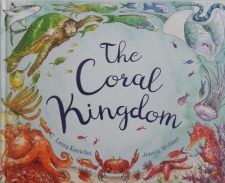
The Coral Kingdom
Laura Knowles and Jennie Webber
Words & Pictures

Our coral reefs, with their gorgeous colours: crimson, red, rose, yellow,

turquoise, emerald, jade, purple, even black, that have taken 1000s of years to grow and give home to a myriad of creatures large and small are under threat.

When the coral is bleached white due to acidity caused by climate change, and stays white for too long, then the reef dies.

Laura Knowles has written a rhyming narrative that outlines the life cycle of a reef and includes a caution that unless we humans take action these amazing ecosystems will be lost forever.

Jennie Webber’s detailed watercolour illustrations show the beauty of the undersea habitat and a final fold-out page gives additional information about coral reef conservation.

A useful addition to a primary school conservation topic box, or, for a child interested in ocean life or ecosystems.

Who’s Hiding on the River? / Who’s Hiding on the Farm?
Katharine McEwen
Nosy Crow

It’s never too early to start learning about nature and here are two board books just right for introducing animals, some wild and some domesticated, to the very young.

Both are beautifully illustrated by Katharine McEwen and there are lots of animals to find in both locations.

Toddlers can spend a day by the river, from a busy morning through to night-time as they explore the pages, manipulate the sturdy flaps in response to the ‘Who’s hiding here?’ on every right hand page to discover tadpoles, cygnets, fish, dragonflies, a stoat, a beaver and more as they swim, wriggle, wade, leap, build and paddle.
The farm book also moves through the day in similar fashion and McEwen’s text is carefully worded to introduce new vocabulary including ‘pecking,’ ‘trotting’, ‘snoozing’ ‘prowling’, munching’ and ‘diving’ along the way.

Published in collaboration with the National Trust these are fun and at the same time, gently educational.
Bear Hug and other Ursine Delights

rapunzal 001 (800x600)

Bear Hug
Katharine McEwen
Templar Publishing
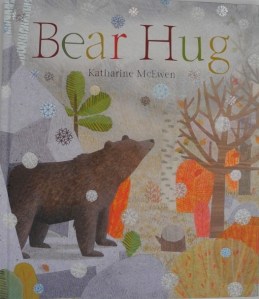
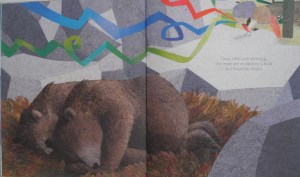
A young bear wakes up and senses that winter is approaching: time to make preparations for the cold that is to come. His parents have prepared him well. Papa showed him how to use the vegetation to make a warm winter bed and mother taught him how to fish. On the cusp of winter, he meets another young bear. Together they fish and feast on ripe berries until as the snow falls harder, they head for the cave

rapunzal 002 (800x600)

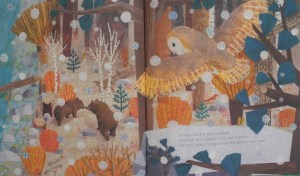
and snuggle down together, on a ‘shudder-cold night’, cosy, warm and sated for the long sleep, a sleep that lasts until birdsong calls them and it’s time to emerge once more. Out they come to greet the spring and before long, their very own little cub ‘soft as thistledown and lively as a sunbeam’. Then the cycle begins all over again.
With its elegant prose and stylized collage illustrations executed predominantly in earthy colours with occasional splashes of contrasting bright hues as the seasons change, this is a beautiful book.

rapunzal 003 (800x600)

I particularly like the pictorial rendition of the birdsong through steamers of colour.


bob & flo 004 (800x600)

Something About a Bear
Jackie Morris
Frances Lincoln Children’s Books
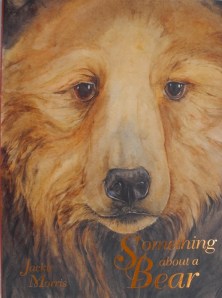
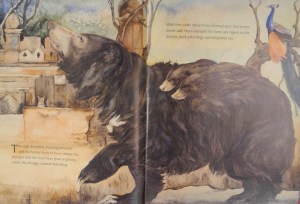
There’s no doubt about Jackie Morris’s love of all things ursine: it shines out from every one of her glorious watercolour paintings in this book. We come close up to bears from all parts of the world. There’s the salmon catching, Brown Bear, the adorable-looking Giant Panda with her child from the mountains of China and the shaggy-coated Sloth Bear in what looks like the grounds of an ancient Indian forest palace.

bbear 002 (800x600)

South America’s only bear, the Spectacled Bear is portrayed sunbathing and nursing her cubs in the tree tops; the huge watchful black Asian Moon Bear stands out starkly against the snowy mountain landscape. In contrast, the next spread reveals the Polar Bear, the largest of all bears swimming through the icy ocean. Smallest of all, the Sun Bear, despite its beguiling look and dog-sized stature, is feared by tigers and even fiercer than a leopard.
Despite the name, American Black bears can be of several different colours from black through ‘cinnamon and honey’ to white, the ‘rarest, sacred spirits of the forest.
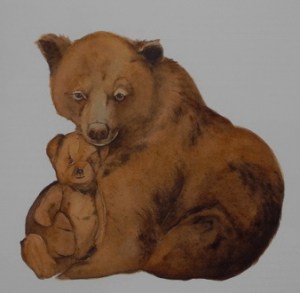
Magnificent every one; but as the child in us all knows, as Jackie Morris suggests, and the penultimate spread reveals, ‘the very best bear of all is

bob & flo 006 (800x600)

The final spread contains small vignettes and additional facts about each bear featured and you and any children you share this superb book with, simply MUST place your hands against those life-sized bear paws on the endpapers.
You can buy this one direct from:
http://www.solvawoollenmill.co.uk/jackie-morris-books

If you can’t get enough of bears then there is also:

bob & flo 001 (800x600)

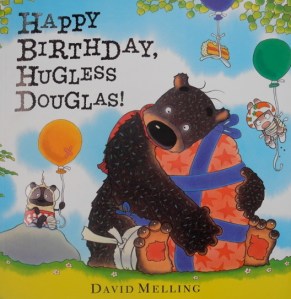
Happy Birthday, Hugless Douglas!
David Melling
Hodder Children’s Books pbk
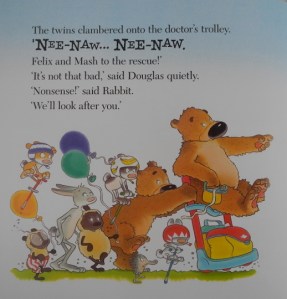
Poor Douglas is devastated when, on his long anticipated birthday, those decidedly overbearing twin cousins of his, Felix and Mash seem determined to usurp all the fun and play things entirely their way. Upset, Douglas heads outside and before long, with a hurt leg and a dizzy head, the birthday bear declares, “This is my worst birthday ever!” It’s time for those crazy cousins to come to the rescue and put their special present into action –

bob & flo 002 (800x600)

with the help of Rabbit and some not too willing volunteers. Then they all set off for a surprise birthday tea party and before it ends, Douglas has changed his mind:

bob & flo 003 (800x600)
With the characteristic Melling warmth and humour, (there’s a laugh at every turn of the page) this is just the thing for sharing with under sixes on birthdays and other days.

Find and buy from your local bookshop:

http://www.booksellers.org.uk/bookshopsearch