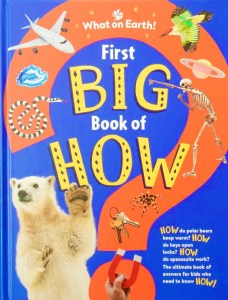
First Big Book of How

After ‘Why’ questions I think those beginning ‘How’ are probably the most often asked by young children. Author Sally Sykes, together with Saranne Taylor have divided the wealth of How questions in this bumper book into six sections, the first being The Body. The fifteen questions posed are engagingly and succinctly answered the first being ‘How does hair grow?’ A double page spread is allocated to each question, much of the space being taken by a striking illustration or photograph into which has been placed a ‘wacky fact’ and a relevant small labelled, close-up diagram. This section also addresses how each of the senses works – did you know that children smell better than adults, with ten year olds having the best sense of smell?
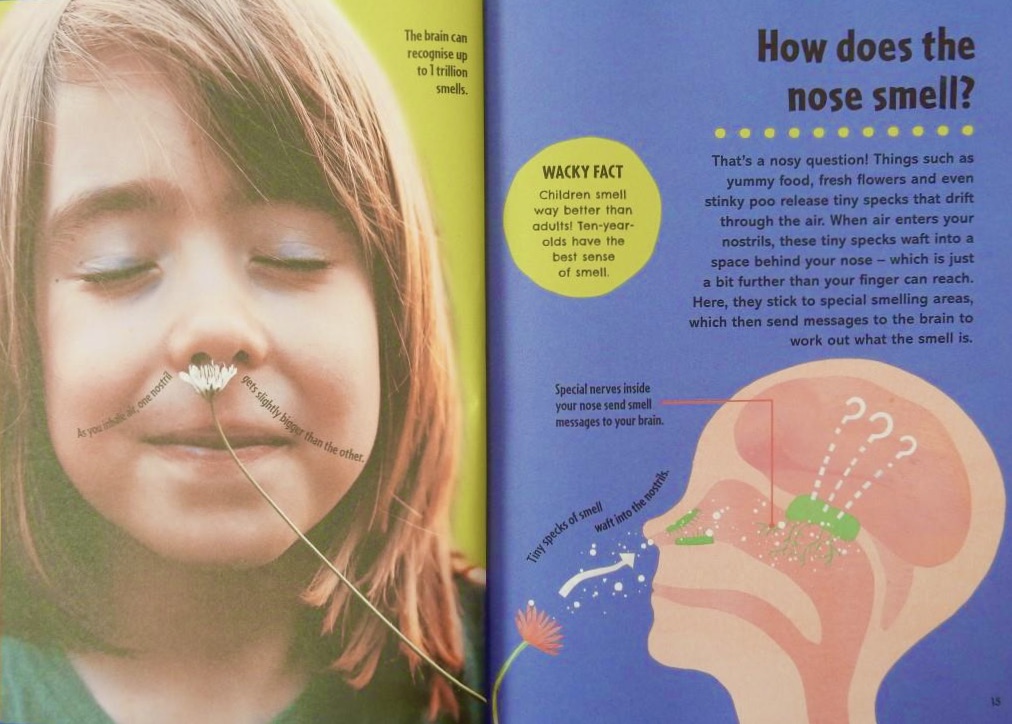
Then come respiration, circulation and the heart, bone growth, digestion, the growth of an unborn baby, the relationship between exercise and good health, catching a cold and more.

The other sections are in turn Machines & Buildings, Wild Animals, Bugs & Creepy Crawlies, Earth and finally, Space. In addition each part has a ‘Wow! What’s that? spread that zooms right in with a photograph as well as two ‘Tell me how … Now!’ spread, the latter briefly answering additional questions.

One to add to family bookshelves and Foundation Stage/ KS1 class collections.

Britannica First Big Book of Why

Britannica First Big Book of Why
Sally Symes and Stephanie Warren, illustrated by Kate Slater
Britannica Books (What on Earth Publishing)

Children are forever asking ‘why’ questions and adults quite often scratch their heads to give appropriate answers; now comes this jumbo book that should help both questioners and responders. It contains a lot of information and seemingly being aimed at slightly younger children than usual, with a single question per spread, is far less overwhelming than is often the case.

Organised into eight sections: minibeasts, pets, wild animals, the body, food, how stuff works, earth and finally, space, each part has fourteen questions of the kind youngsters might well ask. In addition to the question, every spread has a paragraph of text in response, accompanied by either a ‘wacky fact’ or a ‘who knows?’ bubble, one or two large illustrations – some are photographs, others are bold bright art work by Kate Slater.

And, each section concludes with a “Wow! What’s that?’ spread containing half a dozen coloured images for children to match with their names from the six listed.

Back mattter comprises a comprehensive glossary and index, source notes in case readers want to know more about a topic, as well as a ‘meet the Why team’ page and the answers to the matching game.

So, if you know a child who might ask such questions as ‘Why do flies like poo?; ‘why do frogs croak?’; ‘why does music make me want to dance?;

‘why do cakes puff up in the oven?’;

‘why don’t skyscrapers fall over?; or perhaps ‘Why does Saturn have rings?’ then you definitely need to keep a copy of this book to hand, be that at home or in your KS1 classroom. It will also go down well with slightly older, visual learners.