Ferris

This story, set I think in the late 20th century, unfolds around ten year old Ferris (Emma Phineas Wilkey), so called because she was born beneath a ferris wheel at the fairground. Ferris is sensitive, serious and a lover of words, the last thanks to her 4th grade teacher.

It’s an eventful summer for certain. It was then that a ghost appeared to her grandmother Charisse, that Ferris’s six year old sister, Pinky, decided to become an outlaw and that her Uncle Ted left Aunt Shirley, his wife to live in the basemen of Ferris’s home, hoping to paint a masterpiece. Oh yes and it was the summer that Dad declared there was a racoon in the attic; moreover Charisse said she was unwell and agreed to see a doctor.

Add to the mix Ferris’s best friend, Billy Jackson a pianist who hears music in his head all the time, Boomer the dog, teacher Mrs Mielk, Billy’s dad Big Billy Jackson and Charisse’s oft quoted assertion that “every good story is a love story” and you realise that those words definitely apply to Kate DiCamillo’s moving, memorable, quirky tale. Assuredly there’s love in abundance, but there’s also reunion, plenty of humour supplied mainly due to Pinky’s misdemeanours, as well as loss and birth.
The Puppets of Spelhorst

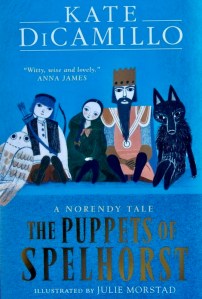
This story has three acts. It begins with a lonely old sea captain, Spelhorst by name. One day when walking in the city, he comes upon a toy shop. Hanging on display in the window are five puppets: there’s a king, a wolf, a girl, a boy and an owl. Immediately the man is drawn to the girl puppet for it reminds him very much of someone he loved and lost long ago. The shopkeeper however, refuses to sell him just one puppet: they’re in a story and must be bought together he insists and so Spelhorst takes them all. That night, thinking sadly of his lost love, he writes for a long time, folds the letter and tosses it in the trunk with the puppets. He then dies in his sleep.

The trunk containing the puppets is sold to a musical rag and bone man, who sells it to a young man and it eventually ends up in the home of his two nieces, Emma and Martha. Emma, the elder of the sisters ranges them on the mantlepiece and later starts writing a play about them. Meanwhile significant misadventures happen to each of the puppets: two of the wolf’s teeth are wrenched out by Martha; later the maid flings the puppet out the window and she’s taken by a fox running to its den in the woods (running through the woods fulfils her greatest wish).The boy that longs to ‘do a great deed’ is seized by a hawk and dropped in the branches of a tree …

Tension mounts as we join the puppets in wondering if they will ever be together again. Eventually they are reunited and Emma’s play is performed. “We did something wondrous, important,” says the boy afterwards.

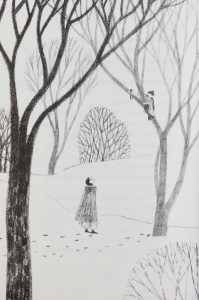
Wondrous and wonderful too, is this hauntingly illustrated novella of desires, belonging and identity that demonstrates the power of stories and their role in living one’s life and fulfilling one’s dreams.
The author’s ending elegantly puts all the pieces together, and I found myself reaching for tissues.

All Except Winston / Good Rosie!

All Except Winston
Rochelle Brunton and Nicoletta Bertelle
Ragged Bears
Young giraffe Winston is left out no matter whether the other giraffes are eating, drinking, playing their favourite game or sleeping. Winston does all these things alone.

Then one day when all the other giraffes are so busy grazing on yummy fruits high in the treetops, he hears a sound. His fellow long-necks ignore the rustle and the snap but Winston lets out a very loud, shrill whistle just in time to warn the others that a lion is on the prowl, hungry for its next meal.

Off they all dash for safety – just in time
Now Winston is ignored no longer; instead he’s a hero.

This seemingly simple story with it’s themes of celebrating difference and finding where you fit into a group is ideal for young children who have just started school or nursery, especially those who like Winston at the start of the book have yet to find out where they fit in.

Nicoletta Bertelle’s richly coloured, textured scenes reflect the glow of the savannah setting adding further warmth to Rochelle Brunton’s gentle telling.

Good Rosie!
Kate DiCamillo and Harry Bliss
Walker Books

Rosie is a terrier who lives with her owner George. She loves her owner but is eager to find another friend of the canine kind: (her reflection in her empty food bowl never answers).

On their daily walks together George and Rosie look at the clouds and one day George points out a dog-shaped one; this saddens Rosie so George suggests something new.

That something is the dog park but Rosie is overwhelmed by their sheer number and doesn’t know how to make friends; she feels a little afraid. Then she meets first Maurice a large Saint Bernard, then bouncy Chihuahua, Fifi. Initially she doesn’t like either of them, but then something happens to change all that.

Then it’s down to little Fif (what happens results in a name change for the Chihuahua) to demonstrate how to make a friend and before the end of the day, the three dogs are best pals and Rosie has something to look forward to on future walks with her human.

This warm-hearted, thoughtful, gently funny story presented in nine parts, is a neat blend of picture book and graphic novel: Harry Bliss’s humorous illustrations contrast nicely with Kate DiCamillo’s understated text in what is an ideal book for those making the transition to independent reading.

La La La

La La La
Kate DiCamillo and Jaime Kim
Walker Books

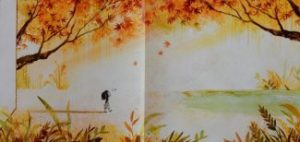
A small girl stands alone and opens her mouth; “La” she sings followed by a few more “La, La La … La”. No response. She stomps across the page and outside.
There she begins chasing and singing to the falling maple leaves, but even her shouts are answered merely with silence.

She continues addressing her ‘Las’ to the pond and the reeds; still nothing comes back.
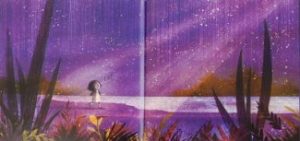
Dejectedly she returns home, sits and ponders. Later on she sallies forth into the purple, starry night. Once again she begins her singing, directing her vocals towards the moon.

Nothing.
Back she goes and returns with a ladder. So desperate is she for a mere response that she climbs right up to the top … Will the moon finally hear her song?
It does, but not for a longish time and then begins a wonderful moonlit duet.

Virtually wordless, this eloquent symphony of sound, light and colour offers an inspiring message of determination and hope. The whole thing unfolds like a silent movie with the little girl’s body language saying so much about her emotions.

This book is twice the length of a normal 32 page picture book, so in addition to recognising the virtuoso performance of Kate DiCamillo and Jaime Kim, it was a brave publisher who allowed them room for their duet to be heard in full.