Secrets of the Sea


Secrets of the Sea
Eleanor Taylor and Kate Baker
Big Picture Press

It is in the oceans that all life on Earth began, yet they are one of the least explored and least understood places on the planet.’ So writes Kate Baker in her introduction to this stunningly beautiful book that takes us from ‘In the Shallows’, through the ‘Forests of the Sea’and the ‘Coral Gardens’, into ‘The Wide, Wide Blue’ and down ‘Into the Deep’.
Venture beneath the waves and there’s an amazing variety of plant and animal life from single celled organisms such as ‘Sea sparkle’ …
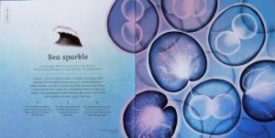
to the Giant pacific octopus an enormous cephalopod that resides in the depth of the ocean and has an armspan of up to 4 metres. Not all octopus species are deep sea dwellers though: Coconut octopus is to be found in the shallows of tropical waters. This amazing creature is able, we’re told, to hide itself not only by changing its colour, texture and form to blend in with its surroundings, but also it can pick up an empty coconut shell, crawl inside and hide. Unsurprisingly it is considered the ‘master-mind’ of invertebrates.
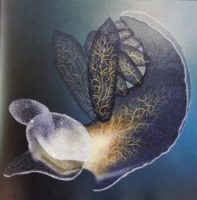
Dive down to the kelp forests and discover minute algae and other fascinating creatures like this Hooded nudibranch:
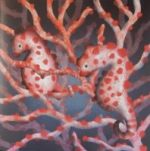
The coal reefs are home to almost 25% of marine life much of which is brightly coloured such as these Pygmy seahorses …
It’s in the open oceans where such as the Sea angel can be found. This graceful dancer is a predatory sea slug, another deadly hunter …

Dive deeper and at depths of about 2000 metres are thriving communities of squat lobsters, white crabs, mussels, snake-like fish, anemones and these giant tube worms …

This is a book that opens the eyes to the staggering beauty of marine life in all its forms. Every illustration is a celebration of the wonders of the oceans and focuses on the intricate shapes, structures, patterns and colours that are revealed when the marine flora and fauna are examined in extreme close-up. Kate Baker’s accompanying text provides a broader picture describing habits and habitat of each organism and some basic facts including Latin name, size and other fascinating snippets of information.

localbookshops_NameImage-2

A Pandemonium of Parrots & An Acorn

%0A

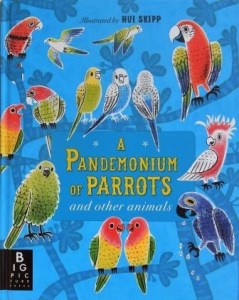
A Pandemonium of Parrots and other animals
illustrated by Hui Skipp
Big Picture Press
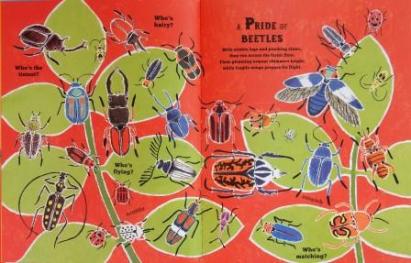
Essentially what we have here in this super book is a series of spreads featuring collective nouns for a dozen or so animals large and small, each one playfully and alluringly illustrated by a talent new to me, Hui Skipp; and embedded within each illustration is a descriptive quatrain (presumably written by Kate Baker), such as this:
With nimble legs and pinching claws,
     they run across the forest floor.
Their gleaming armour shimmers bright,
    while fragile wings prepare for flight.
… as well as questions to answer by exploring what’s depicted on the spread.

DSCN8099

Representing the feathered ones are the parrots of the title, flamingos (a flamboyance), penguins in a huddle and these Hummingbird dazzlers …

%0A

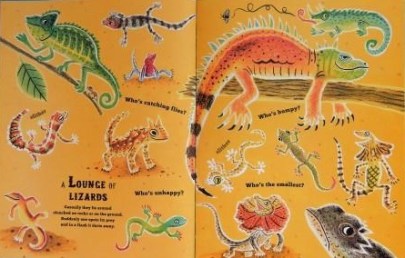
There are tigers – an ambush, a Lounge of Lizards basking in the sunshine …

%0A

       Casually they lie around
slouched on rocks or on the ground.
       Suddenly one spots its prey
       and in a flash it darts away.

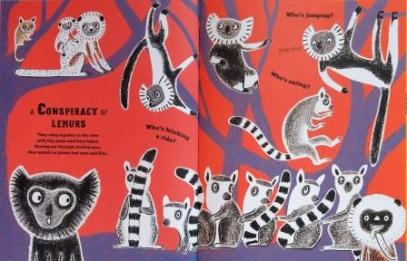
and on the river banks ‘An Army’ of frogs – croaking, singing wonders every one. The mammals are represented by a Sloth of Bears, An Ambush of Tigers, A Troop of Monkeys, A Conspiracy of Lemurs …

DSCN8102

and A Caravan of Camels – beauties all.
The final two spreads are a “Did You See?’ array of all the animals with questions, followed by a concluding Who’s Who that gives snippets of information about each animal included.
Altogether this book is a treat for the eyes, an opportunity to learn some collective nouns and a chance to discover a few facts about thirteen fascinating groups of creatures. One for the primary classroom or family bookshelf.

%0A

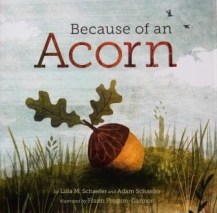
Because of an Acorn
Lola M.Schaefer, Adam Schaefer and Frann Preston-Gannon
Chronicle Books
This is a simple, but wonderfully effective look at a forest habitat and the interconnectedness of the flora and fauna that are a part of the ecosystem.
Because of an acorn, a tree grows; this in turn provides a nesting place for a bird, an insect-eating one that happens to aid seed dispersal.

%0A

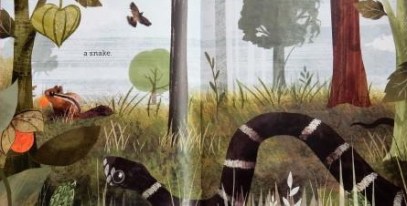
The seed in turn grows, producing a flower that fruits, providing a chipmunk food. A snake with its beady eye upon the chipmunk …

%0A

is in turn seized in a hawk’s talons and when the hawk lands on the branch of, yes, an oak, down comes an ripe acorn and more until ultimately, there’s …

DSCN8126

a forest

Circles and cycles of life are evident in this cleverly conceived, unassuming little book that packs a powerful punch.
In addition to being a super little book to share with a class or group of young children, the fact that the text is simple, patterned, and perfectly matched to the pictures on each page, beginning readers can try reading it for themselves and feel empowered having done so.
There’s so much to see and to discuss in Frann Preston-Gannon’s lush foresty illustrations. UK readers will find some of the animals less familiar and the oak species is different from the British ones but this could be a good talking point.

WNDB_Button localbookshops_NameImage-2