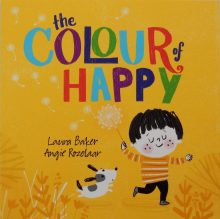
The Colour of Happy
Laura Baker and Angie Rozelaar
Hodder Children’s Books
This sweet, simple rhyming story of a boy finding a dandelion seed head and what happens thereafter is the means for an exploration of feelings for young children around the age of the child narrator, using a rainbow of emotions and the fluffy seed head.
The child, out walking with a pup, spies a dandelion clock: ’Yellow is for happy when I spot a special thing,’ he tells us and having picked it, hops and skips along. But when a gust of wind whisks his treasure away, the boy is engulfed in dark blue sadness.
His emotions then run through the colour spectrum: red for anger as he watches it sail away;
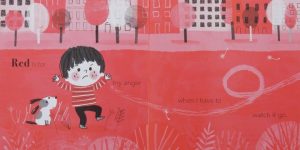
green for feelings of envy when he sees a girl with the seed head; grey when he cannot believe things will be okay; gold for the kindly response from a little girl, and the return of hope as they play together chasing the dandelion clock while it sails off again;
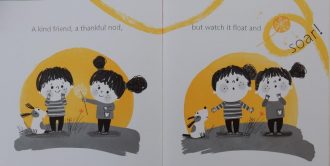
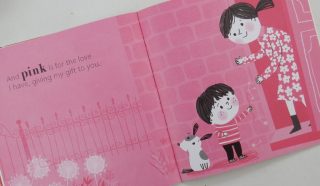
purple for the proud feeling when the boy again holds his treasure safe and bids his friend farewell; orange for the mounting excitement as he heads home and finally, pink as he reaches the front door with his somewhat depleted, love-filled offering …
Little ones will certainly relate to Laura Baker’s lovely story, which offers a great starting point for becoming mindful about their own responses to situations. With a foundation stage class, I envisage children talking about the book, their own feelings with regard to a particular happening; and then perhaps responding with paints or whatever medium they feel right, in music or a dance with coloured scarves perhaps.
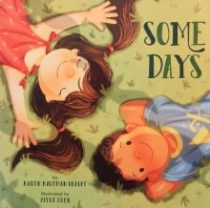
Some Days
Karen Kaufman Orloff and Ziyue Chen
Sterling Children’s Books
We all experience different feelings at different times and so it is with young children and this book, with Karen Kaufman’s lively rhyming text and Ziyue Chen’s warmly hued illustrations, conveys that huge gamut of emotions through the course of a year.
Through two young children, we share in their everyday highlights such as ‘chocolate pudding pie day’s’, ‘Kites up in the sky days. Jumping super high days’; the joys of swimming and sunbathing;
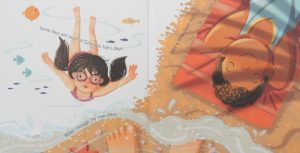
as well as the downs – a nasty cut knee for instance.
Some days are extra special like that for ‘picking out a pup’ or winning a cup. Then come fussy mum days
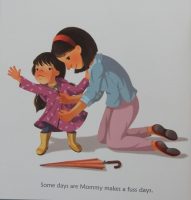
and days when raincoats just won’t do, and there are too wet to play football days with glum stay indoors faces; better though are snow angel making days and watching a warm fire days.
The author acknowledges those bad days when everything feels wrong
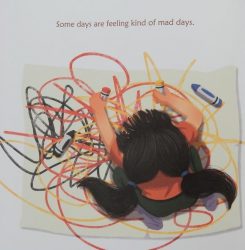
and those when it’s best to be alone.
Finally comes ‘Learning to be me days’ which is really the essence of the whole, a book that celebrates the positive but doesn’t gloss over the negative feelings. It’s a good starting point for discussion in an early years setting, or after a one-to-one sharing at home, perhaps about how best to respond to and deal with negative emotions. After all, being mindful of, and being able to talk about, our emotions and feelings helps us best deal with them.
Helping to develop mindfulness in even younger children is:
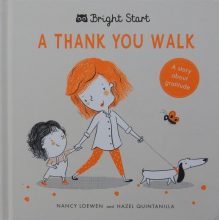
A Thank You Walk
Nancy Loewen and Hazel Quintanilla
Words & Pictures
Nancy Loewen’s brief story of a mother and little girl walking their dog, Duke, is one of the Bright Start series aimed at developing emotional intelligence in the very young.
Simply expressed it tells how as they stroll hand in hand mother and child interact with the animals they encounter. The barking sounds of Duke, the chirping of birds eating seeds, a neighing pony fed carrots, an overturned beetle that they rescue, which flies off with a buzz-buzz,
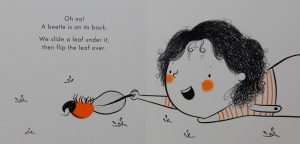
are, the child is told, the creatures’ ways of saying thank you.
Cutely and expressively illustrated in black and white with orange pops, by Hazel Quintanilla the book demonstrates the importance of showing appreciation and thankfulness. It’s never too soon to start saying thank you and as an introduction to being mindful about expressing gratitude it offers a useful starter for a circle time session with a nursery group, or for individual sharing at home.

 Red Reading Hub - Jillrbennett's Reviews of Children's Books