An Animal A Day

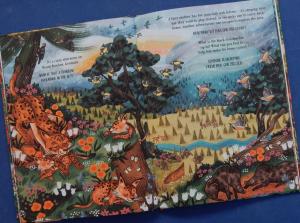
Following A Dinosaur a Day, author Miranda Smith turns her attention to wild creatures of all shapes and sizes.

My first port of call was the date this book arrived in the post – 27th October – where the featured creature was the Eastern Water-Holding Frog found in eastern Australia. This small carnivorous amphibian, I discovered, ‘aestivates’ when it becomes too hot and dry … burrowing underground and making itself a water-conserving cocoon from mucus, only breaking out when it rains, which could be several years later. This frog shares a double spread with five other animals, each of which exhibits a form of hibernation, another type of dormancy.

A number of double spreads are thematic, whereas others are devoted to a single animal. One such is Red Deer (16th November). This date is during the two month rutting season and the sound of stags bellowing and clashing antlers with rival males is one I frequently hear in Bushy Park.


I was surprised to meet one of the world’s biggest tortoises, Española giant tortoise, a resident of Española island off the coast of Ecuador. This herbivorous shelled reptile can be as much as a metre long and weigh 70kg, and may spend as much as two thirds of each day at rest. Sadly this tortoise is among the critically endangered animals.

No matter where you open the book (one suggestion given is that you start on your birthday), you will find something of interest as you visit our planet’s amazing ecosystems and habitats and discover how the native animals are able to thrive, or at least survive. Each one is strikingly illustrated by one of the named artists.
Readers concerned especially with conservation of the threatened species, will find information about how we can all contribute to their survival. Back matter includes a quiz, glossary and index.
AlphaBot / The Secret Mountain / Albert Puzzles and Colouring

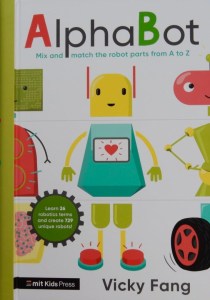
This interactive, non-fiction book published under Walker Books mitKidsPress imprint is sure to be a winner with children. On the first page comes the invitation: ‘Mix and match the AlphaBot parts! / What kind of robot will you build?’ Subsequent pages are split into three parts with scientific terms in alphabetical order defined on the verso sections and robot related illustrations are on each recto section.

The split pages make the book huge fun allowing the reader to design numerous different robots.. Its sturdy construction with a spiral binding will enable it to stand up to the heavy handling it is sure to get in a classroom or at home, as eager youngsters delightedly flip the sections back and forth, playfully learning a considerable amount while so doing. I met a couple of terms I’d not encountered before.

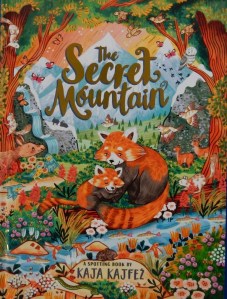
This book takes children on a long, long journey from Mount Everest all the way to Iceland. They will travel via Scotland’s Ben Nevis, then in turn the highest peak in the Andes, the Rocky Mountains, the Urals dividing Europe and Asia, Mount Broken in Germany, the Dolomites, the Heavenly Mountains of central Asia’s Tian Shan, California’s Mount Whitney, Mount Fuji and finally as night falls, Iceland’s Kirkjufell mountain.

As the sun rises over the Himalayas youngsters will see in the foreground of the illustration, a young snow leopard and her cubs heading off to hunt for food. Also out hunting is a bear and readers are asked, ‘What might he be searching for?’

In each of the following illustrations, every one of which is bursting with wildlife, there’s a mother animal of some kind and her young. So across the day you’ll also spot golden eagles, llamas, moose, brown bears, lynx

and more; some are foraging, others in flight or perhaps playing.

Each spread has a search and find element, another of the interactive elements of this immersive, creature-filled compilation for adults and children to share. Additional facts about eleven animals – one per stopping place – are provided in the three final spreads.

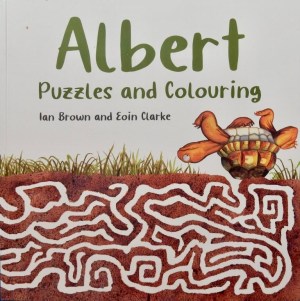
Albert the Tortoise loves to play games with his garden dwelling pals and now in this book he invites young readers to join him and participate in some playful activities at home. There are pages of silhouettes to identity, mazes to negotiate, a search and find, as well as several spreads to colour, others for playing spot the difference, and young children can hone their fine motor skills with dot to dots (those can be coloured in too).

Around the World in 80 Trees / Around the World in 80 Musical Instruments

Here are two titles in a Welbeck Publishing series – thanks to the publisher for sending them for review

Around the World in 80 Trees
Ben Lerwill and Kaja Kajfež

Trees are crucial to life on Earth: they release oxygen. They also provide food, medicine, materials and shelter and since Stone Age times have been prized by humans, some cultures even seeing certain of them as holy. So says Ben Lerwill in his introductory spread for this book.

Then having explained the different kinds of trees (coniferous and broadleaf) and their various parts, with the help of Kaja Kajfež’s gorgeous, detailed illustrations, he takes readers, around the globe to find out about some of 60,000 plus species that are found in the Americas, followed in turn by Africa, Europe and Asia, and finally Oceania. Between each main geographical section are spreads on more general topics – leaves,

roots, pollination, flowers and seeds, and the importance of trees.
Do you know what the oldest tree in the world is, or where it grows? I knew that it’s been named Methuselah but not that it’s the bristlecone pine and has been growing in the White Mountains of California for over 4850 years. In the same state is another record breaker, the coast redwood, the tallest known tree. Other locations visited in this section are the tropical Amazon rainforest and the Andes.
Growing in several parts of the African continent is the mighty baobab, six of the seven species of which I read, can only be found on Madagascar.

Such is the strength of baobab bark that it can be used to make nets, ropes, bags, homes even; and happily the bark that’s ripped off is always replaced by new growth.
Whether you dip in and out of this book or read it straight through, you’ll likely learn something new and exciting; but in conclusion, the author provides a stark reminder that it’s important we all play our part in helping the future health of these wonderful plants.

Around the World in 80 Musical Instruments
Nancy Dickman and Sue Downing

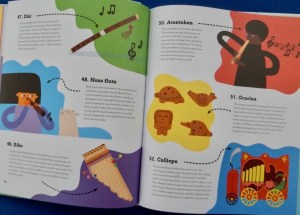
No matter where on earth you might go, you’ll always come across people making music; we might call music-making a universal phenomenon. There are many hundreds of different musical instruments to be found all over the world and they are used for many purposes including for concerts, alongside dancers, in celebrations, for religious ceremonies, and even unfortunately, as a form of intimidation or aggression.

In her account for this book, author Nancy Dickman groups eighty of them under four main headings based on how the instruments make their sounds: percussion instruments, stringed instruments, wind instruments

and a miscellaneous assortment she calls ‘weird and wonderful instruments’. She’s also created a very helpful musical family tree discovered by opening a central gatefold.

We read about the various materials used in the making of the instruments featured in each of the four sections as well as the places in which they are played. Although I’ve seen and heard hundreds of instruments and collected a good many in my travels, I encountered many new to me in this fascinating book with Sue Dowling’s bold illustrations large and small; I’m sure other readers will too.

For school collections and interested individuals from around seven.