Moving the Millers’ Minnie Moore Mine Mansion

Moving the Millers’ Minnie Moore Mine Mansion
Dave Eggers and Júlia Sardà
Walker Books

This non-fiction story begins back in the 1870s when a dog belonging to a prospector was digging in the ground and found not the gopher it had been chasing, but silver. This discovery very soon became Minnie Moore Mine. Several years later the mine was sold to an Englishman, Henry Miller, making it Miller’s Minnie Moore Mine. It made him extremely rich. He found a wife, packed her off to Europe for a while, giving him time to build a riverside house they would share on her return – Millers’ Minnie Moore Mine Mansion. There a son was born to the couple.

When Henry died his widow, Annie was tricked by a crooked banker to invest her money in his bank; it failed and she lost almost all of it. With the little left she bought some pigs intending to become a breeder. However the Bellevue townsfolk would have none of it 
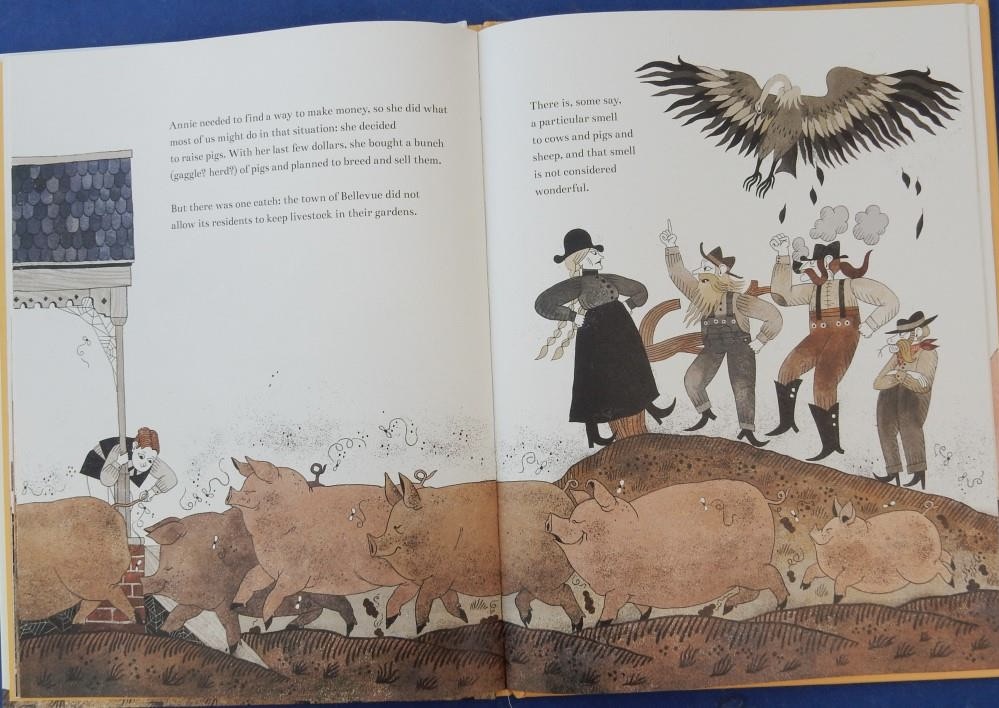
so our enterprising Annie devised a plan – a pretty elaborate one – to move the house out of town. And so she did. Aided and abetted by her son and some hired workers, Millers’ Minnie Moore Mine Mansion was shifted just four miles down the road, 

where without pig restrictions, Annie, Douglas and the porcine team thrived for many years. 

Crazy but true, though if you want to know how they managed to move, you’ll need to get your trotters on a copy of Dave Eggers and Julia Sardà’s book. The former’s chatty, humorous writing style and droll, often dramatic art rendered in earthy tones by the latter show how human perseverance and resourcefulness win through on several occasions.

Slightly bizarre, this would make an entertaining read aloud.

The Listzs

dscn9262

The Liszts
Kyo Maclear and Júlia Sardà
Andersen Press
Are you a list maker? There’s something satisfying about lists, especially lists of things to do, and in particular, the crossing off part. That was the part my favourite literary list-maker, Toad in Arnold Lobel’s Frog and Toad Together liked most too. In fact he couldn’t function properly without his ‘list of things to do today’.
A whole family of list makers populates this wryly whimsical book and they’re called, unsurprisingly, the Listzs. There’s Mum and Dad who make lists all year round, Sundays excluded; on such days they’re um, listless. Youngest child Frederick is a ‘list of fun things to do’ maker whereas big sister Winifred’s lists feature top tens and middle child Edward is a nocturnal list maker. Not wishing to be left out, Grandpa too makes lists – ‘his greatest admirers and most fearsome enemies’; even the cat’s a list maker.
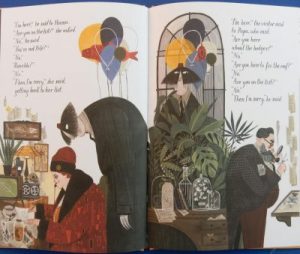
Then one day a visitor arrives; nobody wants to engage with him – he’s not on their lists –

dscn9259

until he comes upon Edward. He has a list of questions and what’s more, he’s the one who’d left the door open and is ready to admit it too. “The door was open,” says the visitor. “I know. I left it open. …” comes the reply. “For me?” – that’s the visitor. Edward thinks so. The two exchange questions, which leads to more exciting outcomes …

dscn9261

Hurray for spontaneity and the possibility of something unexpected turning up.
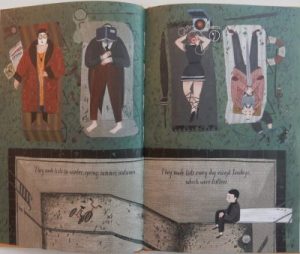
With a quirky gothic feel to it, this near nonsensical tale is likely to appeal to adults as much as children. Visual humour abounds in the suitably dreary-hued illustrations: look at this scene with the family spending a restful Sunday.

dscn9258

This is illustrator Júlia Saradà’s debut picture book: her illustrations herein reminded me very much of the work of Edward Gorey’s witty style. I look forward with interest to seeing what comes next.