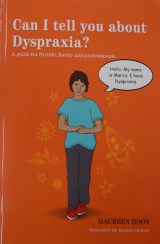
Can I tell you about Dyspraxia?
Maureen Boon
Jessica Kingsley Publishers
Marco talks frankly about what it’s like to have dyspraxia or Developmental Coordination Disorder (DCD), a condition more common in boys. He has difficulty with handwriting, preferring to write on a computer where he is able to express his ideas confidently. Marco also finds a number of things from sitting still to tying knots challenging, his clothes tend to get untidy and he uses a checklist to help him remember things. Tactile sensitivity is another issue Marco has to deal with – wool makes him itch for instance. Navigating new places is another challenge, so when Marco moved to secondary school he needed special help.
In contrast, Clara his friend has verbal dyspraxia; she has trouble finding the right word, reading is tricky and people need to speak slowly or she may not understand.
We are told about the early signs of dyspraxia: sound sensitivity, lateness in getting to one’s feet and restless nights are possible indicators, as is difficulty sitting in one place.
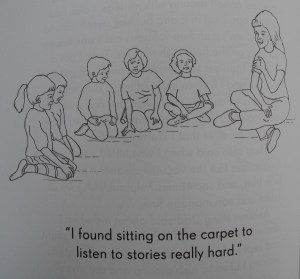
At his first school Marco found many things more challenging than his peers; things like painting, model making, sporting activities requiring balance or coordination, the physical act of writing and using cutlery. (He got round the latter by having a packed lunch.)
Of particular help to Marco are his physiotherapist and occupational therapist. They encouraged him to join a group at a special centre where he worked with other children on activities requiring fine motor skills such as cutting and writing. He also took part in games and balancing skills that helped him at school; Marco was surprised to be encouraged to do more sport and developed a particular liking for swimming.
In addition to Marco’s narrative there are several lists outlining how parents, teachers, and other children can help those like him, as well as a bibliography and list of supportive organisations.
Written by an ex headteacher of a school for physically challenged children, this little book provides a straightforward, reassuring outline of DCD and ways in which others can be supportive.
Buy from Amazon
In the same series is:

Can I tell you about Autism?
Jude Welton illustrated by Jane Telford
Jessica Kingsley Publishers
Young Tom has autism; in this book we discover what this means for him. – how it makes him feel and what helps him. Tom, like every other child is unique although there are things that he has in common with other children with autism. He has difficulties making sense of the world around him and how others behave, so communication and play with others are very challenging and he may invade other people’s personal space. Change too is hard to cope with and can cause major upsets.
For Tom, social awareness is problematic: He is unable to tune in with how others are feeling, what they are thinking or what their tone of voice or facial expressions indicate and he understands what people say in a literal way causing him all kinds of worries. Echolalia is another factor in autism and Tom has been taught to point to indicate things he wants.
Rather than playing with other children, Tom tends to play with things, though he does sometimes engage in parallel play. Ordering objects is a favourite activity and he likes to repeat things over and over.
Routines are greatly reassuring and Tom needs to know what is coming next; changes have to be prepared for, otherwise he finds coping almost impossible. This is where visual timetables are a big help; so too are social stories.
Tom is over-sensitive to smells, sounds and lights although, he explains, others with autism may be tactile defensive. He has issues with some particular motor skills such as cutting; other children find different tasks problematic. There are also issues around food
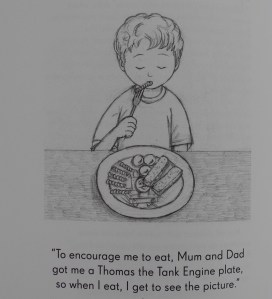
and sleeping that Tom has to cope with although in both instances, his differences are accommodated as far as possible.
Those of us who have taught or worked with children like Tom will already know about what is discussed here; however, the author has, in this little book, presented autism concisely so it is understandable for everyone be they parent, teacher, support worker, other children or merely interested adult. With its additional how to help sections, ‘jargon busting’ explanations, and resource listings, this is an excellent introductory book recommended for use at home or school; indeed older primary pupils can usefully read it for themselves. (There is an illustration by Jane Telford at every turn of the page in the main text.)
Buy from Amazon
Buy from your local bookshop: http://www.booksellers.org.uk/bookshopsearch
For an ‘inside the head’ account of one boy’s autism, those interested should try the beautifully written
The Reason I Jump by Naoki Higashida written when he was thirteen years old.
 Red Reading Hub - Jillrbennett's Reviews of Children's Books